A Comprehensive Botanical and Ecological Study of a Coastal Leguminous Tree
Pongamia pinnata, commonly known as Koromja or Karanja, is a medium-sized evergreen to semi-evergreen tree belonging to the legume family. Widely distributed across tropical and subtropical regions, this species is particularly valued for its exceptional ecological adaptability, nitrogen-fixing ability, and multipurpose utility. It thrives in diverse environments ranging from riverbanks and coastal plains to mangrove fringes and degraded lands, making it a species of considerable ecological and socio-economic significance.
In the Sundarbans and other deltaic ecosystems of eastern India, Pongamia pinnata occupies an important transitional niche between freshwater and saline environments. The tree contributes to shoreline stabilization, soil fertility improvement, and habitat enrichment for a variety of organisms. This article presents a detailed, research-based overview of Pongamia pinnata, focusing on its taxonomy, morphology, habitat preferences, ecological role, and conservation relevance, with particular emphasis on its presence in the Sundarbans region.
Taxonomy & Classification
Pongamia pinnata is a well-established member of the Fabaceae family, a group known for its ecological importance in nitrogen fixation and soil enrichment.
Kingdom: Plantae
Clade: Angiosperms
Clade: Eudicots
Order: Fabales
Family: Fabaceae
Subfamily: Papilionoideae
Genus: Pongamia
Species:Pongamia pinnata (L.) Pierre
The species has also been referred to in botanical literature under the synonym Millettia pinnata. Its classification within the legume family reflects its ability to form symbiotic relationships with nitrogen-fixing bacteria, a trait that significantly enhances soil fertility.
Morphology & Field Identification
Growth Habit and Trunk
Pongamia pinnata is a medium-sized tree, typically reaching heights of 12 to 18 meters, though larger individuals may occur under optimal conditions. The trunk is usually straight or slightly crooked, with a broad, spreading crown. Bark is grey to brown, moderately thick, and fissured or flaky in older trees.
The tree develops a strong taproot system accompanied by lateral roots, enabling it to withstand drought, periodic flooding, and unstable soils common in coastal and riverine zones.
Leaves
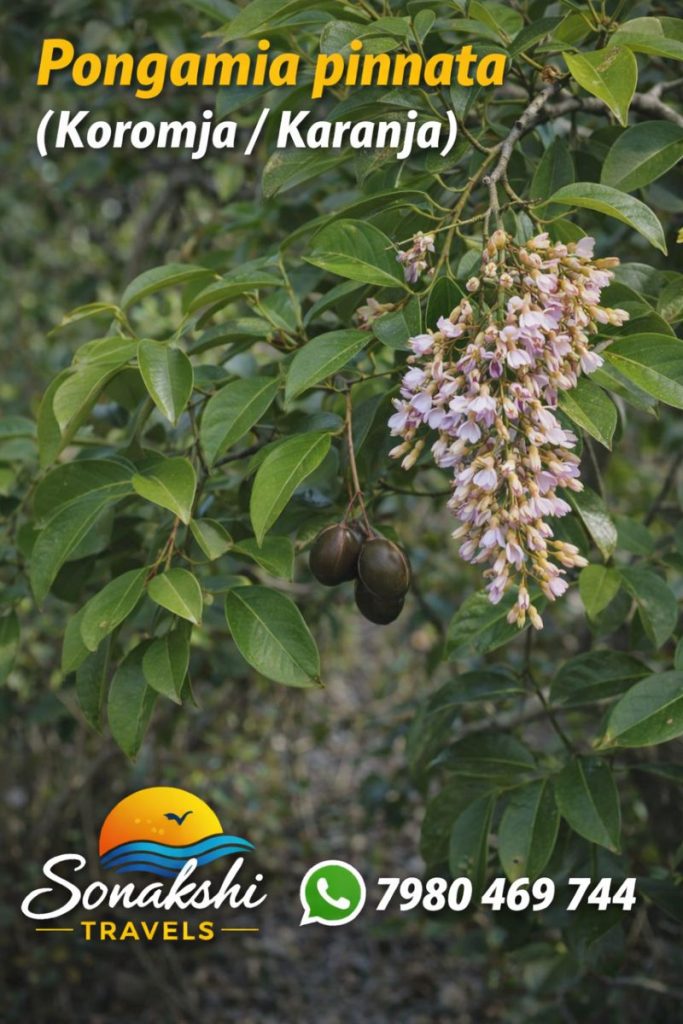
The leaves are alternate, imparipinnate, and composed of five to seven ovate to elliptic leaflets. Leaflets are glossy dark green on the upper surface and paler beneath, with entire margins and a leathery texture.
This leaf structure reduces transpiration and provides resistance against salt spray and intense sunlight, contributing to the tree’s resilience in coastal environments.
Flowers
The flowers are borne in axillary racemes and are typically pinkish-white to lavender in color. Each flower displays the characteristic papilionaceous structure of legumes, with a standard, wings, and keel.
Flowering generally occurs during the late winter to early summer months, attracting a wide range of pollinators, particularly bees.
Fruit and Seeds
The fruit is a flat, indehiscent pod containing a single seed. Pods are thick-walled and woody, providing protection against moisture and predation. Seeds are rich in oil, a trait that has drawn significant interest for biofuel production.
Habitat & Distribution
Global Range
Pongamia pinnata is native to South and Southeast Asia, with a distribution spanning India, Bangladesh, Sri Lanka, Myanmar, Thailand, Malaysia, Indonesia, and northern Australia. Due to its adaptability and utility, it has been introduced to several tropical and subtropical regions worldwide.
The species’ wide distribution reflects its tolerance of diverse climatic and edaphic conditions.
Preferred Habitat
The tree grows best in moist, well-drained soils but demonstrates remarkable tolerance to saline, alkaline, and waterlogged conditions. It is commonly found along riverbanks, estuaries, coastal plains, tidal creeks, and degraded lands.
Full sunlight is preferred, although young saplings can tolerate partial shade. Seasonal flooding does not adversely affect mature trees.
Occurrence
The occurrence of Pongamia pinnata is widespread in tropical landscapes, often appearing as a component of mixed forests or as a standalone tree in agricultural and coastal settings. Natural regeneration occurs through seed dispersal by water and gravity.
Seedlings establish readily in moist soils and display rapid early growth, particularly in nutrient-poor substrates where nitrogen fixation provides a competitive advantage.
Preferred Habitat in the Sundarbans Region
In the Sundarbans, Pongamia pinnata is typically found in less saline zones, particularly along riverbanks, embankments, village fringes, and transitional areas between freshwater swamps and mangrove forests. It is more common in the peripheral and buffer zones rather than the core mangrove areas.
The species benefits from periodic freshwater influx and nutrient-rich alluvial soils. Its presence often indicates relatively stable ground conditions and reduced salinity stress.
To observe coastal and mangrove-associated trees like Karanja in their natural setting, consider joining a guided Sundarban Tour led by experienced local guides.
Ecological Role
Pongamia pinnata plays a crucial ecological role in coastal and riparian ecosystems. As a nitrogen-fixing legume, it enriches soil fertility and supports the growth of surrounding vegetation. Its extensive root system stabilizes soil, reducing erosion along riverbanks and embankments.
The tree provides shade and habitat for birds, insects, and small mammals. Its flowers support pollinator populations, while leaf litter contributes organic matter to the soil, enhancing nutrient cycling.
Habitat Alteration
Habitat alteration poses challenges to the natural distribution of Pongamia pinnata. Coastal development, embankment construction, conversion of wetlands to agriculture, and altered hydrological regimes have reduced suitable habitats in some regions.
In deltaic systems, increasing salinity intrusion and reduced freshwater flow may limit regeneration in marginal areas, despite the species’ overall resilience.
Conservation Efforts
Pongamia pinnata is not considered globally threatened and is often promoted for afforestation, coastal stabilization, and biofuel initiatives. Conservation efforts focus on sustainable planting, protection of natural stands, and integration into agroforestry systems.
In the Sundarbans, maintaining freshwater flow and protecting buffer zones are key measures to ensure the continued presence of this ecologically valuable species.
Explore the ecological richness of the delta responsibly through a customized Sundarban Tour designed for nature lovers.
Did You Know?
Pongamia pinnata seeds are rich in oil and are widely studied for biofuel potential.
The tree improves soil fertility through nitrogen fixation.
It tolerates salinity better than many other leguminous trees.
Its dense canopy provides effective shade in coastal environments.