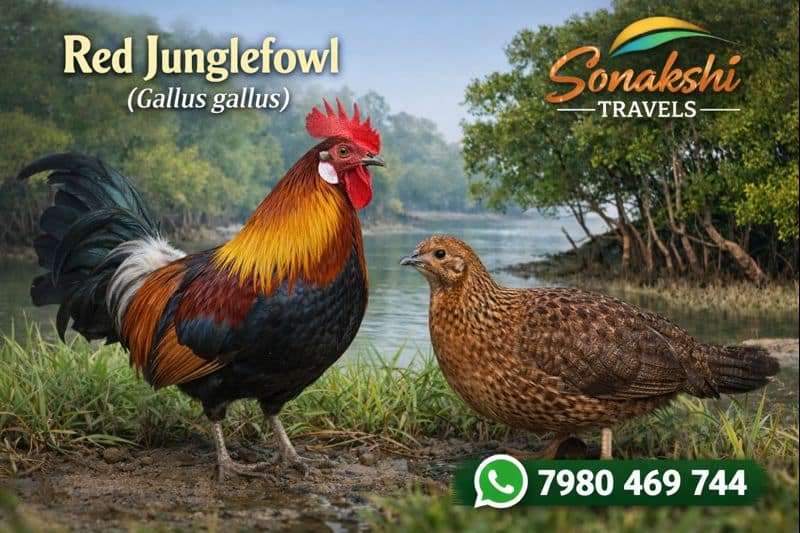
– A Comprehensive Biological and Ecological Profile
Introduction
The Red Junglefowl (Gallus gallus) is one of the most significant bird species in the natural and cultural history of humanity. Widely recognized as the wild ancestor of the domestic chicken, this species occupies a unique position at the intersection of evolutionary biology, ecology, and anthropology. Native to the forests and scrublands of South and Southeast Asia, the Red Junglefowl remains an emblematic bird of tropical ecosystems, exhibiting complex social behavior, pronounced sexual dimorphism, and remarkable adaptability to diverse habitats.
Taxonomy & Classification
Systematic Placement
The Red Junglefowl belongs to the family Phasianidae, a diverse group of ground-dwelling birds that includes pheasants, partridges, and quails. Within the genus Gallus, four species are recognized, of which Gallus gallus is the most widespread and genetically influential. Molecular and morphological studies have conclusively demonstrated that modern domestic chickens are primarily derived from this species, with limited introgression from other junglefowl species.
Morphology & Field Identification
General Appearance
The Red Junglefowl is a medium-sized galliform bird characterized by an upright posture, strong legs adapted for scratching, and a long arched tail in males. Its plumage displays a rich combination of reds, golds, browns, and blacks, providing both visual appeal and effective camouflage in forest undergrowth.
Male Features
Males are highly distinctive and easily identifiable. They possess a bright red single comb and prominent wattles, glossy black breast feathers with green iridescence, and elongated sickle-shaped tail feathers. The hackles on the neck and saddle shimmer in shades of golden orange and copper, serving as visual signals during territorial displays and courtship.
Female Features
Females are comparatively smaller and lack the ornate tail and vivid coloration of males. Their plumage is predominantly brown with fine black barring, providing excellent camouflage during nesting. The reduced comb and wattles further distinguish females from males.
Size & Wingspan
Adult males typically measure 65–75 cm in total length, including the tail, while females range between 40–50 cm. Body weight varies from 500 to 1,000 grams. The wingspan averages 70–85 cm, enabling short bursts of flight.
Flight Characteristics
Although primarily terrestrial, the Red Junglefowl is capable of powerful, short-distance flight. Flight is usually employed to escape predators or reach roosting sites in trees. Takeoff is rapid and noisy, followed by a brief glide.
Habitat & Distribution
Global Range
The species is native to India, Nepal, Bhutan, Bangladesh, Myanmar, Thailand, Malaysia, Indonesia, and parts of southern China. Introduced populations exist in other regions due to human-mediated dispersal.
Preferred Habitat
Red Junglefowl favor mixed deciduous forests, bamboo thickets, forest edges, secondary growth, and scrublands near human settlements. Proximity to water sources and dense undergrowth is a key habitat requirement.
Diet & Feeding Ecology
Diet Composition
This species is omnivorous, consuming seeds, grains, fruits, tender shoots, insects, worms, small reptiles, and amphibians. Seasonal variation in diet reflects local food availability.
Foraging Technique
Foraging is conducted by scratching the ground with strong feet and pecking at exposed food items. Birds often forage in small groups, maintaining vigilance against predators.
Breeding & Reproduction
Breeding Season
Breeding generally coincides with the onset of the monsoon, when food availability is high. Males establish territories and attract females through vocalizations and display behaviors.
Nesting Sites
Nests are shallow ground depressions concealed under dense vegetation, fallen logs, or shrubs. The female alone incubates the clutch, which typically consists of 4–7 eggs.
Unique Adaptations & Behavioral Ecology
Speed & Agility
The Red Junglefowl is a swift runner, capable of rapid acceleration through forest undergrowth. This agility often allows escape without flight.
Camouflage and Nesting Strategy
Cryptic plumage, especially in females, provides excellent concealment. During incubation, females remain motionless for extended periods, relying on camouflage to avoid detection.
Social Behavior
Social structure is based on dominance hierarchies, commonly referred to as a “pecking order.” Groups usually consist of one dominant male with several females, while subordinate males occupy peripheral areas.
Occurrence & Seasonal Movement
The species is largely resident but may exhibit short-range seasonal movements in response to food availability, rainfall patterns, and breeding requirements.
Preferred Habitat in the Sundarbans Region
In the Sundarbans, Red Junglefowl are typically found along forest fringes, elevated islands, and transitional zones between mangrove forests and agricultural land. These areas provide a balance of cover, foraging grounds, and roosting sites.
Experience the living heritage of forest birds while exploring the mangrove wilderness. Join a professionally guided Sundarban Tour and observe native wildlife in their natural environment.
Ecological Role
The Red Junglefowl contributes significantly to ecosystem functioning by dispersing seeds, regulating insect populations, and serving as prey for large carnivores and raptors.
Habitat Alteration
Deforestation, agricultural expansion, hybridization with domestic chickens, and hunting pressure pose localized threats to wild populations. Habitat fragmentation remains a major concern.
Conservation Efforts
Conservation strategies focus on habitat protection, genetic integrity preservation, and awareness programs emphasizing the ecological and evolutionary importance of the species.
Did You Know?
The Red Junglefowl is the primary ancestor of all domestic chicken breeds.
Males produce a distinctive crow that differs subtly from domestic chickens.
They roost in trees at night to avoid ground predators.