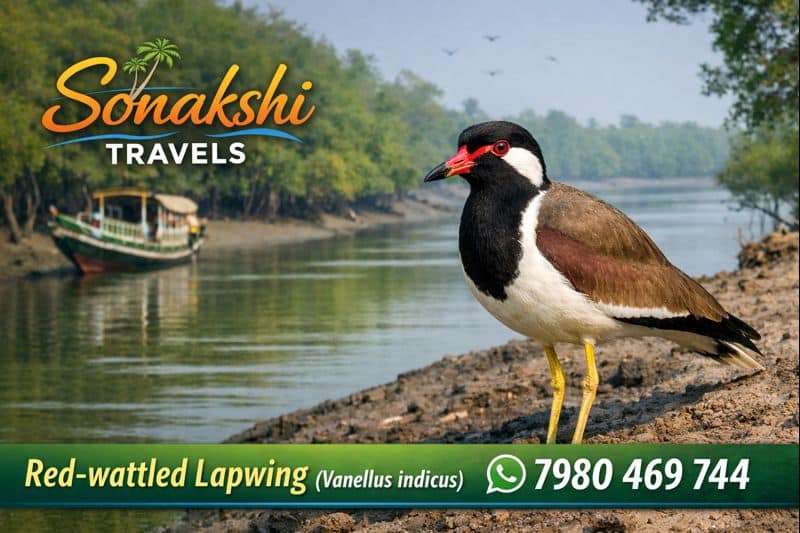
The Vigilant Sentinel of Wetlands and Open Landscapes
The Red-wattled Lapwing (Vanellus indicus) is one of the most familiar and vocally expressive wading birds of the Indian subcontinent. Renowned for its piercing alarm calls, distinctive red facial wattles, and vigilant behavior, this species occupies a special place in both ecological studies and cultural consciousness. Often referred to as the “sentinel of wetlands,” the Red-wattled Lapwing plays a crucial role in maintaining the ecological balance of open landscapes, agricultural fields, riverbanks, and estuarine margins. Its adaptability to both natural and human-modified habitats makes it a valuable indicator species for environmental health.
Taxonomy & Classification
The Red-wattled Lapwing belongs to the order Charadriiformes, a diverse group comprising shorebirds, gulls, and terns. Within this order, it is classified under the family Charadriidae, which includes plovers and lapwings characterized by strong legs, rounded bodies, and ground-nesting behavior.
Scientifically described by Johann Friedrich Gmelin in 1789, Vanellus indicus has remained taxonomically stable, reflecting its well-defined morphological and behavioral traits. Several subspecies have been proposed based on geographical variation, primarily differing in plumage tone and vocal nuances, though these differences are subtle and often overlapping.
Morphology & Field Identification
The Red-wattled Lapwing is a medium-sized wader with a robust build and upright posture. Its most striking features include a contrasting black-and-white plumage pattern and vivid red wattles positioned in front of the eyes. The crown, throat, and upper breast are deep black, sharply demarcated from the white sides of the head and neck. The back and wings are sandy-brown, providing effective camouflage against dry ground and riverine substrates.
Male Features
Male Red-wattled Lapwings typically exhibit slightly brighter red wattles and marginally bolder black markings during the breeding season. Although sexual dimorphism is minimal, males may appear more assertive in territorial displays, often initiating alarm calls and distraction behaviors when a perceived threat approaches the nest.
Female Features
Females closely resemble males in plumage and size, making visual sex determination challenging in the field. Subtle differences may include slightly duller wattles and less pronounced black coloration. Females are equally vigilant, particularly during incubation, and actively participate in nest defense.
Size & Wingspan
Adult Red-wattled Lapwings measure approximately 32–35 cm in length, with a wingspan ranging from 75 to 85 cm. Their relatively long legs and broad wings enable efficient ground foraging and agile flight when evading predators.
Flight Characteristics
In flight, the species displays slow, deliberate wingbeats interspersed with short glides. The contrasting black-and-white wing pattern becomes conspicuous, aiding identification at a distance. When alarmed, the bird often takes off abruptly, emitting loud calls that alert other wildlife in the vicinity.
Habitat & Distribution
Global Range
The Red-wattled Lapwing is widely distributed across South Asia, extending from the Indian subcontinent to parts of Southeast Asia and the Middle East. Its range includes India, Sri Lanka, Nepal, Bangladesh, Pakistan, and parts of Myanmar and Thailand. The species is largely resident throughout its range, with only limited local movements.
Preferred Habitat
This lapwing favors open habitats with access to shallow water or moist soil. Typical environments include riverbanks, lakeshores, marsh edges, agricultural fields, grazing lands, and coastal estuaries. It readily adapts to man-made habitats such as irrigation canals, reservoirs, and even urban open grounds, provided disturbance levels are manageable.
Diet & Feeding Ecology
The Red-wattled Lapwing is primarily insectivorous, feeding on a wide range of invertebrates. Its diet includes beetles, ants, termites, grasshoppers, earthworms, and small mollusks. Occasionally, it consumes seeds and plant matter, particularly during periods of prey scarcity.
Foraging Technique
Foraging typically involves a characteristic run-stop-peck behavior. The bird scans the ground while standing upright, then darts forward to capture prey with rapid, precise movements. This technique allows efficient exploitation of both dry and wet substrates.
Breeding & Reproduction
Breeding activity generally coincides with the onset of the monsoon, when food availability is high. The species is monogamous, with pairs forming strong territorial bonds. Courtship displays include aerial chases, vocal duets, and ground-based posturing.
Nesting Sites
Nests are simple ground scrapes, often located on open gravel, dry mudflats, or sparsely vegetated ground. The lack of elaborate nesting material is compensated by strategic placement and effective camouflage. Clutches usually consist of three to four eggs, which are cryptically colored to blend with the surroundings.
Unique Adaptations & Behavioral Ecology
Speed & Agility
Despite its relatively stocky build, the Red-wattled Lapwing is remarkably agile on the ground. Quick directional changes and sudden bursts of speed help it evade predators and protect its territory.
Camouflage and Nesting Strategy
Egg coloration closely matches the substrate, making nests extremely difficult to detect. Adults employ distraction displays, such as feigning injury, to lure predators away from the nest, demonstrating advanced behavioral adaptation.
Social Behavior
Outside the breeding season, individuals may be seen in loose aggregations, particularly near productive feeding grounds. However, they remain strongly territorial during nesting, aggressively repelling intruders.
Occurrence & Seasonal Movement
The species is largely sedentary, with most populations remaining within their established territories year-round. Minor local movements may occur in response to rainfall patterns and water availability, but long-distance migration is uncommon.
Preferred Habitat in the Sundarbans Region
Within the Sundarbans, the Red-wattled Lapwing is commonly observed along riverbanks, mudflats, embankments, and village fringes adjacent to mangrove forests. The mosaic of tidal creeks, open fields, and brackish wetlands provides ideal foraging and nesting opportunities.
Exploring estuarine birdlife and mangrove ecosystems becomes more rewarding with a well-planned itinerary. Discover a professionally curated Sundarban Tour and experience the region’s unique biodiversity at its best.
Ecological Role
As an active insect predator, the Red-wattled Lapwing helps regulate invertebrate populations, contributing to pest control in agricultural landscapes. Its alarm calls often alert other species to danger, indirectly enhancing community-level survival.
Habitat Alteration
Rapid urbanization, wetland drainage, and agricultural intensification pose localized threats to suitable habitats. Although adaptable, the species depends on open ground and shallow water zones, which are increasingly fragmented by development activities.
Conservation Efforts
Currently listed as a species of Least Concern, the Red-wattled Lapwing benefits from its wide distribution and adaptability. Conservation efforts focus on wetland protection, sustainable agricultural practices, and awareness programs highlighting the importance of ground-nesting birds.
For travelers interested in observing wetland birds within their natural surroundings, a guided Sundarban Tour offers an immersive opportunity to connect with the region’s living landscapes.
Did You Know?
The Red-wattled Lapwing’s alarm call is often humorously interpreted as a warning cry, reflecting its reputation as one of the most vigilant birds of open landscapes. Its presence is frequently associated with ecological awareness, as the species is quick to respond to disturbances.
External Reference
For detailed taxonomic notes and global distribution data, readers may consult the Wikipedia page on the Red-wattled Lapwing (Vanellus indicus).