Biology, Behavior, and Seasonal Ecology with Special Reference to the Sundarbans
The Ruff (Philomachus pugnax) is among the most extraordinary and behaviorally complex migratory shorebirds of the Old World. Renowned for its dramatic sexual dimorphism, elaborate breeding displays, and long-distance seasonal movements, the Ruff occupies a unique position in avian ecological and evolutionary studies. Its remarkable lek-based mating system, coupled with extreme variation in male plumage, has fascinated ornithologists for centuries and continues to inspire modern research in behavioral ecology and genetics.
This article presents a detailed, research-oriented biological account of the Ruff, encompassing taxonomy, morphology, habitat use, feeding ecology, reproductive strategies, and conservation status. Particular emphasis is given to its occurrence in South Asia and its seasonal presence within the Sundarbans landscape, where the species appears as a winter visitor in suitable wetland habitats.
Taxonomy & Classification
The Ruff belongs to the family Scolopacidae, which includes sandpipers, snipes, and their allies. Traditionally placed within the monotypic genus Philomachus, the species is taxonomically distinct due to its unusual breeding system and pronounced sexual dimorphism. Molecular studies, however, indicate close evolutionary relationships with the genus Calidris, and some classifications now incorporate the Ruff within that broader clade.
The species epithet pugnax is derived from Latin, meaning “combative,” reflecting the aggressive interactions observed among males during the breeding season. This nomenclature aptly captures the behavioral essence of the species during lek displays.
Morphology & Field Identification
General Appearance
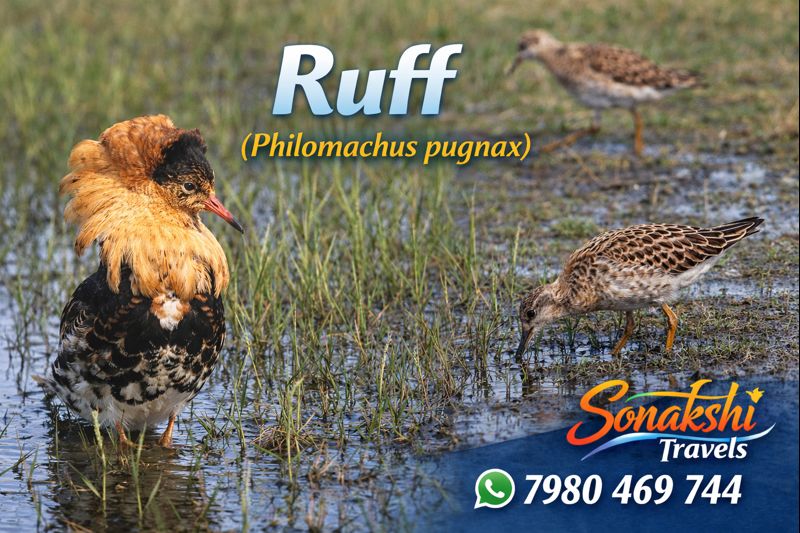
Outside the breeding season, the Ruff appears as a medium-sized wader with relatively long legs, a slender neck, and a straight, medium-length bill. Non-breeding plumage is subdued, consisting of grey-brown upperparts and pale underparts, allowing effective camouflage in marshy and wetland environments.
Male Features
Male Ruffs are among the most visually striking shorebirds during the breeding season. They develop ornate ruffs of elongated feathers around the neck and head, displaying a wide range of colors including black, chestnut, white, and mottled combinations. No two males exhibit identical plumage, making each individual visually unique. These ornamental features play a central role in sexual selection and dominance hierarchies within leks.
Female Features
Females, traditionally referred to as “reeves,” are significantly smaller than males and lack the extravagant plumage. Their appearance remains relatively uniform throughout the year, characterized by brownish upperparts and pale underparts. This marked sexual dimorphism is rare among shorebirds and reflects divergent reproductive roles.
Size & Wingspan
Adult males typically measure between 29 and 32 centimeters in length, while females range from 22 to 26 centimeters. Wingspan varies from approximately 50 to 60 centimeters. Body mass fluctuates seasonally, with individuals gaining substantial fat reserves prior to migration.
Flight Characteristics
In flight, Ruffs display steady wingbeats interspersed with short glides. Flocks often form loose, shifting formations during migration. The white wing stripe and contrasting underwing patterns assist field identification when birds are observed in flight over wetlands.
Habitat & Distribution
Global Range
The Ruff has an extensive Palearctic breeding range, extending across northern Europe and Siberia. During the non-breeding season, it migrates southward to Africa, South Asia, Southeast Asia, and parts of Australia. This broad distribution reflects the species’ adaptability to a wide range of wetland environments.
Preferred Habitat
Ruffs primarily inhabit freshwater and brackish wetlands, including marshes, flooded grasslands, shallow lakes, and agricultural fields such as rice paddies. They favor open areas with soft substrates that support abundant invertebrate prey.
Diet & Feeding Ecology
Diet Composition
The diet of the Ruff consists mainly of aquatic and terrestrial invertebrates, including insects, larvae, worms, mollusks, and crustaceans. During migration and wintering periods, plant material such as seeds and grains may supplement the diet.
Foraging Technique
Ruffs employ a methodical foraging strategy, walking slowly through shallow water or moist soil while probing and picking prey from the surface. Their flexible feeding behavior allows them to exploit a wide range of microhabitats.
Breeding & Reproduction
Breeding System
The Ruff is renowned for its lek-based mating system, in which males congregate at traditional display grounds to attract females. Males adopt different behavioral strategies, including territorial, satellite, and female-mimicking morphs, each with distinct reproductive advantages.
Nesting Sites
Females select nesting sites independently, typically choosing well-concealed locations in grasslands or marsh edges. Nests are shallow scrapes lined with vegetation, providing insulation and concealment for eggs.
Unique Adaptations & Behavioral Ecology
Speed & Agility
Although not as fast as coastal sandpipers, Ruffs demonstrate agility in both terrestrial and shallow-water environments. Their long legs and balanced gait facilitate efficient movement across uneven wetland substrates.
Camouflage and Nesting Strategy
Females and chicks rely heavily on camouflage to avoid predation. Plumage coloration blends seamlessly with surrounding vegetation, while nesting sites are selected to minimize visibility.
Social Behavior
Outside the breeding season, Ruffs are highly gregarious and form large flocks during migration and wintering. This sociality enhances foraging efficiency and reduces individual predation risk.
Occurrence & Seasonal Movement
The Ruff is a long-distance migrant, traveling thousands of kilometers between breeding and wintering grounds. Migration occurs along well-established flyways, with individuals utilizing a network of stopover wetlands to replenish energy reserves.
Preferred Habitat in the Sundarbans Region
In the Sundarbans, the Ruff is observed as a winter visitor, primarily in peripheral wetlands, seasonally flooded grasslands, and freshwater bodies adjacent to mangrove forests. Although the core mangrove habitat is less suitable, surrounding wetlands provide adequate foraging and roosting opportunities during migration.
Ecological Role
By regulating populations of aquatic invertebrates, the Ruff contributes to maintaining wetland ecological balance. Its presence also serves as an indicator of wetland health and seasonal productivity.
Habitat Alteration
Wetland drainage, agricultural intensification, and climate-induced hydrological changes pose significant threats to Ruff populations. The loss of traditional stopover and wintering habitats can disrupt migratory success.
Conservation Efforts
Conservation strategies emphasize wetland protection, sustainable water management, and international cooperation along migratory flyways. Long-term monitoring programs are essential for assessing population trends and guiding conservation action.
Did You Know?
The Ruff exhibits one of the most complex mating systems among birds, with genetically determined male morphs that employ entirely different reproductive strategies within the same population.