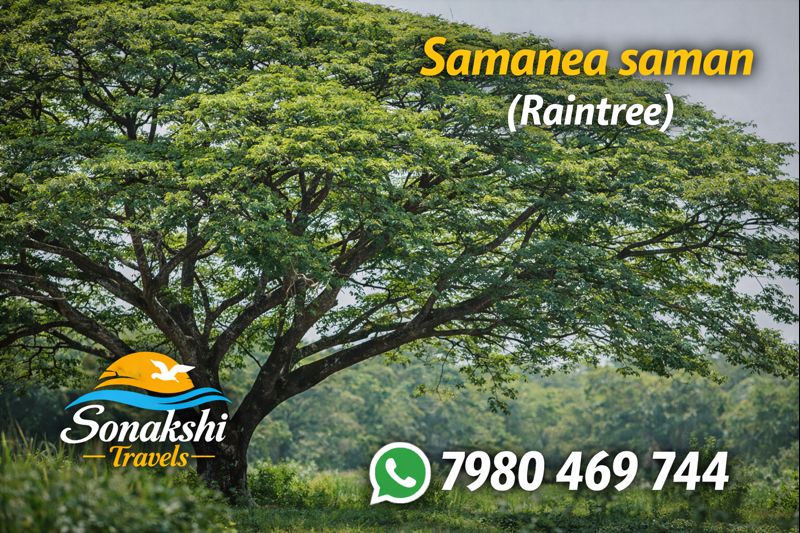
Samanea saman, commonly known as the Raintree, is one of the most majestic and widely admired shade trees of tropical and subtropical regions. Instantly recognizable by its massive umbrella-shaped canopy, feathery foliage, and rhythmic leaf movements, the Raintree is both an ecological asset and a cultural landmark across landscapes. From highways and city avenues to rural commons and forest fringes, this species has become synonymous with shade, resilience, and ecological stability.
Native to Central and South America but extensively naturalized throughout South and Southeast Asia, Samanea saman plays a significant role in soil enrichment, microclimate regulation, and habitat creation. In the Indian subcontinent and particularly in eastern India, the species is an integral part of roadside plantations, institutional campuses, and transitional landscapes bordering sensitive ecosystems such as the Sundarbans. This article presents an in-depth, research-based examination of Samanea saman, focusing on its biological characteristics, ecological functions, habitat preferences, and relevance within deltaic regions.
Taxonomy & Classification
Systematic Position
Samanea saman belongs to the legume family Fabaceae, a family known for its ecological importance due to nitrogen fixation and soil improvement. The species has undergone taxonomic revisions and is sometimes referred to by its earlier name Albizia saman, though Samanea saman is the currently accepted nomenclature.
Kingdom: Plantae
Clade: Angiosperms
Clade: Eudicots
Order: Fabales
Family: Fabaceae
Subfamily: Caesalpinioideae
Genus: Samanea
Species: Samanea saman (Jacq.) Merr.
The species is taxonomically distinct due to its broad canopy architecture, bipinnate leaves, and characteristic inflorescences with prominent staminal filaments.
Morphology & Field Identification
Growth Habit and Crown Architecture
Samanea saman is a large, fast-growing, deciduous to semi-evergreen tree that can attain heights of 20 to 25 meters, with a canopy spread often exceeding its height. The crown is dome-shaped to umbrella-like, forming an expansive shaded area beneath, which significantly influences the microclimate of its surroundings.
Trunk and Bark
The trunk is stout, straight, and often short in proportion to the canopy spread. The bark is dark brown to grey, rough, and fissured in mature trees. The girth of old specimens can be exceptionally large, making the tree a dominant visual element in open landscapes.
Leaves
Leaves are bipinnately compound, with each leaf comprising multiple pairs of pinnae, each bearing numerous small, oblong leaflets. The foliage is soft green and exhibits nyctinastic movement—leaflets fold inward during the night and in response to rainfall, a trait that gives rise to the common name “Raintree.”
Flowers
The flowers are borne in globose heads and are pale pink to rose-colored, with long, silky stamens radiating outward. Flowering generally occurs during the warmer months and attracts a wide range of pollinating insects.
Fruits and Seeds
The fruit is a flattened, indehiscent pod containing several seeds embedded in a sweet, sticky pulp. These pods are consumed by livestock and wildlife, aiding in seed dispersal.
Habitat & Distribution
Native Habitat
Samanea saman is native to tropical regions of Central and South America, where it grows in savannas, open woodlands, and riverine plains. It thrives in areas with pronounced wet and dry seasons.
Introduced and Naturalized Habitats
The species has been widely introduced across Asia, Africa, and the Pacific for shade, timber, and ornamental purposes. It readily naturalizes in open lands, roadsides, and agricultural boundaries.
Global Range
Today, Samanea saman is found throughout tropical and subtropical regions of the world, including India, Bangladesh, Sri Lanka, Southeast Asia, parts of Africa, and island nations of the Pacific. Its adaptability to diverse climatic conditions has enabled widespread cultivation.
In India, the tree is especially common in plains and coastal regions, where it is valued for shade and soil improvement.
Preferred Habitat
Soil Preferences
The Raintree prefers deep, well-drained loamy soils but can tolerate a wide range of soil types, including sandy and lateritic soils. Its extensive root system allows access to deep soil moisture, contributing to drought tolerance.
Climate and Light
Samanea saman thrives in full sunlight and warm climates with moderate to high rainfall. It tolerates seasonal drought but does not perform well in waterlogged or highly saline soils.
Occurrence
In the Indian subcontinent, the Raintree is commonly found along highways, city roads, railway corridors, school campuses, and village commons. Its presence in semi-natural landscapes reflects deliberate planting rather than wild occurrence.
Shaded avenues and riverine landscapes define delta travel experiences. Explore curated itineraries with our
Sundarban Tour Package options designed for immersive nature journeys.
Preferred Habitat in the Sundarbans Region
Role in Deltaic Landscapes
Within the Sundarbans region, Samanea saman is primarily confined to non-saline inland zones, village settlements, embankments, and administrative or tourism infrastructure areas. It does not occur within core mangrove forests but plays a valuable role in buffer zones.
The tree’s broad canopy provides shade and moderates temperatures in exposed deltaic settlements, while leaf litter contributes organic matter to nutrient-poor soils.
Ecological Role
Soil Enrichment and Nitrogen Fixation
As a leguminous species, Samanea saman forms symbiotic relationships with nitrogen-fixing bacteria, improving soil fertility. This function is especially important in degraded or compacted soils along roadsides and embankments.
Habitat and Microclimate Regulation
The expansive canopy creates a cooler microclimate beneath, supporting understory vegetation, livestock resting zones, and urban biodiversity. The tree also provides nesting and roosting sites for birds.
Habitat Alteration
Human Influence
Urban development, road widening, and infrastructure expansion sometimes lead to the removal of mature Raintrees. However, the species’ popularity often ensures replacement planting.
In delta regions, rising soil salinity and altered hydrology limit suitable planting zones.
Conservation Efforts
Urban and Landscape Conservation
Samanea saman is not threatened globally. Conservation focuses on protecting mature trees in urban and rural landscapes and encouraging planned planting in buffer zones and public spaces.
Proper spacing and management ensure long-term structural stability and ecological benefits.
For a more personalized exploration of delta villages and green corridors, consider our
Sundarban Private Tour experiences curated for nature-focused travelers.
Did You Know?
Unique Botanical Traits
The Raintree’s leaves fold during rainfall and at night, a phenomenon linked to changes in light and humidity. This movement reduces water loss and protects delicate leaf tissues.
In many cultures, the tree is considered a symbol of shelter and abundance due to its immense shade and longevity.