A Comprehensive Botanical and Ecological Study of a Lesser-Known Euphorbiaceae Tree
Shirakiopsis indica, locally known as Hurmui, is a medium-sized deciduous tree belonging to the family Euphorbiaceae. Although not as widely recognized as some dominant forest species, this plant plays an important ecological role within tropical and subtropical landscapes of South and Southeast Asia. Its association with moist forests, riverine systems, and transitional woodland zones highlights its adaptability and ecological value.
In eastern India, including regions adjacent to the Sundarbans, Shirakiopsis indica occurs sporadically in semi-natural forests, village groves, and riparian margins. The species is particularly notable for its tolerance of seasonal moisture variation and its contribution to forest structure and soil stabilization. This article presents a detailed, research-oriented profile of Shirakiopsis indica, covering taxonomy, morphology, habitat preferences, distribution patterns, ecological significance, and conservation considerations, with special emphasis on the Sundarbans region.
Taxonomy & Classification
Shirakiopsis indica belongs to the Euphorbiaceae family, one of the largest and most diverse plant families, encompassing trees, shrubs, and herbs adapted to a wide array of ecological conditions. The genus Shirakiopsis was established following taxonomic revisions that separated certain species from the broader genus Sapium.
Kingdom: Plantae
Clade: Angiosperms
Clade: Eudicots
Order: Malpighiales
Family: Euphorbiaceae
Genus:Shirakiopsis
Species:Shirakiopsis indica
Taxonomically, the species is distinguished by its milky latex, inflorescence structure, and characteristic fruit morphology. The reclassification into Shirakiopsis reflects improved understanding of phylogenetic relationships within Euphorbiaceae.
Morphology & Field Identification
Shirakiopsis indica is a deciduous tree typically reaching heights of 10–18 meters, though larger individuals may occur in undisturbed habitats. Its structural features and reproductive characteristics allow reliable identification in the field.
Trunk and Bark
The trunk is erect and moderately straight, with grey to pale brown bark. In younger trees, the bark remains smooth, while older specimens may develop shallow fissures. When cut or injured, the bark exudes a white, milky latex, a diagnostic trait of many Euphorbiaceae members.
Leaves
Leaves are simple, alternate, and broadly ovate to elliptic, measuring 8–20 cm in length. The leaf margins are entire, and the apex is acuminate. Prominent venation is visible on both surfaces, with a glossy appearance on the upper surface. Petioles are relatively long and slender.
Flowers and Fruits
The species is monoecious, bearing male and female flowers on the same individual. Flowers are small, greenish to yellowish, and arranged in axillary or terminal inflorescences. Pollination is primarily insect-mediated.
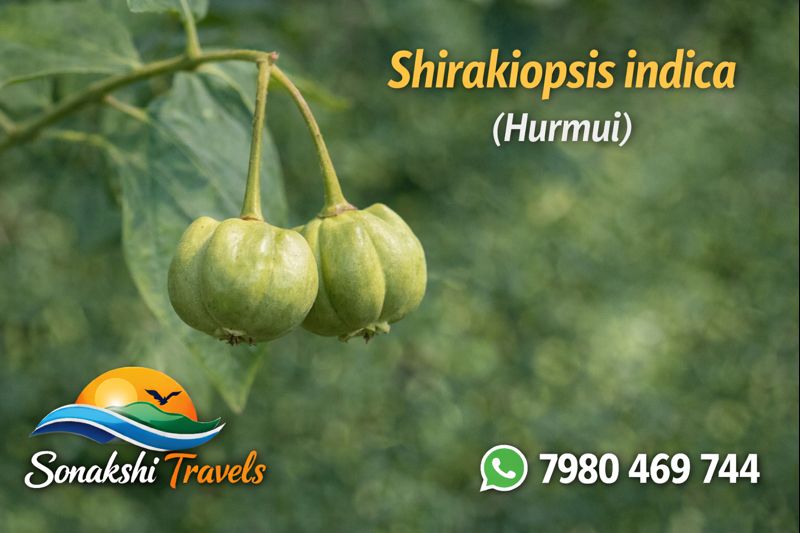
Fruits are three-lobed capsules that mature to a brownish color and dehisce upon ripening. Each lobe contains a single seed, which is dispersed through gravity and surface runoff during seasonal rains.
Habitat & Distribution
Shirakiopsis indica is adapted to a variety of moist tropical habitats, particularly those influenced by seasonal rainfall and periodic flooding. Its presence often indicates relatively stable soil conditions and moderate disturbance regimes.
Global Range
The species is distributed across South and Southeast Asia, with confirmed occurrences in India, Bangladesh, Nepal, Myanmar, Thailand, and parts of southern China. Within this range, it is most commonly found in lowland forests and foothill regions.
Preferred Habitat
Preferred habitats include moist deciduous forests, riverbanks, forest edges, and mixed woodland zones. The species favors well-drained alluvial soils but tolerates temporary waterlogging during the monsoon season.
Exploring native tree species becomes more insightful when combined with guided nature experiences. Carefully designed Sundarban Tour Package options allow visitors to observe such flora within their natural surroundings.
Occurrence
In India, Shirakiopsis indica occurs primarily in eastern and northeastern regions, extending into central India in suitable habitats. It is often encountered as scattered individuals rather than forming dense stands.
Preferred Habitat in the Sundarbans Region
Within the Sundarbans landscape, Shirakiopsis indica is largely restricted to freshwater-influenced zones and transitional forest areas rather than core saline mangrove habitats. It occurs along riverbanks, canal margins, and elevated forest patches where salinity levels are lower.
These zones provide favorable conditions for seedling establishment and growth, allowing the species to persist despite the dynamic hydrological environment.
Ecological Role
Shirakiopsis indica contributes significantly to ecosystem functioning within its native range. Its root system stabilizes soil along riverbanks and forest edges, reducing erosion during heavy rainfall events.
The tree provides habitat and shelter for various insects, birds, and small mammals. Leaf litter contributes organic matter to the soil, enhancing nutrient cycling and supporting decomposer communities.
Habitat Alteration
Habitat alteration represents a growing concern for Shirakiopsis indica. Deforestation, conversion of forest land for agriculture, and alteration of natural river courses reduce suitable habitats and limit natural regeneration.
In deltaic regions such as the Sundarbans, increased salinity intrusion and reduced freshwater flow may further constrain the species’ distribution.
For travelers interested in understanding transitional forest ecosystems and lesser-known native trees, curated Sundarban Private Tour experiences offer focused ecological exploration.
Conservation Efforts
Shirakiopsis indica is not currently listed as threatened, but localized declines have been observed due to habitat loss. Conservation strategies should emphasize protection of moist deciduous forests and maintenance of natural hydrological regimes.
In the Sundarbans region, sustainable land-use practices and community-based conservation initiatives indirectly support the continued survival of this species.
Did You Know?
Shirakiopsis indica was previously classified under the genus Sapium.
The tree produces a characteristic milky latex when injured.
It is commonly associated with freshwater-influenced forest zones.
The species contributes to soil stabilization in riparian environments.
External Reference
For additional taxonomic details and botanical descriptions, consult the relevant entry on Wikipedia.