A Detailed Botanical and Ecological Account of a Tropical Wetland Herb
Sphenoclea zeylanica is a distinctive wetland plant widely distributed across tropical Asia and other warm regions of the world. Recognized for its dense, cone-shaped inflorescence and strong association with marshy and seasonally inundated landscapes, this species occupies a unique position among semi-aquatic herbs. It is commonly encountered in rice fields, floodplains, pond margins, and freshwater swamps, where prolonged waterlogging and nutrient-rich sediments dominate the ecological conditions.
In deltaic systems such as the Sundarbans, Sphenoclea zeylanica contributes to the understory vegetation of freshwater-influenced zones, playing a subtle yet significant role in soil stabilization and nutrient cycling. This article presents a comprehensive, research-oriented overview of the species, covering its taxonomy, morphology, habitat preferences, ecological importance, and conservation considerations, with particular emphasis on its occurrence within the Sundarbans region.
Taxonomy & Classification
Sphenoclea zeylanica belongs to a small but distinctive taxonomic group adapted to aquatic and semi-aquatic environments. Its systematic placement reflects specialized morphological and reproductive traits that differentiate it from other wetland herbs.
Kingdom: Plantae
Clade: Angiosperms
Clade: Eudicots
Order: Solanales
Family: Sphenocleaceae
Genus: Sphenoclea
Species:Sphenoclea zeylanica Gaertn.
The family Sphenocleaceae is monotypic in many classifications, with Sphenoclea zeylanica as its most prominent representative. The species exhibits several primitive floral features, making it of particular interest in botanical and evolutionary studies related to wetland angiosperms.
Morphology & Field Identification
Growth Habit and Stem
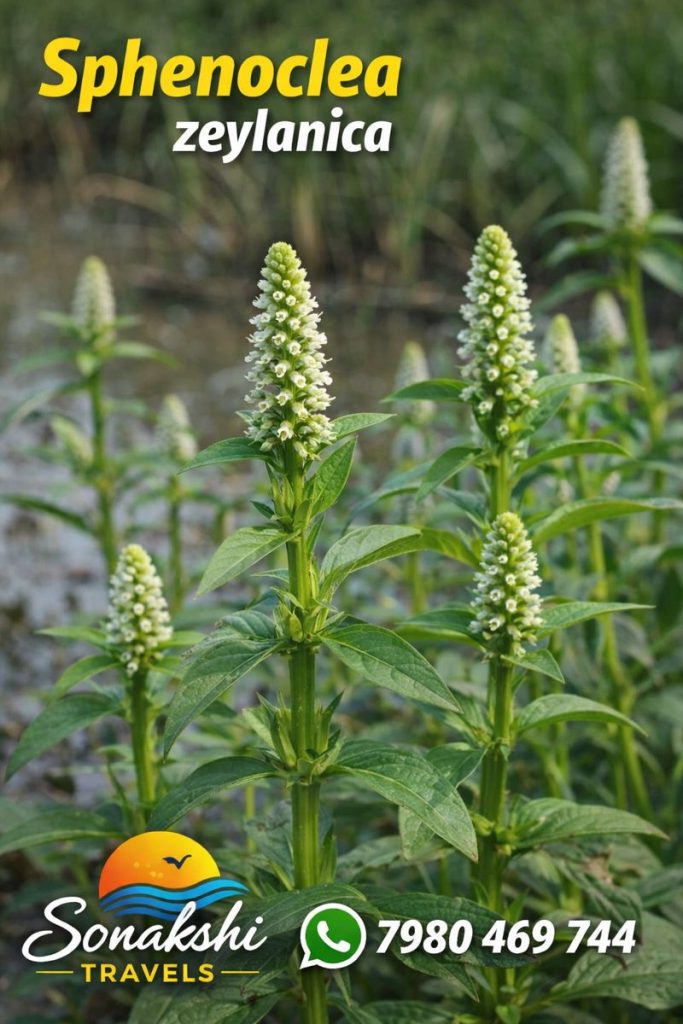
Sphenoclea zeylanica is an erect, annual to short-lived perennial herb that typically reaches heights of 60 to 150 centimeters. The stem is cylindrical, fleshy, and unbranched or sparingly branched, with a smooth, glabrous surface. Its succulent nature allows efficient internal water storage, an adaptation well suited to fluctuating hydrological conditions.
The stem base is often partially submerged in waterlogged soil, while the upper portion remains emergent, ensuring access to light and air for photosynthesis and gas exchange.
Leaves
The leaves are alternate, simple, and oblong to lanceolate in shape. Leaf blades are smooth, entire, and somewhat fleshy, with a glossy green surface. The venation is pinnate but faint, reflecting the plant’s reliance on water-rich tissues rather than extensive vascular reinforcement.
Leaves clasp the stem at the base, a feature that provides mechanical support and reduces damage from water movement in flooded habitats.
Inflorescence and Flowers
The most distinctive feature of Sphenoclea zeylanica is its dense, cylindrical to ovoid terminal inflorescence. This cone-like structure consists of numerous small, tightly packed flowers arranged spirally along a central axis.
Individual flowers are minute, with inconspicuous petals, often greenish to pale yellow. Despite their small size, the flowers are produced in large numbers, ensuring effective pollination and high seed output.
Fruit and Seeds
The fruit is a small, capsular structure containing numerous tiny seeds. These seeds are lightweight and easily dispersed by water, enabling the species to rapidly colonize newly flooded or disturbed wetlands. Seed viability remains high even after prolonged submergence.
Habitat & Distribution
Global Range
Sphenoclea zeylanica is native to South and Southeast Asia, with a broad distribution extending across India, Bangladesh, Sri Lanka, Myanmar, Thailand, Laos, Cambodia, Vietnam, and southern China. Through both natural dispersal and human-mediated movement, the species has also become established in parts of Africa, northern Australia, and some Pacific islands.
Its wide geographic range reflects a high degree of ecological tolerance, particularly to prolonged flooding and nutrient-rich substrates.
Preferred Habitat
The species thrives in freshwater and mildly eutrophic environments, including marshes, pond margins, irrigation canals, floodplains, and rice paddies. It prefers fine-textured soils such as clay and silt that retain moisture for extended periods.
Full sunlight promotes optimal growth, although the plant can tolerate partial shade in densely vegetated wetlands. Seasonal inundation is a critical factor, as it suppresses competing terrestrial vegetation and facilitates seed germination.
Occurrence
The occurrence of Sphenoclea zeylanica is closely aligned with monsoonal and flood-driven hydrological cycles. Germination typically begins at the onset of the rainy season, followed by rapid vegetative growth during periods of standing water.
Flowering occurs as water levels stabilize or gradually recede, allowing the inflorescence to remain emergent. Seed dispersal coincides with subsequent flooding, ensuring the continuation of the life cycle. The species often forms dense, monospecific stands in suitable habitats.
Preferred Habitat in the Sundarbans Region
Within the Sundarbans landscape, Sphenoclea zeylanica is primarily restricted to freshwater-influenced zones located away from high-salinity tidal channels. Such habitats include inland wetlands, low-lying agricultural margins, seasonal ponds, and the banks of freshwater creeks.
The plant benefits from the nutrient-rich alluvial soils deposited during monsoonal floods. These sediments support vigorous growth and high reproductive output. Its presence often indicates relatively stable freshwater conditions within the otherwise saline-dominated mangrove ecosystem.
Curious to explore freshwater wetlands within the mangrove delta? Discover immersive itineraries with our Sundarban Tour Package and experience the living landscape.
Ecological Role
Sphenoclea zeylanica plays an important ecological role in wetland systems. Its dense root network binds soft sediments, reducing erosion during flood events. The plant contributes organic matter to the ecosystem as its tissues decompose, supporting detritivores and microbial communities.
The dense inflorescences provide microhabitats for insects, while submerged plant parts offer shelter to aquatic invertebrates and juvenile fish. By stabilizing sediments and moderating nutrient fluxes, the species helps maintain the functional integrity of floodplain ecosystems.
Habitat Alteration
Habitat alteration poses a significant challenge to the long-term persistence of Sphenoclea zeylanica. Drainage of wetlands, conversion of floodplains into permanent agricultural land, excessive application of chemical fertilizers, and disruption of natural flooding regimes can drastically reduce suitable habitats.
In deltaic regions like the Sundarbans, increasing salinity intrusion due to reduced freshwater inflow and sea-level rise further restricts the species to shrinking freshwater refugia.
Conservation Efforts
Although Sphenoclea zeylanica is not currently classified as a threatened species, its conservation is intrinsically linked to the protection of wetlands. Sustainable water management, preservation of seasonal flood regimes, and maintenance of freshwater zones are essential for its continued survival.
Community awareness and integrated wetland management strategies can help balance agricultural productivity with biodiversity conservation, ensuring that species such as Sphenoclea zeylanica continue to thrive.
Learn about wetland conservation through responsible travel. Join a curated Sundarban Private Tour and witness the delicate balance of delta ecosystems.
Did You Know?
Sphenoclea zeylanica produces thousands of tiny seeds from a single inflorescence.
The plant’s cone-shaped flower spike is one of the most distinctive features among wetland herbs.
It is often considered an indicator of nutrient-rich freshwater wetlands.
The species can complete its life cycle within a single monsoon season.