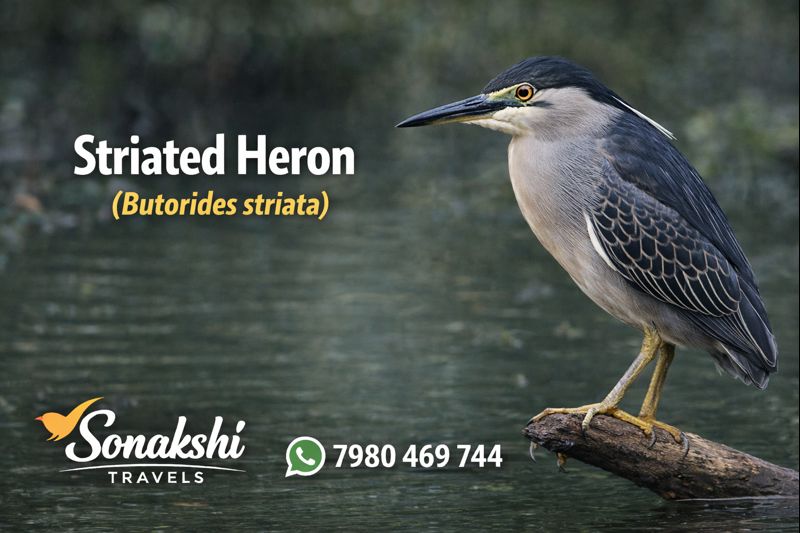
The Striated Heron (Butorides striata), also widely known as the Little Heron or Mangrove Heron in parts of its range, is a small yet remarkably adaptive member of the heron family. This species is renowned for its secretive nature, patient hunting strategy, and exceptional ability to thrive across diverse wetland habitats. From tropical mangroves and estuaries to freshwater streams and human-modified landscapes, the Striated Heron exemplifies ecological flexibility. In India, and particularly within the Sundarbans mangrove ecosystem, it represents a vital component of coastal and riparian biodiversity.
Taxonomy & Classification
The Striated Heron belongs to the family Ardeidae, a group that includes herons, egrets, and bitterns. Its genus Butorides comprises small, stocky herons characterized by short necks and deliberate movements. Historically, this species was considered conspecific with the Green Heron (Butorides virescens), but taxonomic revisions now recognize them as distinct species based on morphological and geographic differences.
Kingdom: Animalia
Phylum: Chordata
Class: Aves
Order: Pelecaniformes
Family: Ardeidae
Genus: Butorides
Species: Butorides striata
Several subspecies are distributed across Africa, Asia, Australia, and the Americas, reflecting subtle regional variations in plumage tone and body size.
Morphology & Field Identification
The Striated Heron is a compact, short-legged heron with a relatively thick neck and sturdy bill. Its posture is often crouched, giving it a hunched appearance while perched along water edges. Compared to larger herons, it appears more discreet and is frequently overlooked due to its subdued coloration and motionless behavior.
Male Features
Adult males typically display a dark bluish-grey to greenish-black crown and back, contrasting with grey wings and a pale grey to buff underbody. During the breeding season, the plumage becomes richer in tone, and bare facial skin may intensify in color, enhancing visual signals during courtship.
Female Features
Females closely resemble males but are generally slightly duller in coloration. The difference between sexes is subtle, and field identification based solely on sex is challenging without observing breeding behavior or size comparisons within pairs.
Size & Wingspan
The Striated Heron is relatively small, measuring approximately 44 to 47 centimeters in length. Its wingspan ranges from 75 to 85 centimeters. Body weight typically falls between 200 and 350 grams, making it significantly lighter than most other heron species.
Flight Characteristics
In flight, the species exhibits rapid wingbeats interspersed with short glides. The neck is partially retracted, and the legs trail behind the body. Flights are usually low and direct, often occurring when the bird is disturbed or relocating between nearby feeding sites.
Habitat & Distribution
Global Range
The Striated Heron has an extensive global distribution, occurring across sub-Saharan Africa, South and Southeast Asia, East Asia, Australia, and parts of South America. This broad range underscores its adaptability to varying climatic zones, from tropical coasts to temperate wetlands.
Preferred Habitat
Preferred habitats include mangroves, tidal creeks, estuaries, riverbanks, ponds, lakes, marshes, and flooded agricultural fields. The species shows a strong preference for sheltered areas with overhanging vegetation, which provide both concealment and strategic vantage points for hunting.
Diet & Feeding Ecology
The Striated Heron is a versatile carnivore, feeding primarily on small fish, crustaceans, aquatic insects, tadpoles, frogs, and mollusks. In coastal habitats, it frequently consumes crabs and shrimp, while inland populations rely more on freshwater prey.
Foraging Technique
Foraging is characterized by remarkable patience. The bird often stands motionless at the water’s edge or on low branches, waiting for prey to approach. Once within range, it strikes swiftly with its sharp bill. Notably, this species has been observed using bait, such as dropping insects or feathers onto the water surface to lure fish—an example of advanced problem-solving behavior in birds.
Breeding & Reproduction
Breeding seasons vary by region, typically coinciding with periods of increased food availability. Unlike many herons, the Striated Heron may nest solitarily or in loose, small colonies.
Nesting Sites
Nests are usually constructed in low trees, shrubs, mangroves, or dense reeds, often close to water. The nest is a simple platform of sticks and twigs. Females lay two to five pale blue or greenish eggs, which are incubated by both parents. Chicks fledge within a few weeks but remain dependent on adults for some time.
Unique Adaptations & Behavioral Ecology
Speed & Agility
Although not built for sustained flight, the Striated Heron demonstrates impressive agility during hunting. Rapid neck extension and precise bill control enable efficient prey capture, even in shallow or cluttered environments.
Camouflage and Nesting Strategy
Its muted plumage blends seamlessly with mangrove roots, muddy banks, and shaded vegetation. During daylight hours, individuals often remain completely still, relying on camouflage to avoid detection by predators and humans alike.
Social Behavior
This species is generally solitary outside the breeding season. Territorial behavior is common around feeding sites, with individuals defending preferred hunting spots through visual displays and short chases.
Occurrence & Seasonal Movement
In tropical regions, the Striated Heron is largely resident, showing limited seasonal movement. In subtropical and temperate areas, some populations exhibit local dispersal linked to rainfall patterns and water availability. In India, it is commonly observed year-round in suitable habitats.
Preferred Habitat in the Sundarbans Region
Within the Sundarbans, the Striated Heron is strongly associated with mangrove-lined creeks, tidal channels, and mudflats. The complex root systems of mangrove trees provide ideal perching and nesting sites, while tidal fluctuations ensure a steady supply of aquatic prey.
Interested in exploring mangrove birdlife up close? Discover our carefully planned Sundarban Tour experiences designed for nature enthusiasts.
Ecological Role
As a mid-level predator, the Striated Heron plays an essential role in controlling populations of small fish and invertebrates. Its presence indicates healthy wetland conditions and contributes to maintaining ecological balance within mangrove and freshwater systems.
Habitat Alteration
Habitat loss due to mangrove deforestation, wetland drainage, pollution, and unregulated coastal development poses localized threats. Although adaptable, the species depends on intact shoreline vegetation for nesting and foraging.
Conservation Efforts
Globally, the Striated Heron is classified as Least Concern, reflecting its wide distribution and stable population trends. Conservation strategies focus on wetland protection, mangrove restoration, and sustainable water management, which collectively benefit this species and broader wetland biodiversity.
Experience the hidden corners of the mangroves with a responsible Sundarban Tour and observe secretive species like the Striated Heron.
Did You Know?
The Striated Heron is one of the few bird species known to use bait to catch fish.
Juveniles are brown with heavy streaking, providing excellent camouflage among mangrove shadows.
Despite its small size, it can successfully hunt prey nearly half its own body length.