Sundarban luxury tour beyond quiet waters – Where silence defines the journey
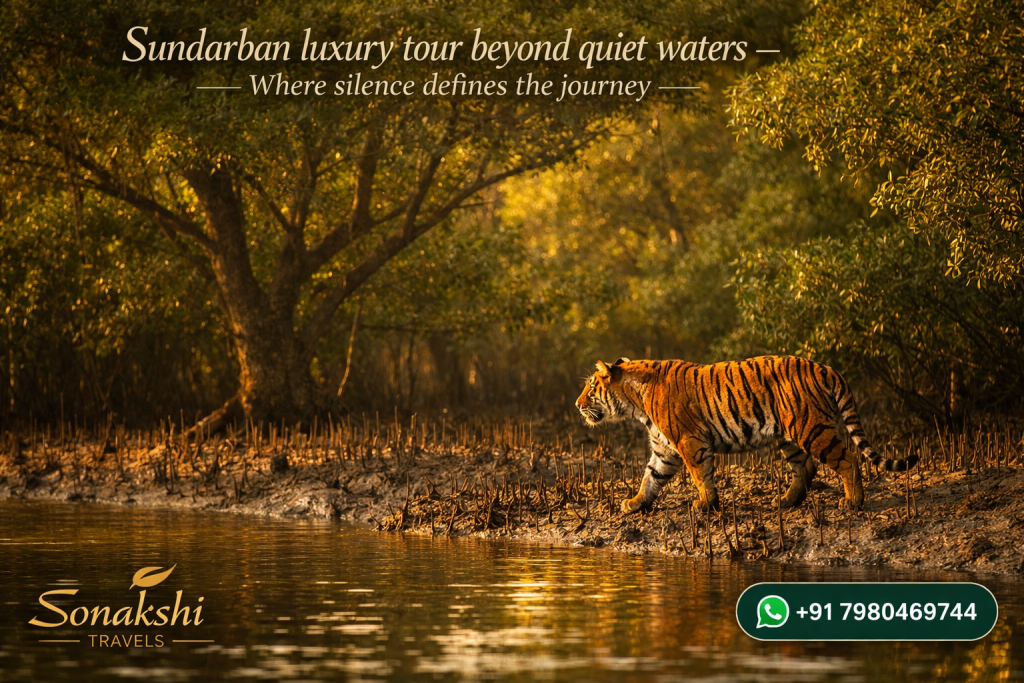
There are journeys that impress the eye at once, and there are journeys that work more slowly, entering the mind through mood, rhythm, and feeling. A Sundarban luxury tour belongs to the second kind. It does not depend on noise, display, or restless movement. Its deepest value appears when the traveler begins to notice how silence lives in the landscape. Water moves, but without drama. Forest edges shift in light, but without spectacle. The air holds bird calls, distant wingbeats, soft engine pauses, and the slight touch of tide against the boat. In such a setting, silence is not empty. It is full of meaning.
The title of this journey goes beyond the idea of quiet water because the real experience is not limited to surface calm. Still water alone does not explain the Sundarban. Silence here has structure. It comes from distance, from the wide spread of tidal channels, from the mangrove wall that absorbs sound, and from the unusual fact that life in this delta often reveals itself through traces rather than direct display. A refined traveler soon understands that the landscape does not perform for attention. It asks for patience, and that patience changes the quality of the journey itself.
That is why a serious Sundarban travel experience cannot be understood only as movement through rivers. It is also movement away from the ordinary pressure of modern sound. In most places, travel is described through activity. Here, the more important truth lies in restraint. The finest moments often arrive when nothing dramatic happens and yet everything feels deeply alive. The boat glides. Light shifts over muddy banks. Mangrove roots appear and disappear with the tide. A kingfisher flashes across the frame of vision for a second and is gone. The mind becomes quieter because the landscape does not rush it.
Silence as the true form of luxury
Many people use the word luxury too easily. They attach it to decoration, comfort, or exclusivity without asking what truly makes an experience rare. In the Sundarban, luxury takes a different shape. It is the privilege of entering a place without pressure, without crowding, and without the constant demand to react. A Sundarban luxury private tour feels elevated not because it is loud in its presentation, but because it protects the conditions in which the landscape can be felt properly. Privacy, space, and unbroken attention create a more meaningful richness than any surface ornament.
This is especially important in a tidal forest where the environment speaks in low tones. If a traveler arrives with the habit of constant stimulation, much of the place remains hidden. The deeper form of luxury lies in being able to slow down enough to hear the small language of the delta. That language includes the gentle slap of water against the wooden side of a boat, the soft friction of wind through leaves, the sudden silence after one bird call ends, and the weight of stillness before another sound begins. In such moments, luxury becomes the freedom to notice what ordinary travel often destroys.
There is also a psychological dimension to this. Silence is restorative, but not in a simple or shallow way. In the Sundarban it can be humbling, even corrective. It reduces the ego of the traveler. It reminds the visitor that this is not a landscape arranged for human comfort. It is a living system with its own rhythm, its own rules, and its own ancient habits. This recognition creates respect. When that respect grows, the journey becomes finer, calmer, and more intelligent.
Beyond surface calm lies a living rhythm
The phrase quiet waters can mislead those who imagine stillness as absence. The waters of the Sundarban are not empty and never truly still. They breathe with tide. They carry silt, salt, light, shadow, and memory of distant sea movement. Their calm appearance often hides continuous change. Channels widen and narrow. Reflections break and reform. Banks soften, collapse, rebuild, and mark new edges. Silence in such a place is not dead stillness. It is disciplined movement.
This is one reason a thoughtful Sundarban tour often feels unlike any other river journey. The traveler begins by looking outward, but gradually learns to observe process rather than only scenery. Mud is not just mud; it is the working ground of the mangrove world. Exposed roots are not decorative forms; they are living adaptations to unstable, saline, oxygen-poor soil. The waterline itself is a shifting sentence written and rewritten through the day. Silence gives these details room to become visible.
The best response to such a landscape is not constant speech. It is careful attention. In many destinations, commentary fills the experience. In the Sundarban, too much commentary can stand between the traveler and the place. A meaningful journey often develops when speech becomes occasional and observation becomes primary. That is why the emotional memory of the delta stays long after the trip. It is not built only from what was seen. It is built from how the environment altered the speed of thought.
The ecology of silence in the mangrove world
Silence in the Sundarban is shaped by ecology. Mangrove landscapes do not produce the same kind of sound environment as open plains, mountain roads, or urban waterfronts. The forest edge absorbs and softens noise. The muddy banks do not echo sharply. Branch structure, suspended roots, humid air, and broad tidal channels create a sound field that feels muted, layered, and often intimate even within large open space. This is not merely poetic language. It reflects how habitat form influences acoustic behavior.
That ecological quality matters because it changes the way wildlife and human presence are perceived. In many forests, movement is announced loudly. In the Sundarban, movement can remain half-hidden. A ripple, a disturbed patch of mud, a quick bird alarm, or a brief change in stillness may communicate more than obvious sound. For the traveler, this creates a heightened form of awareness. One does not simply look for life; one listens for subtle disturbance inside apparent calm.
This is where the idea of Sundarban eco tourism gains serious meaning. Ecological travel is not only about visiting a natural place. It is about entering that place in a way that allows its real character to remain legible. In the Sundarban, silence is part of that character. Noise can flatten the environment, making everything feel ordinary. Quiet attention allows the layered intelligence of the habitat to emerge. The traveler starts to see that each sound has proportion and consequence.
Silence reveals adaptation
When the journey is quiet enough, the mangrove system begins to explain itself without formal lecture. The eye notices pneumatophores rising like breathing instruments from the soil. It notices how water marks tree trunks at different heights. It notices crabs, birds, drifting leaves, and the delicate meeting point of freshwater influence and saline force. These details are scientific in reality, yet they arrive through experience. Silence makes them readable.
Such observation is central to a high-quality Sundarban luxury travel experience. The landscape should not be reduced to a list of attractions. It should be encountered as a living web of adjustments. The trees are shaped by salt. The banks are shaped by tide. Animal behavior is shaped by concealment, feeding opportunity, and caution. Human perception, if patient enough, begins to follow the same discipline.
How silence changes the traveler
One of the most striking aspects of this journey is that the landscape does not merely offer beauty; it reorganizes the inner state of the observer. At first, many travelers carry the usual mental habits of modern life. They arrive expecting constant visual reward, easy explanation, and quick emotional response. But the Sundarban softens those expectations. The mind stops chasing. It begins to receive. This shift is not dramatic, but it is profound.
On a well-designed Sundarban private tour, this inner transition often becomes even more noticeable. Without crowd noise and without the pressure of shared public attention, the traveler has room to experience silence personally. The river becomes less of a scene and more of a presence. The forest line does not feel distant; it feels watchful, composed, and self-contained. The traveler, in turn, becomes more measured. Speech grows softer. Observation grows sharper. Even time feels different.
This is one reason silence defines the journey. It is not a decorative background condition. It is the force that shapes perception. In the absence of distraction, even simple moments become complete. A bend in the creek is enough. A pause before sunset is enough. The drifting reflection of mangrove branches is enough. The value of the journey increases because attention is no longer broken into fragments.
The emotional texture of restrained travel
There is a special emotional quality in travel that does not force feeling. The Sundarban allows emotion to rise gradually from contact rather than instruction. The traveler is not told what to feel at every stage. Instead, the environment produces calm, tension, wonder, humility, and quiet joy in natural sequence. This makes the experience more durable in memory. What is gently discovered often lasts longer than what is loudly presented.
For this reason, a refined luxury Sundarban cruise should never try to overpower the destination. The setting itself already contains depth. Too much noise, too much performance, or too much staged excitement weakens the rare intelligence of the place. The highest form of comfort here is comfort that stays discreet and lets the environment remain central.
The river as a corridor of thought
In the Sundarban, movement by water creates a rare kind of continuity. Roads interrupt thought with turns, stops, signals, and hard edges. River travel is different. It carries the mind forward in an unbroken line. This continuity matters because silence is easier to feel when movement is smooth. The traveler is not pulled again and again into mechanical awareness. Instead, attention widens.
That is why a luxury Sundarban river cruise can feel mentally spacious in a way that few journeys do. The body remains still while the landscape shifts. This produces a subtle but powerful form of contemplation. One sees banks, creeks, foliage, sky, and water as parts of one connected field. The eye no longer hunts only for separate objects. It begins to understand relation, balance, and interval. Silence helps build this understanding because nothing is competing too strongly for dominance.
Even the pauses matter. When the boat slows, the world does not stop. Tiny movements continue everywhere. Water insects touch the surface. Leaves tremble. Mud remembers the receding tide. A distant bird call measures space better than a map. In such pauses, the traveler realizes that quiet waters are only the beginning. Beyond them lies a whole system of patient motion, and silence is the method by which that motion becomes perceptible.
Why privacy deepens the experience
Silence becomes more meaningful when it is not constantly broken by unrelated conversation or crowd behavior. This is where the structure of a private journey changes the quality of observation. An exclusive Sundarban private tour allows the traveler to remain inside the mood of the landscape. The eye is not repeatedly pulled away. The emotional continuity of the river is preserved.
Privacy also gives dignity to subtle experience. Not every meaningful response to nature is outward or social. Some of the strongest travel moments are inward: a quiet realization, an unexpected stillness of mind, a sudden sense of proportion before the vastness of tidal life. On a more intimate journey, such responses can develop naturally. They do not need to be performed. They do not need to be explained at once.
This is why the finest form of Sundarban luxury tour package design should protect silence rather than fill every interval. In a destination like this, empty time is not wasted time. It is interpretive time. It is the space in which the traveler begins to understand what kind of place the Sundarban truly is.
Silence as ethics, not only atmosphere
There is another reason silence matters here. It is not only beautiful. It is respectful. The Sundarban is a habitat of sensitivity, concealment, and balance. To move through it with care is to accept that human presence should not dominate every moment. Quiet travel recognizes that the forest is not a stage. It is a living environment whose dignity lies partly in its independence from us.
This understanding gives depth to the idea of a Sundarban travel guide even when no formal guidebook is being read. The landscape itself becomes the teacher. It teaches moderation. It teaches patience. It teaches that observation without interference can be more rewarding than constant pursuit. In this sense, silence is a discipline of ethical travel. It allows the delta to remain itself.
Such ethical quietness is also part of what makes a true Sundarban luxury tour memorable. Real refinement is not domination over place. It is harmony with place. The traveler who understands this returns with more than photographs or scenic impressions. The traveler returns with a changed idea of what meaningful travel can be.
Where silence defines the journey
In the end, the title reaches its full meaning only when one accepts that this journey is shaped less by events than by atmosphere. Beyond quiet waters lies a more complete truth: the Sundarban is a landscape where silence becomes form, method, and message. It shapes how the river is seen, how the forest is understood, how the traveler feels, and how the memory of the journey settles in the mind.
A superficial visit may notice only calm channels and scenic edges. A deeper encounter recognizes something far more powerful. Silence in the Sundarban is alive with ecological intelligence, emotional depth, and philosophical weight. It teaches the traveler to value interval over rush, attention over noise, and presence over display. In that sense, the finest Sundarban luxury tour is not simply a comfortable passage through a beautiful delta. It is an education in quiet perception.
That is why the journey stays with people long after they return. They remember not only what they saw, but how the place taught them to see. They remember that silence was never empty. It was the true medium of the landscape. Water carried it. Mangroves held it. Light entered it. Thought slowed inside it. And somewhere beyond those quiet waters, the journey became more than travel. It became a rare form of understanding.