Sundarban tour — the forest that never sleeps
Hear the wild whisper after dark
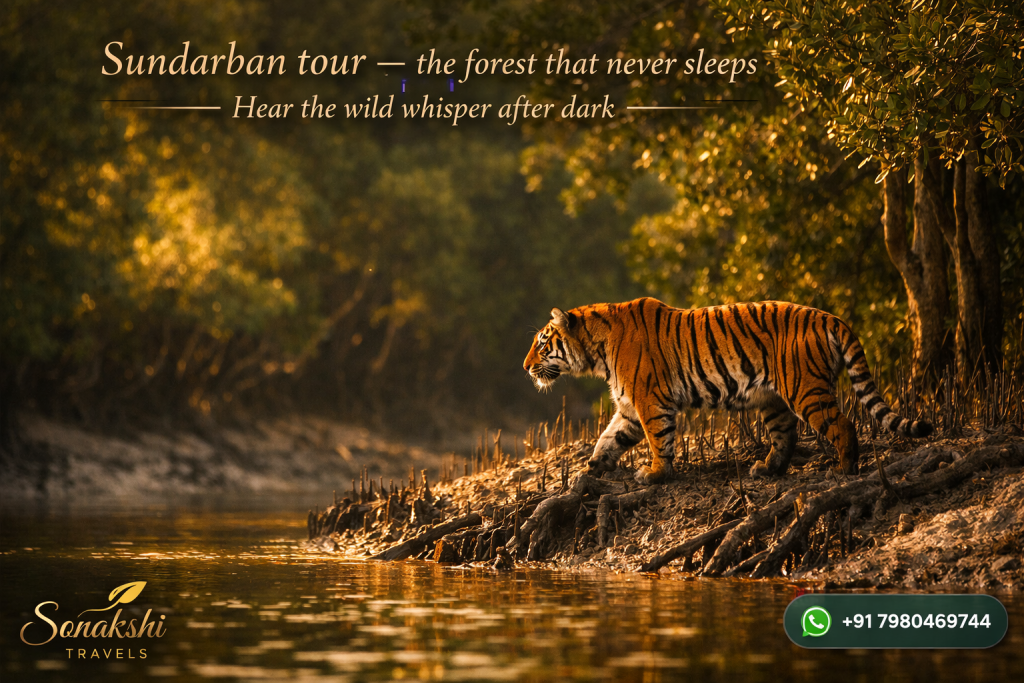
There are landscapes that become quiet at evening, and there are landscapes that seem to wake more deeply when light begins to withdraw. The mangrove delta belongs to the second kind. In daylight, a visitor may notice water, roots, mudbanks, bird calls, and shifting channels. Yet after dark, the same space changes its character without changing its form. The river remains the river. The forest remains the forest. But sound becomes more important than shape, rhythm becomes more important than distance, and attention becomes sharper because the eye can no longer dominate experience. This is where the deeper meaning of a Sundarban tour begins to reveal itself.
The title suggests a forest that never sleeps, and this is not merely a poetic impression. Mangrove ecosystems continue their work through every hour. Tides move with relentless discipline. Mud breathes through exposed roots. Small organisms feed, burrow, and filter. Crabs emerge, retreat, and reappear. Fish disturb the dark surface. Insects change the acoustic texture of the air. Birds that seemed settled at dusk shift again in response to movement below. Predators remain part of the unseen order. Nothing important stops. The night does not close the system. It exposes its continuity.
That continuity is what makes the after-dark atmosphere so powerful. In many places, human time controls the meaning of evening. Shops close, lights appear, roads empty, and daily patterns announce that one phase has ended. In the mangrove world, the opposite feeling often takes hold. Human certainty becomes smaller. The visitor begins to understand that the land has its own schedule, its own intelligence, and its own responses. A serious Sundarban travel experience is memorable not because it offers spectacle at every moment, but because it teaches the mind to register forms of life that continue beyond human convenience.
Why the forest feels more awake after sunset
After dark, perception changes first. During daylight, people trust visual evidence. They look for outlines, movement, color, and distance. In the mangrove region, evening reduces the power of the eye and strengthens the authority of hearing. A splash carries farther. A wingbeat feels larger. The rubbing of water against wood acquires pattern. Leaves do not simply move; they seem to answer one another. The call of a night-active bird enters the silence with much greater force than it would under a bright sky. The result is not empty quietness. It is concentrated listening.
This is one reason the forest can feel sleepless. Darkness does not erase activity. It edits human understanding. The visitor no longer receives information in a complete visual field. Instead, the environment arrives in fragments: a tremor in water, a rustle within low vegetation, the sudden pause of insect sound, the distant thud of something entering mud, the narrow echo of current touching a creek edge. Each fragment suggests a living order beyond the reach of quick interpretation. The mind becomes alert, and alertness itself creates the sensation that the whole forest is awake.
In ecological terms, this impression has strong grounding. Mangrove habitats are highly dynamic edge environments. Land and water are not firmly separate. Salinity changes. Tidal levels advance and retreat. Organic matter moves continuously. Countless organisms depend on timing rather than stillness. Nocturnal and crepuscular behaviors are part of that pattern. Certain species feed more actively when visibility drops. Others respond to temperature shifts in mud and water surfaces. Still others use darkness as protection. The forest after dark is therefore not a silent backdrop. It is an active system managing exchange, survival, and movement through reduced light.
The language of sound in a night mangrove
What many people remember most strongly is not what they saw, but what they heard. Sound in the delta is layered. The first layer is the broad, steady sound of water. This is not always loud. Often it is restrained, almost thoughtful. It moves against a boat hull, brushes a bank, or travels through a narrow channel with a soft, repeating pulse. The second layer is made of smaller living interruptions: fish breaking surface tension, insects establishing their dense and sometimes metallic chorus, unseen birds calling in irregular intervals, and the faint scratch of crabs negotiating mud.
The third layer is the most powerful because it is made of uncertainty. A pause in sound can be as meaningful as sound itself. When a chorus suddenly thins, the listener feels the presence of a change before understanding its source. A heavier disturbance from the bank does not need to be visually confirmed to alter the emotional atmosphere. This is where the wild whisper of the title becomes important. The forest rarely shouts. It suggests. It indicates. It lets the listener feel that something is near, moving, waiting, or observing. That subtlety is one of the deepest strengths of a Sundarban tourism landscape when approached seriously.
Even ordinary sounds become charged with meaning in such an environment. A branch touching another branch over water can sound deliberate. The pull of current along roots can resemble breathing. The night call of a bird can appear less like a call and more like a location marker inside darkness. These impressions matter because they show how the human mind responds when the environment cannot be simplified into scenery. A meaningful Sundarban travel guide to experience should therefore understand that the forest is not only a place to observe. It is a place to listen to with unusual care.
Roots, tide, and darkness as a living structure
The night character of the mangrove is shaped not only by animals but also by form. Mangrove roots are among the most distinctive structures in this deltaic world. During daylight they appear sculptural, complex, and botanical. After dark they become something more atmospheric. Their vertical and angled emergence from mud changes the way sound travels, the way water curls into edges, and the way shadow gathers in small spaces. A bank lined with roots feels less like a passive shoreline and more like a breathing threshold.
Tide intensifies this effect. As water rises and falls, the relationship between root, mud, and current keeps changing. Spaces open and close. Shallow edges become hidden. Small channels deepen or soften. Creatures that were unseen at one stage of water become active at another. Because of this, darkness in the delta is never static. It is structured by movement. The forest feels awake because its architecture is continuously interacting with the tide. That interaction is one reason a thoughtful Sundarban tour package should never be reduced to visual sightseeing alone. The deeper experience lies in sensing how the landscape behaves when light is no longer the main guide.
This is also why after-dark perception often feels psychological as much as physical. The mind is forced to work with incomplete evidence. It must interpret tone, interval, direction, and texture. In a city, that kind of uncertainty often produces impatience. In the mangrove, it can produce humility. The visitor begins to accept that not everything will be fully seen, named, or confirmed. That acceptance can feel unsettling at first, but it eventually becomes one of the most memorable gifts of the journey. The forest asks the mind to become quieter so that it can notice more.
The emotional discipline of listening
There is a difference between hearing noise and listening to an environment. The latter requires restraint. It asks a traveler not to demand immediate explanation from every sound. In the mangrove after dark, restraint becomes a form of intelligence. The listener learns that meaning often appears through repetition. A sound that occurs once may be random. A sound that returns with interval begins to indicate pattern. A silence that follows repeated activity may suggest a larger presence nearby. This careful method of attention gives depth to the entire Sundarban travel package experience, especially for those who want more than surface-level impressions.
Listening also changes emotional scale. During daylight, the human observer often feels central. The eye organizes the scene and assumes control. After dark, the observer feels smaller. The forest does not arrange itself for easy human reading. That loss of control is precisely what makes the place powerful. It reminds the visitor that wildness is not defined only by visible danger or dramatic appearance. Wildness can also be defined by autonomy. The environment continues to act according to its own order whether or not a human fully understands it.
For this reason, the night atmosphere of the mangrove is not merely mysterious. It is corrective. It reduces human self-importance. It trains patience. It shows that silence is not the absence of activity but the absence of human domination over meaning. A strong Sundarban trip package narrative should therefore treat the nocturnal forest not as a decorative extra, but as one of the clearest expressions of the delta’s true character.
Wildlife presence without theatrical display
One of the most remarkable features of the Sundarban after dark is that wildlife presence is often felt more strongly than it is seen. This creates a very different relationship between visitor and habitat. In many travel settings, wildlife is treated as an object to be displayed. Here, the environment resists that simplicity. Presence may come through a shift in sound, a disturbance in shallow water, the abrupt rise of alertness among smaller creatures, or the sense that the edges of the creek hold more life than the eye can confirm. The result is a deeper respect for habitat behavior itself.
This is especially important in a region associated with powerful animal life. Yet the strongest impression at night is rarely sensational. It is disciplined. The visitor begins to understand that wild animals do not need to reveal themselves fully in order to shape the emotional atmosphere of a place. Their possibility is enough. Their patterns, territories, feeding routes, and hidden movement enter the experience through indirect signs. That is why a mature Sundarban private tour can feel so different from ordinary sightseeing. It allows greater quiet, greater concentration, and a more intimate reading of subtle surroundings.
Research on mangrove ecosystems repeatedly shows how important these habitats are as nurseries, feeding grounds, protective zones, and interfaces between aquatic and terrestrial systems. At night, the visitor can feel this ecological density even without technical language. The mud is active. The water is active. The banks are active. The canopy edges are active. Nothing in the system feels empty. Even when the channel appears still, stillness is only the visible surface of a continuous biological exchange.
The river as a corridor of hidden communication
At night, river channels function less like scenic routes and more like corridors of communication. Sound travels along them. Scent moves across them. Tidal force enters them and withdraws from them. Reflections break and reform with minimal light. A narrow creek can hold extraordinary tension because it gathers sound from both water and bank without revealing the full source. This is one reason a Sundarban luxury tour focused on atmosphere and depth can leave a stronger intellectual impression than a louder, more hurried form of travel.
The river also changes the meaning of darkness. On open land, darkness can feel flat. On tidal water, darkness is relational. It is measured by sound, by current, by the distance between banks, by the shape of overhanging branches, and by the way even a faint reflection suggests movement beyond the center of vision. The channel becomes a listening chamber. Each bank answers the other. Each small disturbance carries farther than expected. In this setting, whisper is not weakness. Whisper is reach.
This helps explain the unusual psychological force of nighttime in the Sundarban. The mind is no longer consuming fixed scenes. It is building a sense of place from living signals. That process is slower, more demanding, and ultimately more memorable. A refined Sundarban luxury private tour experience should preserve this slowness because speed would destroy the very quality that makes the forest after dark meaningful.
Why darkness reveals the truth of the mangrove
Daylight can be beautiful, but it can also make a visitor too confident. Shapes are visible, routes appear readable, and the forest seems easier to understand than it truly is. Darkness removes that illusion. It does not make the mangrove more dangerous in a theatrical sense; it makes it more honest. The visitor recognizes that this is a habitat built on adaptation, concealment, exchange, and timing. The river is not merely scenic water. The bank is not merely land. The silence is not emptiness. Every element is active within a larger balance.
That honesty matters because it gives moral depth to the experience. The forest that never sleeps is not performing for human admiration. It is maintaining life through constant adjustment. Tides, salinity, decomposition, feeding, nesting, lurking, filtering, and regeneration continue regardless of human presence. To sense even a small part of this after dark is to understand why the delta deserves serious attention within Sundarban eco tourism. Ecological respect begins when the visitor stops treating the landscape as a still image and begins to recognize it as a living process.
This is also why the most lasting memory may not be an event but a condition: the feeling that the forest was speaking in low tones all around, never fully silent, never fully visible, never fully at rest. That condition enters the mind slowly and remains there. It changes how later memories of the journey are organized. One remembers the weight of darkness over water, the patience required to listen, the alertness carried by even the smallest sound, and the strange calm that comes from accepting that much of life will remain hidden.
Hearing the wild whisper after dark
To hear the wild whisper after dark is not merely to hear sound. It is to enter a different discipline of attention. The mangrove asks the visitor to become slower, quieter, and less certain. In return, it offers a richer form of perception. Water becomes language. Silence becomes interval. Hidden movement becomes a kind of presence that reshapes thought. The forest does not sleep because the systems that sustain it do not sleep. The tides continue. The mud continues. The roots continue. The unseen life of the banks continues. Darkness simply allows the traveler to notice that continuity with greater seriousness.
For that reason, the deepest value of a Sundarban tour centered on night atmosphere lies in what it teaches. It teaches that wildness can be subtle. It teaches that ecological truth is often heard before it is seen. It teaches that a forest may reveal its character most fully when human certainty becomes quiet. And it teaches that the whisper of the delta is not weakness, softness, or emptiness. It is the sound of a living world continuing its work beyond the limits of light.
When the Sundarban journey is remembered later, that is often what remains strongest: not a dramatic scene, not a convenient summary, but the sustained impression of a habitat alive in darkness, composed of tide, root, mud, water, and hidden motion. The wild whisper is therefore not a metaphor alone. It is the true tone of the mangrove after dark. It is the low, constant speech of a forest that never sleeps.