Sundarban Travel That Feels Deeply Personal – Craft Journeys Beyond Standard Packages
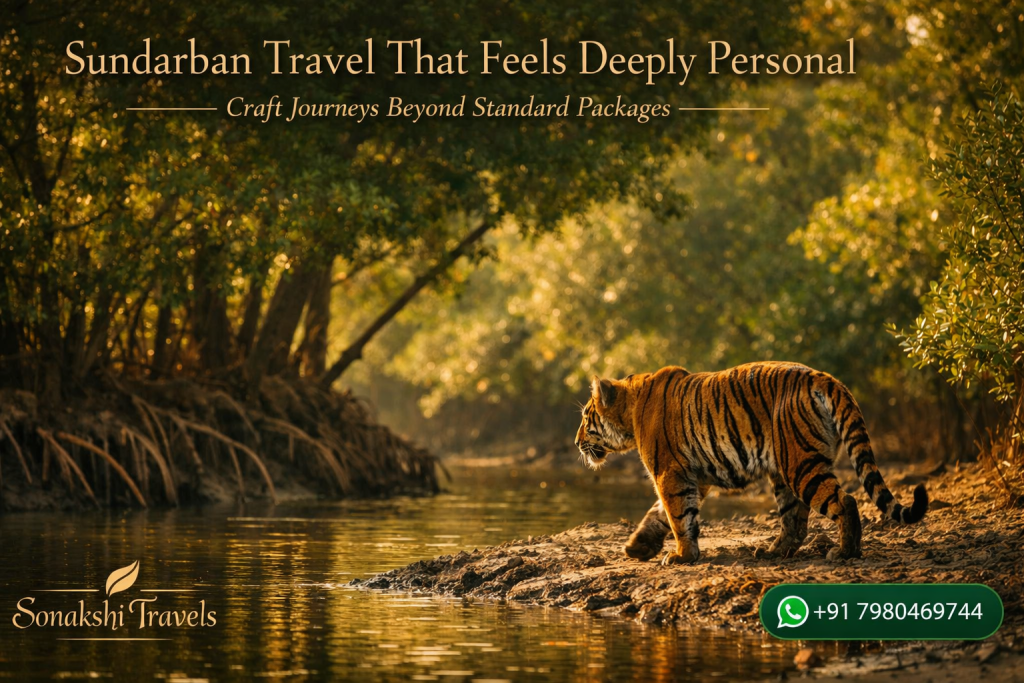
There are journeys that are completed by movement alone, and there are journeys that change shape because of attention. The Sundarban belongs to the second kind. It is not a destination that reveals itself fully through a fixed checklist, a hurried schedule, or a crowd moving in one direction at one speed. It is a living estuarine landscape of tide, mud, silence, light, roots, birds, memory, and sudden movement. Because of that, the most meaningful Sundarban travel is often the kind that feels deeply personal.
A personal journey in the Sundarban is not simply a matter of privacy or comfort. It is a matter of perception. When the experience is shaped with care, the forest stops feeling like a product and begins to feel like a relationship. The traveller notices the pause between two sounds. The traveller feels how slowly the river bends. The traveller understands that a mangrove landscape does not perform in the way many destinations do. It asks for patience, emotional quietness, and a willingness to observe detail. This is why a more intimate approach often creates a richer Sundarban travel experience than any standard format can offer.
Why a Personal Journey Matters in the Sundarban
The Sundarban is one of those rare places where the environment itself changes the logic of travel. In a city, movement is direct. In a mountain road, the route rises and turns. In a mangrove delta, the land is unstable, the water is always involved, and the visible scene is never separate from hidden ecological systems. The forest is shaped by salinity, sediment, tidal flushing, root adaptation, creek behaviour, and the movement patterns of wildlife. A personal journey matters because such a place cannot be understood well through a uniform template.
Standard travel formats often assume that every traveller seeks the same tempo, the same emotional distance, and the same style of engagement. But people do not arrive at the Sundarban in the same inner condition. Some come with a wish for stillness. Some come with a strong desire to watch birdlife carefully. Some want to spend long stretches in reflective silence on the river. Some want close family time without the noise of a large group. Some want an immersive conservation-oriented experience where the landscape is read slowly, not consumed quickly. A thoughtful Sundarban private tour answers these differences with sensitivity.
When a journey becomes personal, the destination is no longer reduced to a package identity. Instead, it becomes a field of response. The river response is different in early light and in late light. The forest response is different when watched silently and when approached as scenery. Even the same stretch of water can feel empty to one traveller and emotionally full to another. This is where personalization matters. It respects the truth that the value of the Sundarban lies not only in what is seen, but in how it is experienced.
Beyond Standard Packages Means Beyond Standard Perception
The phrase “beyond standard packages” does not need to mean excess. It does not even need to mean luxury in the narrow sense. It means moving beyond a preset emotional script. Many routine travel structures are designed to move people through a destination efficiently. That approach may work for urban landmarks or highly visual monuments. The Sundarban is different. It is less about accumulation and more about absorption. The deeper the traveller listens, the more the landscape offers.
This is why a carefully designed Sundarban personalized travel package can become more meaningful than a generic group movement through the same waters. The difference may lie in how time is allowed to breathe. It may lie in the freedom to remain quiet when a flock shifts direction over the mudflat. It may lie in the chance to let a child watch fiddler crabs at the river edge without being rushed. It may lie in the opportunity for a couple to feel that the forest is surrounding them rather than being displayed to them.
A deeply personal Sundarban luxury tour is therefore not defined only by comfort elements. Its true value lies in interpretation, atmosphere, and emotional fit. It allows the traveller to enter the mangrove world in a way that feels aligned with temperament, curiosity, and purpose. It also creates ethical space for the destination to remain itself. The Sundarban should not be forced into loud entertainment. It should be encountered as a living wetland world with its own pace and dignity.
The Psychology of Silence in a Mangrove Landscape
Silence in the Sundarban is never empty. It is layered. There is the surface silence of water spreading under a pale sky. Then there is the broken silence of wingbeats, distant calls, soft engine reduction, root friction, and mud movement along the banks. A personal journey allows a traveller to feel these layers rather than pass through them. This matters because human attention changes in environments where noise is reduced and rhythm is natural.
Research in environmental psychology has repeatedly shown that quieter natural settings can improve attentional recovery, reduce mental fatigue, and deepen reflective awareness. In the Sundarban, this effect is especially strong because the environment is neither visually flat nor aggressively dramatic. It asks the brain to shift from rapid scanning to careful noticing. A well-crafted exclusive Sundarban private tour supports that transition. It reduces interruption and creates room for genuine presence.
That sense of presence is often what travellers remember most. Not a single dramatic moment, but a change in mental texture. Thoughts slow down. Observation becomes more precise. People begin to notice how the horizon is broken by mangrove lines, how the water changes colour with suspended silt, how the exposed roots look both fragile and defensive. The forest begins to feel less like a backdrop and more like a system of intelligence. Such moments are difficult to manufacture inside a rigid standard group format, but they are often central to a meaningful Sundarban nature tour.
Ecology and Personalization Belong Together
A personal journey is not only emotionally richer. It can also be ecologically wiser. The Sundarban is a highly sensitive tidal ecosystem where mangrove vegetation, aquatic channels, birdlife, crustacean behaviour, and predator-prey systems are deeply interconnected. To experience such a place responsibly, the travel design should encourage observation, restraint, and respect. Personalization helps because it can reduce the pressure to perform travel in a loud, hurried, crowd-led way.
This is where a thoughtful private Sundarban eco tour or a sensitive Sundarban customized private tour gains importance. It can be shaped around slower engagement, more careful interpretation, and better environmental awareness. Instead of treating the landscape as a spectacle, it frames the forest as an ecosystem under continuous natural and human pressure. It gives meaning to the mangrove roots not only as visual forms, but as adaptive structures helping trees survive in saline, oxygen-poor soils. It gives meaning to bird movement not only as beauty, but as behaviour linked to feeding grounds, water level, and habitat condition.
That shift in understanding changes the emotional quality of the journey. The traveller no longer asks only, “What did I see?” but also, “What kind of world was I entering?” This is one reason why a personal and research-aware Sundarban eco tourism approach can feel more satisfying than a generic model. It leaves the traveller with relationship, not just record.
How Personal Travel Changes Observation
Observation is never neutral. It is shaped by pace, crowd density, expectation, and emotional state. In a standard large-format movement, people often look for confirmation of what they already know. They want the famous image, the expected sight, the simple summary. But in the Sundarban, the deeper truths are often subtle. The curve of a creek may reveal more about the landscape than any dramatic claim. The behaviour of egrets in shallow water may explain the rhythm of the wetland better than a rushed commentary. The stillness of a muddy bank may carry tension because the environment is never inactive, only unread.
A carefully shaped Sundarban private wildlife safari or Sundarban private safari tour allows for a more interpretive style of looking. Instead of treating the forest as a series of “spots,” it invites continuous attention. The traveller begins to read pattern, not only event. One learns to respect absence as part of the landscape. In a true mangrove environment, what remains hidden is part of what defines experience. Personal travel makes space for that understanding.
This is also why many travellers later describe the journey as emotional rather than merely scenic. A strong Sundarban exploration tour is not always defined by the number of visible highlights. It may be defined by the feeling that the forest was met on its own terms. That feeling is rare in modern travel, where many destinations are over-explained before they are even entered. In the Sundarban, personal travel restores mystery without turning mystery into fantasy.
Personal Travel for Couples, Families, and Quiet Thinkers
Different people seek different forms of closeness with a place. For couples, the Sundarban can feel intimate because it is not built around urban performance. The river creates distance from everyday noise. The landscape removes distraction. A well-designed Sundarban couple private tour often becomes memorable not because of staged romance, but because shared silence becomes meaningful. Sitting beside each other while the boat moves through a tidal channel can create a sense of companionship that feels unforced and lasting.
For families, personalization matters in another way. Children often respond strongly to texture, movement, and small ecological details. Adults may focus on the big picture, but children may notice the skittering patterns on mud, the shape of roots, the sound of birds shifting between branches, or the strange way the tide changes what is visible. A careful Sundarban family private tour can honour that natural curiosity. It allows the journey to feel educational without becoming academic and calm without becoming dull.
Then there are travellers who come not for social excitement, but for inward space. They may be writers, photographers, researchers, or simply people who need a landscape that does not speak too loudly. For them, a personal Sundarban private boat tour or a reflective private Sundarban river cruise can become almost meditative. The movement of the boat, the openness of the water, and the rooted stillness of the mangroves combine to create a rare mental condition: alert quietness.
The Role of Careful Design in a Personal Journey
A journey feels personal when it appears coherent from the inside. That coherence does not come from decorative language. It comes from thoughtful design. The traveller should feel that the experience has been shaped around the nature of the place and the temperament of the people entering it. This is where the judgment of a capable Sundarban travel agency or an experienced Sundarban tour operator becomes meaningful.
Good design is not loud. It is often almost invisible. It is felt in the flow of the day, the balance between movement and pause, the quality of interpretation, and the emotional comfort of not being pushed through an experience. In a mangrove destination, that kind of planning matters because the environment itself is subtle. The wrong pace can flatten it. The wrong style can make it feel mechanical. But the right design can make even a simple moment feel profound.
Some travellers prefer an intimate Sundarban tailor-made tour. Others seek a more refined Sundarban luxury private tour where privacy and comfort support deeper immersion. Some may value a quiet floating atmosphere through a luxury Sundarban river cruise. The language changes, but the principle remains the same: the travel form should serve the ecological and emotional character of the place, not overpower it.
Personal Does Not Mean Artificial
One important point must be made clearly. A personal journey is not the same as an overly customized performance. The Sundarban should not be overdesigned to the point where its raw truth disappears. Personalization should bring the traveller closer to reality, not further from it. The best personal experiences keep the wetland authentic. They do not decorate the forest into something theatrical. They simply create the conditions in which the traveller can meet it more honestly.
That is why the strongest Sundarban luxury travel experience is often the one that preserves texture rather than hiding it. Mud remains mud. Tide remains tide. Distance remains part of the feeling. Silence remains important. A personal journey should not erase the estuarine character of the region. It should help the traveller receive it with greater depth, greater calm, and greater respect.
In this sense, even a carefully planned Sundarban tour package can feel deeply individual if it has been shaped with sincerity. The difference lies in whether the structure controls the traveller or supports the traveller. When support replaces control, the forest has room to enter memory in a real way.
When the Journey Stays with You
The most personal journeys often continue after they end. The Sundarban has this power because it works slowly on the mind. It is not always immediate. A traveller may return and only later understand what felt different. Perhaps it was the lack of visual clutter. Perhaps it was the seriousness of the water. Perhaps it was the quiet realization that life in a mangrove delta is shaped by adjustment, balance, and vulnerability. Perhaps it was the way the landscape refused to be simplified.
This is where deeply personal Sundarban tour design proves its worth. It does not merely deliver access. It helps create memory with texture. It allows the traveller to carry back something more than photographs or descriptions. It leaves a pattern of feeling: slowness, alertness, humility, intimacy, and respect for a world that survives through adaptation.
For many people, this is the true promise of meaningful Sundarban tour packages that move beyond standardization. They do not ask the traveller to consume the forest. They ask the traveller to meet it. They do not reduce the river to scenery. They allow it to become atmosphere. They do not treat personalization as luxury decoration. They treat it as a way of restoring seriousness, beauty, and inner connection to travel.
In the end, the Sundarban feels deeply personal when the journey is built around listening. Listening to the river’s changing body. Listening to the architecture of roots. Listening to silence as a real part of the landscape. Listening to one’s own response inside that world. When travel is shaped with that level of care, the experience moves beyond routine labels and fixed expectations. It becomes not just a trip into a mangrove forest, but an encounter with a living landscape that feels intimate, intelligent, and unforgettable.