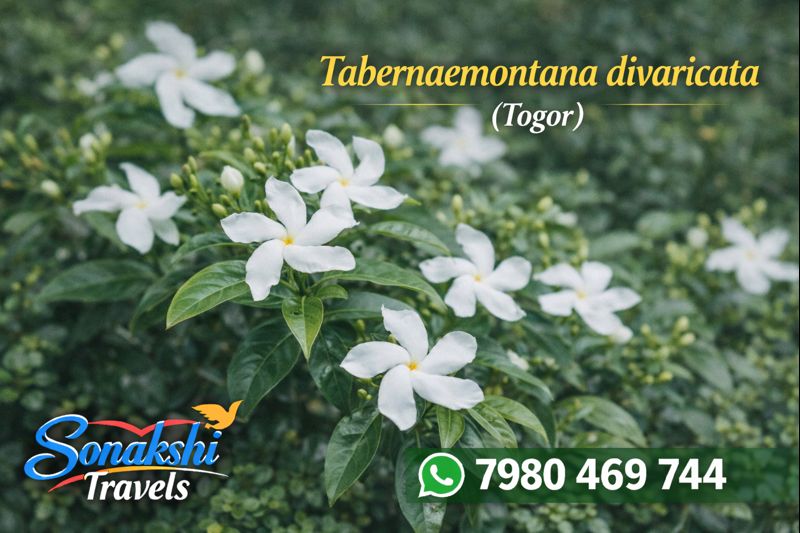
Tabernaemontana divaricata, widely known in Bengal and eastern India as Togor, is a graceful evergreen shrub admired for its pristine white, pinwheel-shaped flowers and gentle fragrance. Belonging to the dogbane family, this species holds a unique position at the intersection of ornamental horticulture, traditional knowledge systems, and tropical ecology. While Togor is commonly cultivated in gardens and temple courtyards, it also thrives in semi-wild conditions, adapting efficiently to warm, humid climates.
Beyond its aesthetic appeal, Tabernaemontana divaricata plays a subtle yet meaningful ecological role in tropical landscapes. Its flowers attract pollinators, its dense foliage provides shelter for small fauna, and its hardy nature allows it to persist across a wide range of environmental conditions. In regions surrounding the Sundarbans, Togor is frequently encountered in village homesteads and forest-edge habitats, reflecting both cultural preference and ecological adaptability. This article presents a detailed, research-based exploration of the species, covering taxonomy, morphology, habitat preferences, distribution, ecological role, and conservation considerations.
Taxonomy & Classification
Systematic Placement
Tabernaemontana divaricata belongs to the family Apocynaceae, a diverse group of plants known for their milky latex, ornamental flowers, and complex secondary compounds. Members of this family range from shrubs and trees to climbers and herbs, many of which are adapted to tropical and subtropical regions.
The genus name Tabernaemontana honors Jacob Theodor von Bergzabern (Tabernaemontanus), a Renaissance botanist, while the species epithet divaricata refers to the plant’s spreading branch pattern.
Morphology & Field Identification
Growth Habit and Structure
Tabernaemontana divaricata is an evergreen shrub or small tree, typically reaching heights of 2–4 meters. The plant exhibits a rounded to slightly spreading form, with numerous branches creating a dense canopy of glossy foliage.
Stem and Bark
The stems are smooth and greyish-brown, exuding a milky latex when cut or injured. Young branches are green and flexible, gradually becoming woody as they mature.
Leaf Characteristics
Leaves are opposite, simple, and elliptic to oblong in shape, measuring 10–20 cm in length. The leaf surface is glossy dark green with a prominent midrib and smooth margins. The leathery texture helps reduce water loss in warm climates.
Flowers and Inflorescence
The flowers are the most striking feature of Togor. They are white, waxy, and typically arranged singly or in small clusters at the ends of branches. Each flower has five twisted petals forming a pinwheel-like structure. Blooming may occur throughout the year, with peak flowering during warmer months.
Fruits and Seeds
The fruit consists of paired follicles that turn orange to reddish upon maturity. Each follicle contains several seeds embedded in a soft pulp, which may attract birds and other small animals.
Habitat & Distribution
Natural Habitat
Tabernaemontana divaricata thrives in tropical and subtropical environments, preferring warm temperatures and moderate to high humidity. It grows well in open woodlands, forest margins, village groves, and cultivated landscapes.
Altitude Range
The species is primarily a lowland plant, occurring from sea level up to approximately 1,000 meters, where frost-free conditions prevail.
Global Range
Geographical Distribution
Tabernaemontana divaricata is native to South Asia and Southeast Asia. Due to its ornamental popularity, it has been widely cultivated and naturalized in tropical regions across Africa, the Americas, and the Pacific islands.
Distribution in the Indian Subcontinent
In India, Togor is commonly found across eastern, southern, and northeastern states, including West Bengal, Assam, Odisha, Kerala, Tamil Nadu, and Tripura.
Preferred Habitat
Soil Requirements
The plant prefers well-drained loamy soils rich in organic matter. However, it shows considerable tolerance to varied soil types, including sandy and slightly clayey substrates.
Light and Moisture
Partial shade to full sunlight supports healthy growth and abundant flowering. Regular moisture enhances vigor, although mature plants can withstand short dry periods.
Occurrence
Seasonal Behavior
As an evergreen species, Tabernaemontana divaricata maintains foliage year-round. Flowering may occur intermittently throughout the year, with increased intensity during warmer seasons.
Preferred Habitat in the Sundarbans Region
Local Distribution
In the Sundarbans region, Togor is primarily found in village homesteads, temple grounds, embankments, and forest-edge settlements. It does not occur in core mangrove forests but thrives in freshwater-influenced buffer zones with reduced salinity.
Adaptation to Deltaic Conditions
The species tolerates high humidity, saline air, and seasonal water fluctuations, making it well suited to the Sundarbans’ peripheral landscapes.
Observing flowering shrubs around villages and forest edges adds cultural depth to a guided Sundarban Tour,
where nature and tradition coexist.
Ecological Role
Pollinator Support
The fragrant white flowers attract a variety of pollinators, including butterflies, bees, and moths, contributing to local pollination networks.
Habitat Contribution
Dense foliage provides shelter for small birds and insects, enhancing microhabitat diversity in cultivated and semi-natural landscapes.
Habitat Alteration
Human Influence
Urban expansion, replacement with exotic ornamentals, and loss of green spaces may reduce semi-wild populations. However, cultivation remains widespread.
Environmental Resilience
The species demonstrates resilience to pruning, variable rainfall, and moderate environmental stress.
Conservation Efforts
Conservation Status
Tabernaemontana divaricata is not considered threatened due to its wide cultivation and adaptability.
Sustainable Landscaping
Encouraging the use of native and culturally significant shrubs like Togor in landscaping supports biodiversity and heritage conservation.
Experiencing fragrant garden plants and rural greenery enriches any immersive Sundarban Tour, revealing the softer side of the delta.
Did You Know?
Pinwheel Flower Structure
The twisted petals of Togor flowers create a pinwheel-like appearance, making them easily recognizable among tropical ornamentals.
Milky Latex
Like many members of the Apocynaceae family, the plant produces a milky latex that serves as a natural defense against herbivores.
External Reference
For further botanical details and historical context, consult the Wikipedia page on Tabernaemontana divaricata.