Updated: 27 February 2026
The Deeper You Drift into the Delta, the More the Outside World Dissolves into Mangrove Reflections and Bird Calls
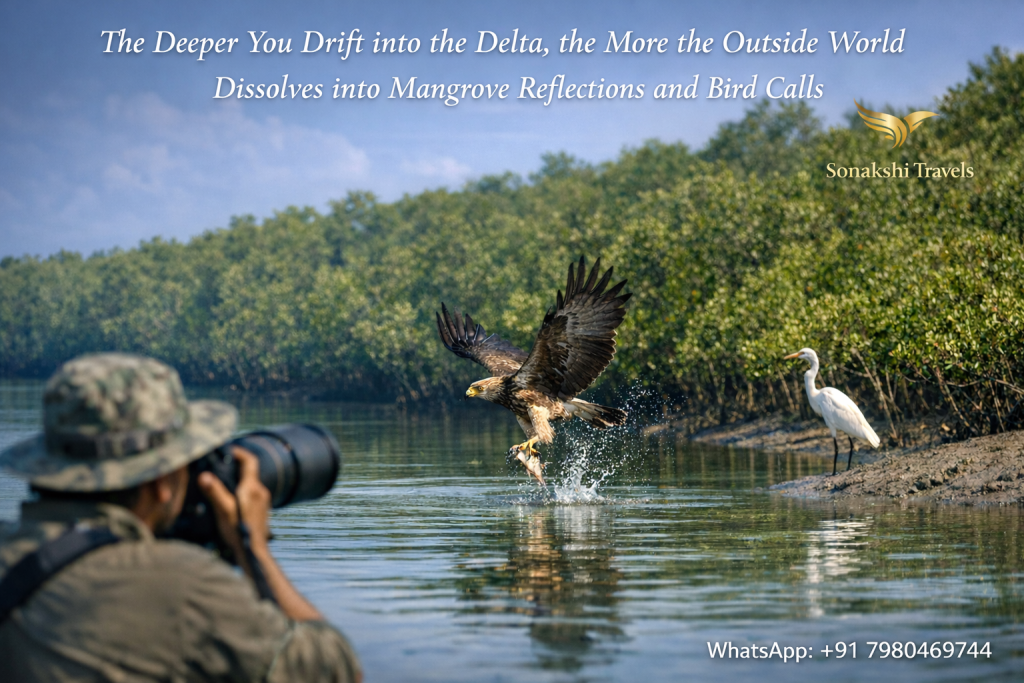
There are environments that impose themselves upon the visitor through spectacle. They demand attention through vertical scale, engineered symmetry, or cultural noise. The deltaic expanse of the Sundarbans works differently. It does not overwhelm through magnitude; it absorbs through gradual immersion. The process is quiet and cumulative. Concrete edges recede, engine sounds soften, and the built world’s straight lines loosen into tidal curves. For broader ecological context and grounded regional reading, many travelers begin with the reference framework available on SundarbanTravel.com, where the delta is approached as an ecosystem before it is treated as a destination.
Drifting deeper into this landscape is not simply physical movement across estuarine channels. It is a transition from externally structured time toward ecologically structured time. The outside world—defined by deadlines, digital interruptions, and linear scheduling—loses its dominance. In its place emerges a system governed by tide cycles, salinity gradients, and the behavioral rhythms of species that have evolved to read currents rather than clocks. The transformation is gradual yet decisive. One does not “arrive” at silence; one acclimatizes to it.
This article examines that dissolution in depth. It traces how hydrology shapes perception, how mangrove morphology influences spatial awareness, how acoustic ecology restructures cognition, and how human presence at the forest’s edge negotiates uncertainty. The deeper one drifts, the clearer it becomes that the delta does not erase the outside world violently; it renders it secondary through ecological coherence.
Hydrological Architecture: Water as the Primary Medium
The defining characteristic of the delta is not forest cover but water movement. The Sundarbans form part of one of the most extensive deltaic systems on Earth, shaped by sediment carried over millennia by major river networks before meeting the Bay of Bengal. This continuous deposition produces a shifting mosaic of mudflats, islands, tidal creeks, and estuarine channels. Stability, in this context, is provisional. What appears fixed in a satellite image may be reconfigured by erosion, accretion, or surge within a generation.
Hydrology determines orientation. There are no conventional roads within the forest interior. Navigation follows channels that widen and narrow according to sediment flow and tidal volume. Twice daily, saline water penetrates inland, then withdraws. This oscillation regulates oxygen levels in soil, redistributes nutrients, and influences the feeding patterns of aquatic organisms. For readers who want a strictly field-based overview of how waterways shape movement and perception inside the forest, the foundational notes on a delta-focused Sundarban tour offer helpful ecological framing without reducing the place to a checklist.
Tidal Time Versus Mechanical Time
In urban contexts, time is segmented into hours, minutes, and appointments. Within the delta, time is calibrated to tidal windows. Access to certain creeks depends on water height. Mudflats emerge and vanish. Animal movement correlates with exposure of foraging grounds. Human activity at the forest margins—fishing, crab collection, honey gathering—aligns with these predictable yet dynamic cycles.
For the visitor, this realignment can be disorienting. Waiting for water levels to shift is not a delay but a structural necessity. Gradually, impatience yields to observation. Light changes across reflective surfaces. The density of plankton-rich water alters tone and clarity. The mind, accustomed to artificial acceleration, begins to synchronize with natural cadence. In that synchronization, the outside world’s urgency fades without confrontation.
Mangrove Morphology and the Psychology of Confinement
Mangrove forests differ from terrestrial forests in both structure and sensory experience. Trees such as Heritiera fomes (commonly associated with the region’s name), along with Avicennia, Rhizophora, and Sonneratia species, possess specialized root systems adapted to saline, waterlogged substrates. Pneumatophores rise vertically from mud to facilitate gas exchange. Stilt roots anchor trunks against tidal flow. These adaptations produce a dense, interlocking architecture that limits horizontal visibility.
Unlike open savannahs or alpine landscapes where distance is perceptible, the mangrove environment compresses perspective. Vision rarely extends far beyond the immediate channel. This spatial compression alters psychological orientation. When horizons contract, attention shifts from distant anticipation to immediate detail—ripples against root structures, subtle bird movement between branches, changes in water texture indicating submerged life.
Filtered Light and Sensory Intensification
The canopy filters sunlight into fragmented patterns. Reflections multiply across brackish surfaces, producing mirrored layers of root and sky. In such an environment, contrast sharpens perception. Sound travels differently through humid air and dense vegetation. Even small disturbances—an oar dipping, a fish surfacing—acquire amplified significance.
Neuroscientific research on attention restoration often distinguishes between environments that demand directed attention and those that invite “soft fascination,” where awareness is held gently rather than forced. Mangrove interiors frequently produce that effect: the mind is engaged by pattern, rhythm, and variation, yet it is not pushed toward constant evaluation. For travelers who prefer a quieter, low-interruption field setting—where immersion is protected by controlled human presence—observations commonly align with what is described in a private Sundarban tour, where fewer competing stimuli can allow the sensory environment to do its work.
Acoustic Ecology: The Delta as a Living Sound Map
Sound in the delta operates as a primary orienting mechanism. In the absence of urban noise, subtle acoustic cues become legible. Dawn often begins with layered bird calls—territorial announcements, mate communication, group coordination. Midday may quieten, punctuated by intermittent wing beats or the splash of feeding fish. Evening reintroduces complexity as diurnal and nocturnal species overlap during transitional activity.
Acoustic ecologists describe such environments as biophonically rich: species-specific frequencies create patterns that repeat and shift with habitat type. For experienced listeners, variations in call density or abrupt silence may indicate disturbance beyond visible range. Sound functions as both expression and information system.
Listening as Cognitive Reorientation
Urban soundscapes are dominated by anthropogenic noise—engines, machinery, electronic signals. These sounds often require the brain to filter, suppress, and protect attention. In contrast, deltaic sounds are functionally embedded within survival processes. Listening becomes interpretive rather than defensive. The mind shifts from noise management to contextual decoding.
This reorientation fosters presence. Without continuous digital interruption, auditory attention stabilizes. The layered calls of kingfishers, herons, and drongos form a textured field rather than isolated events. Over time, the visitor’s internal tempo aligns with these cycles. Silence is no longer absence but expectation.
Wildlife Presence and the Ethics of Distance
The delta sustains complex food webs anchored in tidal productivity. Nutrient influx from river discharge supports plankton blooms, which in turn sustain fish populations. These fish feed birds, reptiles, and mammals. Spotted deer navigate forest edges. Wild boar forage in exposed flats. Estuarine crocodiles patrol creeks. Apex predators influence the behavior of subordinate species even when they remain unseen.
Encounters are frequently indirect. Tracks impressed in wet sediment reveal nocturnal passage. Alarm calls from birds signal disturbance beyond visible range. Such indirect evidence reinforces awareness that observation is partial. The forest retains agency, and the visitor’s role is necessarily restrained.
Icon and Ecosystem
While the tiger occupies symbolic prominence, ecological integrity depends upon interactions across trophic levels. Predator presence regulates herbivore distribution, which influences vegetation regeneration. Mangrove stability supports fish nurseries that sustain avian populations. The dissolution of the outside world is partly rooted in this systemic coherence: there is little ornamental excess, and the environment does not perform for human attention.
Recognizing this interdependence tempers expectation. The delta is not arranged for spectacle, and wildlife does not appear on demand. Immersion requires patience and respect for distance. Ethical presence becomes essential to sustaining the very processes that allow the soundscape and reflections to remain undisturbed.
Human Communities at the Threshold
Beyond the forest’s protected core lie inhabited islands and embanked settlements. Residents live within negotiated boundaries shaped by erosion, salinity, and storm exposure. Livelihood activities depend upon intimate knowledge of tidal behavior and changes in resource availability. This coexistence with uncertainty informs cultural expression and everyday discipline.
Ritual practices often acknowledge forces beyond human control. Protective symbols carried on boats reflect recognition of environmental volatility. These practices are not decorative additions; they are pragmatic languages of risk management. The human relationship with the delta is defined less by domination than by adaptation.
Shared Vulnerability
In this environment, vulnerability is distributed. Embankments require maintenance. Crops respond to salinity fluctuations. Wildlife movements intersect with human pathways. Awareness of shared exposure fosters a worldview that values balance. For the visitor, witnessing this negotiation reinforces humility. The outside world’s illusion of insulation weakens when confronted with tidal inevitability.
Reflections as Metaphor and Mechanism
Water surfaces within the delta frequently mirror the canopy with striking clarity. Roots appear suspended in inverted symmetry. Sky and foliage interlace. These reflections are not merely aesthetic phenomena; they reveal structural reciprocity. Land depends upon water for formation. Water depends upon sediment for channel definition. Each shapes the other continuously.
Psychologically, reflection operates with similar force. As visual symmetry stabilizes attention, internal dialogue quiets. The act of observing mirrored roots or drifting leaves can become meditative without deliberate technique. Cognitive load decreases. The outside world—structured by abstraction—recedes before tangible immediacy.
Uncertainty as Constant Condition
The delta is shaped by forces that resist predictability. Shorelines shift. Channels silt and reopen. Salinity gradients fluctuate across short distances. Such instability is not an anomaly but a baseline condition. Species survival depends upon flexibility across seasons, tides, and habitat edges.
For individuals accustomed to engineered predictability, immersion within this uncertainty can be transformative. It challenges assumptions of permanence. Structures appear provisional. Boundaries are negotiated, not guaranteed. Yet life persists through adaptation, and observing that persistence reframes personal ideas about control and fragility.
Adaptation as Principle
Mangroves filter salt through specialized mechanisms. Aquatic species tolerate brackish gradients. Human communities elevate homes and reinforce embankments. Adaptation is iterative, not final. Recognizing this pattern situates the visitor within a continuum rather than outside it. For those who want a structured overview of how responsible field movement is organized without turning the experience into a consumer checklist, the planning context inside well-structured Sundarban tour package can clarify how logistics may support ecological sensitivity.
Immersion and Cognitive Afterimage
Departure from the delta often reintroduces noise incrementally—engine hum, roadway vibration, signal reception. Yet internal tempo remains altered. Memory of filtered light and layered bird calls persists as a cognitive afterimage. Research in environmental psychology has repeatedly associated immersive natural settings with reductions in stress markers and improvements in sustained attention, particularly when the environment encourages gentle, continuous engagement rather than rapid novelty.
The delta’s impact lingers because it restructures sensory hierarchy. Vision yields to listening. Speed yields to tide. Control yields to adaptation. Even after re-entry into structured environments, fragments of that recalibration remain accessible through memory, altering how later noise and urgency are perceived.
Conclusion: Dissolution as Reorientation
To drift deeper into the delta is to participate in a gradual unlearning. The outside world does not vanish; it loses primacy. Mangrove reflections replace architectural lines. Bird calls substitute mechanical rhythm. Tidal cycles override mechanical segmentation of time. Hydrological architecture reshapes spatial awareness. Acoustic ecology recalibrates attention. Ecological interdependence reframes human centrality.
The Sundarbans reveal a mode of existence governed by reciprocity and adaptation rather than permanence and acceleration. Immersion within this system does not provide spectacle-driven revelation. It offers something quieter and more durable: reorientation. When the delta’s reflections and calls have dissolved the noise of elsewhere, what remains is presence—alert, attentive, and aware of continuity beyond individual schedules.
Long after leaving the waterways, this reorientation endures. The outside world resumes its volume, yet the memory of tidal rhythm and filtered light persists as counterpoint. For readers who prefer to experience that transition in a tightly bounded time window—so the sensory arc remains intact from entry to exit—some refer to the 1 night and 2 days Sundarban plan as a practical format for preserving immersion without dispersing attention across too many external obligations.