Updated: March 14, 2026
The first bite of hilsa on a boat in the Sundarbans
—it tasted like monsoon and memory
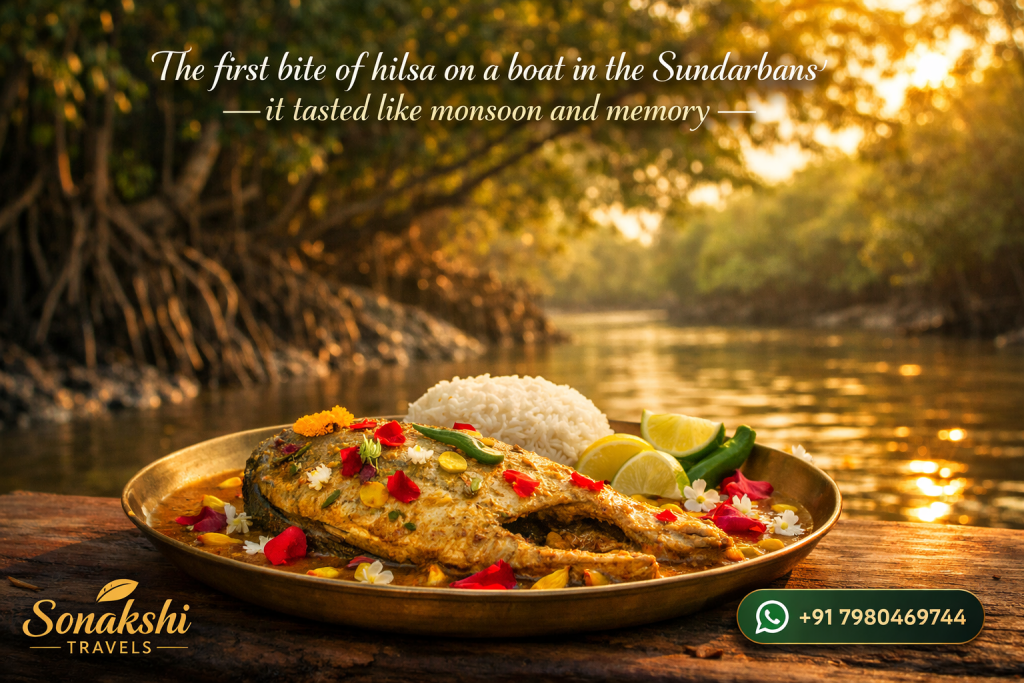
There are meals that satisfy hunger, and there are meals that seem to open a chamber of recognition somewhere deeper than appetite. The first bite of hilsa eaten on a moving boat in the Sundarbans belongs to the second kind. It does not arrive as a mere dish served in a scenic setting. It arrives as an encounter between landscape and taste, between the tidal world outside and the inward archive of memory that food can awaken without warning. On that boat, with the river carrying a soft grey light and the mangroves standing at a respectful distance, the fish did not feel separate from the place. It seemed to have absorbed the very grammar of the delta before reaching the plate.
That is why the experience resists simple description. One can say the hilsa was tender, fragrant, oily in the graceful way only hilsa can be, and bright with mustard or green chilli or a trace of turmeric depending on the preparation. All that may be true. Yet those details, though necessary, are still incomplete. The first bite becomes unforgettable because it is taken within a landscape where water is never still in spirit, where mud carries the record of retreating tides, and where every living thing seems shaped by rhythm rather than permanence. In such a setting, taste becomes environmental. Flavor is no longer confined to the mouth. It expands into air, sound, motion, humidity, and memory.
Even in a carefully arranged Sundarban private tour, where the boat is quiet and the meal is served with thoughtfulness, hilsa does not lose its essential intimacy. In fact, privacy sharpens the experience. Without crowd noise or interruption, one notices the small things: the sheen of oil on the fish catching ambient light, the faint movement of curry in the plate as the boat shifts, the sudden union of warm rice and river air, the way a distant bird call seems to enter the moment of eating itself. Food in such circumstances becomes more than hospitality. It becomes perception.
Why hilsa belongs to this landscape
Hilsa carries an emotional authority in Bengal that very few foods possess. It is not merely admired for taste. It is treasured because it moves through culture as memory, season, family history, migration, longing, and return. In the Sundarbans, that authority becomes even more meaningful. The great delta is a region where water is destiny. Salinity, current, silt, tide, and river mouth all shape life at a fundamental level. Hilsa, a migratory fish known for moving between marine and riverine worlds, seems almost symbolically fitted to such a place. It is a creature of passage, and the Sundarbans is a geography of passage.
For this reason, the first bite of hilsa on a boat feels less like consuming an ingredient and more like participating in a long ecological conversation. The fish represents estuarine complexity. The mangroves represent adaptation. The tidal river represents motion without theatrical display. When these meet on a plate, one senses why the meal carries more meaning here than it would in a dining room far from the water. The boat is not incidental. It is the proper threshold between food and setting. It keeps the eater inside the same living system from which the emotional power of the fish arises.
That is one reason the culinary atmosphere associated with the Sundarban hilsa festival has such resonance. The celebration is not powerful merely because hilsa is served. It is powerful because the fish is encountered in a delta where water, memory, and livelihood have always been interwoven. The experience acquires dignity from location. The palate understands this before the intellect fully explains it.
The boat as a dining room of movement
A meal eaten on land usually asks the body to become still. A meal eaten on a boat asks the body to negotiate subtle motion. This difference matters. The first bite of hilsa in the Sundarbans is shaped not only by flavor but by physical instability so slight that it feels almost ceremonial. The plate is held with a little more care. The hand becomes marginally slower. The senses remain more alert. Even the act of lifting food carries an awareness of movement underneath. This changes the psychology of eating.
On a boat, one does not dominate the setting. One participates in it. The river continues its own work. The current does not pause for lunch. The mangrove edge remains indifferent yet watchful. Light changes quietly on the water. The body, meanwhile, learns to eat inside a moving world. That humility influences taste. Hilsa, with its soft flakes and delicate bones, already demands attention. On a boat, that demand becomes part of a larger discipline of care. One eats more slowly, more respectfully, and with a stronger sense that the moment cannot be separated from its environment.
In a thoughtfully arranged Sundarban luxury tour, this quality becomes especially pronounced. Comfort may refine the setting, but refinement does not weaken the elemental truth of the experience. Linen, polished service, and quiet seating do not remove the river from the meal. They only clear distractions away from it. The true luxury lies not in excess, but in being able to pay complete attention to the union of fish, tide, scent, and silence.
The taste of monsoon in the mouth
To say that the first bite tasted like monsoon is not to make a decorative comparison. It is to describe the layered sensation that hilsa can produce in the delta. Monsoon is not a single flavor. It is density, moisture, return, fertility, suspended light, river fullness, and the strange emotional softness that rain-bearing air introduces into thought. Hilsa, especially when prepared with mustard, green chilli, and minimal interference, has a way of carrying that same density. It feels saturated rather than sharp. It is rich, but not dull. It is intense, but never crude. The oil lingers like weather does—slowly, envelopingly, almost atmospherically.
On the boat, the association strengthens. The river itself seems to contribute a background note. Humid air makes aroma feel rounder. Steam rising from rice meets the breathing surface of the water. The scent of cooked hilsa mingles with estuarine air in a way that indoor dining can never imitate. What results is not confusion, but completion. The fish tastes more like itself because the world around it speaks the same language.
That is why the meal can feel inseparable from a deeper Sundarban travel memory. Even those who arrive with no personal childhood connection to hilsa often feel that they are remembering something older than a specific event. The taste suggests inherited feeling. It calls up kitchens, family tables, wet afternoons, newspaper-wrapped fish from local markets, patient deboning, mustard paste on the fingers, and the emotional seriousness with which Bengal treats a meal of ilish. In the Sundarbans, these associations become amplified by place.
Why memory awakens so quickly
Food scholars and psychologists have long observed that smell and taste can trigger memory with remarkable force. This is partly because olfactory pathways are deeply connected with regions of the brain involved in emotion and recollection. But scientific explanation alone does not exhaust the matter. Some foods trigger memory more powerfully because culture has already placed memory inside them. Hilsa is one of those foods. It is not only biochemically evocative. It is socially and historically loaded. It arrives already carrying stories.
In Bengal, hilsa is associated with domestic affection, ritual exchange, monsoon longing, literary reference, and the dignity of simple but serious cooking. Therefore the first bite on a Sundarbans boat does not emerge into an empty mind. It lands in a consciousness already prepared—by family, language, seasonal imagination, and collective memory—to treat hilsa as more than nutrition. The setting intensifies that preparedness. The boat feels provisional, the river ancient, the fish intimate. The result is emotional acceleration. One bite can collapse years.
This is also why the atmosphere often associated with Sundarban ilish utsav 2026 or similar culinary celebrations is remembered so vividly. The food does not act alone. It is supported by soundscape, river movement, shared expectation, and the quiet ceremonial value of eating a culturally beloved fish in the heart of a tidal ecosystem. Memory forms more rapidly when multiple senses agree that a moment matters.
The texture of hilsa and the ethics of attention
Hilsa is not a careless fish. It asks the eater to slow down. Its bones are fine and numerous; its flesh is delicate; its oil is generous but not forgiving of haste. In this sense, hilsa creates a discipline of attention that fits the Sundarbans unusually well. The delta also punishes haste of perception. It reveals itself through patience. Distances deceive. Movement is often subtle. Sound matters. Surfaces conceal. The first bite of hilsa on a boat therefore feels appropriate not only because the fish belongs to Bengal, but because its method of eating resembles the method by which one must encounter this landscape.
To eat hilsa properly is to respect detail. To move through the Sundarbans properly is also to respect detail. Both require one to stop imposing speed on experience. One begins to understand that delicacy is not weakness. It is a mode of truth. The fish flakes under the fingers with soft authority. The river glides without spectacle. The mangrove roots hold ground through complexity rather than force. The meal and the landscape seem to educate perception in the same direction.
Within a refined Sundarban luxury private tour, this shared discipline becomes even clearer. One notices not only the taste of the fish but the silence around the act of tasting. Conversation drops naturally for a few moments. People instinctively become inward. The meal creates a respectful pause. Such pauses are rare in ordinary tourism, but they are central to the deeper emotional meaning of the Sundarbans.
The river outside and the river inside the dish
There is something almost philosophical about eating hilsa while floating through a tidal channel. The fish on the plate and the river outside are not identical realities, yet they mirror one another. Both speak of transition. Both resist fixed boundaries. Both are shaped by unseen movement. Even the flavor of hilsa seems migratory—marine richness softened by freshwater delicacy. The dish becomes a small edible version of delta logic.
Looking out from the boat after the first bite, one becomes aware that the meal does not end at the rim of the plate. The eye returns to the water with altered sensitivity. The river no longer appears as scenic background. It begins to feel present in the body. The taste has translated environment into sensation. That is a rare achievement. Most travel meals accompany a journey. This one interprets it.
In that sense, the experience belongs to the most meaningful kind of Sundarban tour or Sundarban tour package not because it is elaborate, but because it allows place and food to illuminate one another without noise. The river outside explains the dish. The dish explains the river. The traveler stands, or rather sits, in the middle of that conversation.
Silence, companionship, and shared recognition
Not all memorable food experiences depend on speech. In fact, some of the finest are marked by a momentary reduction of language. The first bite of hilsa on a Sundarbans boat often produces exactly that. People do not immediately search for clever remarks. They look down at the plate, then outward at the river, and something in their expression changes. The silence is not emptiness. It is recognition.
This matters whether one is alone, with family, or in a carefully arranged Sundarban private tour package. Shared meals usually create social energy, but hilsa in this setting can create shared inwardness instead. Each person tastes according to private memory, yet the environment gives those private reactions a collective frame. One senses that others, too, are meeting something beyond flavor. A quiet emotional agreement forms without much need for explanation.
That may be one reason why the memory lasts. Human beings tend to remember moments that feel both intimate and shared. A hilsa meal on a boat in the Sundarbans satisfies both conditions. It touches personal memory while taking place in a landscape large enough to hold collective significance.
Why the moment stays after the meal is over
Long after the plate is cleared, the first bite remains strangely available to memory. It returns not merely as taste but as a complete sensory event: a muted sky, a table on deck, the tremor of the boat, the moist air, the faint metallic brightness of river light, the fragrance rising from the fish, and the calm seriousness with which everyone seemed to eat. Such memories remain vivid because they are spatially anchored. The mind can place them exactly.
They also remain because the experience resolves a deep cultural intuition. Hilsa has always seemed to belong to Bengal not only as cuisine, but as feeling. The Sundarbans, meanwhile, often appears in imagination as one of Bengal’s most concentrated expressions of water, vulnerability, fertility, patience, and mystery. When hilsa is tasted there, these two emotional worlds meet. The fish becomes more than emblem. It becomes confirmation.
For this reason, the meal is not reducible to culinary pleasure. It becomes a form of understanding. One begins to grasp, with unusual clarity, why certain foods can carry geography inside them. One also understands why a river meal in the delta can feel more truthful than a more sophisticated meal elsewhere. Truth, in this case, lies in correspondence between flavor and world.
A taste that explains the delta
In the end, the first bite of hilsa on a boat in the Sundarbans is memorable because it compresses an entire philosophy of place into a single human act. One sits between land and water, stability and movement, appetite and remembrance. The fish offers richness, but also fragility. The boat offers shelter, but also exposure. The river offers beauty, but in a language of restraint. The mind receives all of this at once, often before it knows how to name it.
That is why the taste feels like monsoon and memory. Monsoon is the season in which Bengal rediscovers its own softness and depth. Memory is the inward weather through which identity returns. Hilsa, eaten on the river in the Sundarbans, binds the two together with astonishing ease. It is not simply delicious. It is interpretive. It tells the eater something essential about the delta: that meaning here does not arrive through spectacle, but through saturation; not through noise, but through atmosphere; not through excess, but through the quiet fullness of things that belong exactly where they are.
Anyone who has taken that first bite in such a place understands that the experience cannot be replaced by description alone. It must be lived at the pace of the river and received with the humility that both hilsa and the Sundarbans demand. Only then does the meal become what it truly is: not lunch on a boat, but a moment in which taste, landscape, and memory enter into perfect accord.