Updated : 27 February 2026
Discover the Sundarbans Wildlife Tour: A Field Guide to Mangrove Life
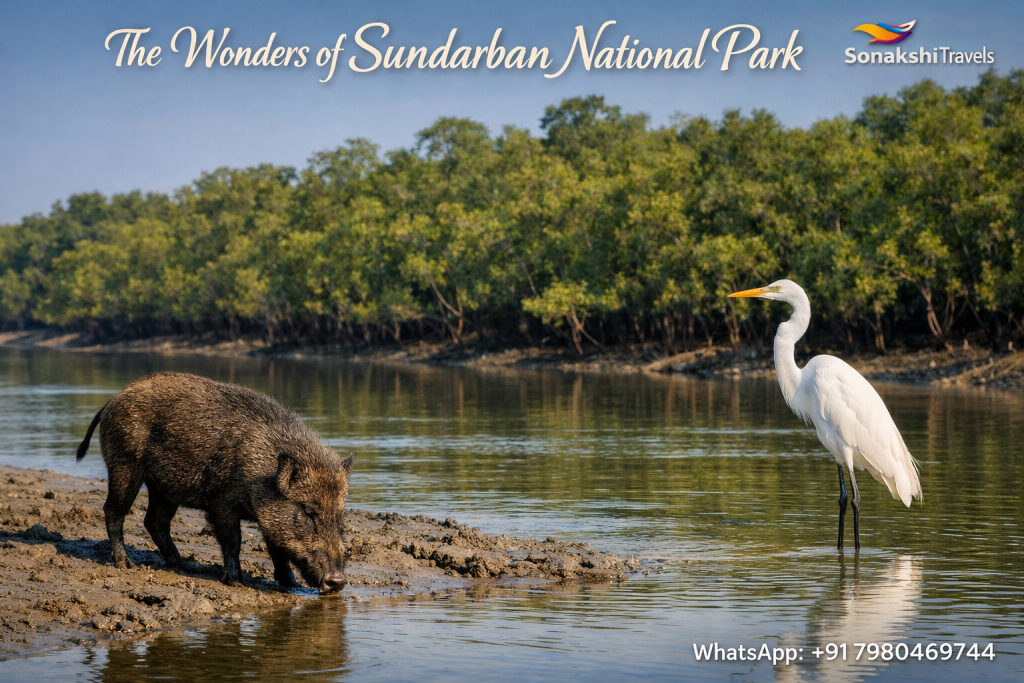
The Sundarbans wildlife tour is not a generic nature outing. It is a close-range ecological reading of a tidal mangrove system where every animal—tiger, crocodile, bird, dolphin, deer—operates under constraints that are uncommon in terrestrial protected areas. For a grounded, reference-based overview of the region’s regulated ecology and travel framework, the resource base at Sundarban Travel provides useful context. Salinity, shifting channels, mud dynamics, and limited freshwater are not background details; they are shaping forces that determine how bodies move, hunt, rest, breed, and survive.
Wildlife viewing in the Sundarbans therefore depends on a different kind of attention. The forest rarely offers open, continuous visibility. Instead, it presents brief windows: a ripple beside a reed line, a set of tracks dissolving into wet clay, a bird’s alarm call that changes the mood of an entire creek. A wildlife-focused tour becomes valuable when it helps a visitor interpret these signs without overstating certainty. This article deepens the original theme by examining the region’s key faunal groups through function—what each species does in the mangrove ecosystem, how the mangrove environment reshapes its behaviour, and why the Sundarbans remains one of South Asia’s most complex wildlife arenas.
The Mangrove Ecosystem as a Wildlife Engine
In many forests, wildlife ecology is primarily structured by vegetation zones and elevation. In the Sundarbans, the primary structuring force is water—its salinity, its rhythm, and its ability to erase evidence. Twice-daily tides flood and withdraw through creeks and rivers, relocating nutrients, fish, and crustaceans, while also forcing terrestrial mammals to negotiate unstable ground. The mangroves themselves are not passive scenery. Their root structures create sheltered nurseries for fish and prawns, their leaf litter becomes detritus that feeds invertebrates, and their brackish margins become hunting lines for reptiles and birds.
This is why the wildlife list of the Sundarbans is best understood as an interconnected food network rather than a set of isolated “attractions.” Dolphins depend on fish abundance in channels and confluences; fish abundance is supported by mangrove productivity and sediment chemistry; crocodiles occupy the same brackish corridors where fish concentrate; and birds track these movements with precision, shifting feeding behaviour with tide height. Even the tiger—often framed as purely terrestrial—feeds within this same web, using river edges, mudflats, and creek junctions as tactical zones for ambush.
A wildlife tour gains depth when it interprets the ecosystem as an engine: mangroves generate productivity; tides distribute it; and animals position themselves to capture it. Visitors who want the broader ecological framing before focusing on species-level detail often begin with the central overview of the Sundarban tour experience, then return to wildlife interpretation with clearer mental models.
Royal Bengal Tigers: Predation in a Brackish Labyrinth
The Royal Bengal Tiger (Panthera tigris tigris) of the Sundarbans is not simply a tiger living near water; it is a tiger shaped by water. The mangrove landscape compresses movement into corridors. Forest islands, creeks, and channels break continuous territory into fragments, and the tiger’s daily decisions are influenced by where it can cross, where it can rest, and where it can ambush without being detected.
Swimming as Ecology, Not Exception
In many tiger reserves, swimming is observed as an occasional behaviour. In the Sundarbans, it is an operational requirement. Tigers routinely cross channels to patrol territory, reach prey-rich islands, or avoid human activity. This repeated exposure to brackish water and shifting currents contributes to a behavioural profile that can appear unusually aquatic. A wildlife tour that focuses on tigers should therefore pay attention to “water logic”: narrow crossings, gentle bends, shallow edges, and sheltered creek mouths where a tiger can enter and exit with minimal effort.
The environment also influences how evidence is left behind. Tracks can be sharply printed on certain mud textures yet vanish minutes later under tidal wash. This creates a field challenge: tiger presence is real, but its signatures are temporary. Skilled interpretation relies on reading directionality, depth, and freshness, while recognising that the landscape actively erases proof.
Territory, Prey, and the Mangrove Constraint
Tiger territories in the Sundarbans extend across complex mosaics of forest blocks and waterways. Because visibility is limited and movement pathways are constrained, tigers rely on familiarity with micro-terrain—high ground patches, root platforms, and shaded creek edges that allow resting without prolonged exposure. Prey selection is likewise shaped by the delta. Deer and wild boar remain important, but coastal and creek-edge opportunities can introduce additional feeding patterns, including scavenging and opportunistic capture of smaller animals where they are abundant.
This does not make the Sundarbans tiger “less tiger.” It remains an apex predator. Yet its dominance is expressed through stealth, patience, and route knowledge rather than long pursuits in open terrain. For visitors, this means tiger sightings are never guaranteed; the ecological value lies as much in understanding the predator’s operating environment as in seeing the animal directly.
Risk Boundaries and Human–Tiger Interface
The Sundarbans is one of the few landscapes where tiger territory and human livelihood zones exist in close proximity along riverbanks. This interface influences tiger movement near settlement edges, especially where prey distribution, forest cover, and river routes create inadvertent pathways. A responsible wildlife interpretation does not sensationalise conflict. Instead, it frames conflict as an outcome of overlapping spatial needs: humans depend on water and forest access; tigers depend on the same corridors for movement and hunting. Conservation strategies increasingly focus on early-warning systems, rapid response, and non-lethal deterrence, aiming to protect both people and the tiger population without transforming the ecosystem into a fortress.
Saltwater Crocodiles: The Dominant Reptiles of the Channels
The Saltwater Crocodile (Crocodylus porosus) is the Sundarbans’ most visibly formidable reptile, and its presence is not incidental. Brackish channels, mud banks, and creek junctions create ideal conditions for an ambush predator that can remain motionless for long periods, conserving energy while waiting for prey to enter strike range.
Ambush Architecture: Where Crocodiles Choose to Be
Crocodiles are not randomly distributed across the waterways. They are often associated with specific microhabitats: gentle bends where currents slow, banks where basking is possible, and shallow margins where fish and birds congregate. These are not merely comfortable locations; they are strategic. A crocodile’s hunting advantage increases where prey must pass through narrowed channels or feed along predictable edges.
From a wildlife-tour perspective, crocodile observation becomes meaningful when tied to this architecture. The visitor learns to recognise the subtle cues: the low, angled head profile near a bank; the stillness that contrasts with rippled water; the preference for certain basking slopes that retain warmth. This turns a sighting into a behavioural lesson rather than a momentary photograph.
Role in the Food Web
Crocodiles influence the broader ecosystem by shaping prey behaviour and scavenging dynamics. As apex aquatic predators, they can reduce local concentrations of certain prey species and affect where birds choose to feed. They also function as scavengers, removing carcasses that might otherwise disrupt water quality in enclosed creeks. In a tidal delta where organic accumulation can quickly alter microhabitats, scavenging is not a minor role; it contributes to system stability.
Avian Diversity: Birds as Indicators of Tides and Habitat Health
The Sundarbans supports a rich bird community that includes resident mangrove specialists, estuarine hunters, and migratory visitors. Bird diversity here is not just a checklist for enthusiasts; it is a diagnostic tool. Birds respond rapidly to changes in fish availability, mudflat exposure, water clarity, and human disturbance. Because they occupy multiple levels of the food web, their behaviour often reveals what is happening beneath the surface.
Functional Guilds: Who Feeds Where
Kingfishers—including the Black-Capped Kingfisher (Halcyon pileata) and Brown-Winged Kingfisher (Pelargopsis amauroptera)—tend to occupy creek edges and mangrove branches with clear lines of sight to shallow water. Their presence often signals fish activity close to the surface.
- Black-Capped Kingfisher (Halcyon pileata)
- Brown-Winged Kingfisher (Pelargopsis amauroptera)
Raptors such as the White-Bellied Sea Eagle (Haliaeetus leucogaster) function as high-level hunters and scavengers, tracking fish movement, bird colonies, and exposed carcasses along banks. Their flight patterns—circling, hovering, or direct low passes—often reflect active hunting rather than casual movement.
- White-Bellied Sea Eagle (Haliaeetus leucogaster)
Waders and mudflat birds shift their feeding windows with tide levels. When mudflats are exposed, they exploit invertebrates and small fish trapped in shallow pools. When tides rise, they relocate to higher edges or alternative feeding sites. This tidal dependency makes them sensitive indicators of habitat disturbance, especially where erosion or human activity reduces safe feeding zones.
Migratory Presence Without Romanticising It
Migratory birds visit the broader delta system because the wetlands offer seasonal feeding opportunities. Their arrival is ecological, not symbolic. The Sundarbans provides resting and foraging habitats along migration routes, and the birds’ condition—body mass, feeding success, flock behaviour—can reflect wetland productivity. For readers mapping the wider taxonomy of regulated experiences that surround such ecological observation, the structured overview on Sundarban package tour planning can help explain how wildlife-focused time on water is typically organised without turning the discussion into a general itinerary guide.
Aquatic Marvels: Dolphins and Marine Turtles
The Sundarbans’ aquatic wildlife is often underappreciated because it does not always surface dramatically. Yet dolphins and turtles represent some of the most ecologically significant life forms in the delta, shaped by turbid water, tidal mixing, and the distribution of fish in deep channels.
Ganges River Dolphin: Life in Low Visibility
The Ganges River Dolphin (Platanista gangetica), locally known as Shushuk, is adapted to murky river systems where sight is not the dominant sensory tool. In such environments, navigation and foraging rely heavily on sound-based perception. The delta’s confluences, deeper channels, and current breaks can become productive zones where fish aggregate, and these areas often become the most likely places to detect dolphin presence through surface rolls, brief breaths, or subtle wave patterns.
From an interpretive standpoint, dolphins teach a critical lesson about the Sundarbans: ecological richness does not require clear water. Turbidity can coexist with abundance. The visitor’s role is to observe patiently and understand that many aquatic species are present even when they are not continuously visible.
Marine Turtles: Nesting and Survival Pressures
Marine turtles such as the Olive Ridley (Lepidochelys olivacea) and the Green Sea Turtle (Chelonia mydas) use parts of the delta coastline and adjoining zones as nesting grounds. Their life cycle in this region is exposed to multiple pressures: shifting sands, predation on eggs and hatchlings, and disturbance in nearshore habitats. A wildlife-centred discussion of turtles should remain precise: nesting is not guaranteed to be observed during a tour, but the ecological importance of the delta as a transitional habitat between riverine and marine systems is central to understanding why turtles appear here at all.
Deer and Monkeys: The Visible Mammals That Keep the System Moving
Herbivores and mid-level mammals are often the most consistently observed wildlife in the Sundarbans, and their ecological role is foundational. They convert plant productivity into animal biomass, shaping vegetation through grazing and browsing, and sustaining predators through prey availability.
Spotted Deer and Barking Deer: Prey Under Constant Calculation
Spotted Deer (Axis axis) and Barking Deer (Muntiacus muntjak) operate under a predation environment where escape routes are not always straightforward. In open forests, deer may run long distances; in mangroves, dense roots, mud suction, and narrow pathways limit speed and stability. This influences vigilance behaviour. Deer in the Sundarbans often display heightened alertness near creek edges and forest openings, using sound cues—bird alarms, branch snaps, water movement—to assess risk.
On a wildlife tour, deer observation becomes more than “seeing deer.” It becomes a way to read predator presence indirectly. Sudden stillness, tight group clustering, and repeated scanning toward specific forest edges may indicate recent predator movement. These behavioural signs are not proof, but they are meaningful data in an ecosystem where direct predator sightings are rare.
Rhesus Macaque: Opportunism and Social Intelligence
The Rhesus Macaque (Macaca mulatta) is frequently encountered in parts of the region and demonstrates how intelligence becomes an ecological advantage in mixed habitats. Macaques exploit seasonal food availability, forage along forest margins, and use social communication to manage risk. Their alarm calls can also contribute to the broader “soundscape of caution” that affects other animals’ behaviour. When monkeys vocalise sharply in a focused direction, it often indicates the presence of a disturbance—predator, human activity, or unusual movement—worth interpreting with restraint and context.
Overlooked Species with High Ecological Value
Wildlife attention in the Sundarbans often concentrates on tigers and crocodiles, yet several lesser-known species are equally important for understanding ecosystem health. These animals frequently operate as indicators: their presence suggests intact habitat, functional prey systems, and reduced disturbance in critical zones.
Fishing Cat: A Predator Built for Wet Margins
The Fishing Cat (Prionailurus viverrinus) is among the most distinctive small felids of the region, adapted to hunting in wetland and mangrove edges. Its ecological significance lies in its niche: it targets fish, amphibians, and small aquatic animals in zones where terrestrial predators may be less efficient. This reduces direct competition with larger predators while adding complexity to the food web.
Fishing cats are rarely seen casually; their value on a wildlife tour is primarily interpretive. They demonstrate that the Sundarbans is not only a place of large, iconic species, but also a landscape where specialised predators evolve to exploit boundary habitats—waterlines, reed beds, and shallow margins.
River Terrapin: A Conservation Priority in the Delta
The Northern River Terrapin (Batagur baska) represents one of the Sundarbans’ most conservation-sensitive reptiles. Its survival depends on suitable nesting banks and safe movement corridors between freshwater preferences and brackish breeding zones. Because eggs and adults are vulnerable to disturbance and exploitation, terrapin conservation often requires intensive protection of nesting areas and long-term habitat stability. Discussions of controlled, low-impact wildlife observation are often most coherent in the context of a exclusive Sundarban private tour, where noise and crowding can be better managed around sensitive banks.
- River Terrapin (Batagur baska)
Indian Python: A Silent Regulator
The Indian Python (Python molurus) is an understated but ecologically meaningful predator, contributing to population regulation of smaller mammals and birds. In a mangrove system where many animals cluster along limited dry ground, a large constrictor can exploit predictable movement corridors. Python presence also indicates that certain habitat pockets retain the cover and prey density required for large reptiles to persist.
- Indian Python (Python molurus)
Conservation Reality: Monitoring Wildlife in a Landscape That Erases Evidence
Conservation in the Sundarbans faces a technical difficulty that is easy to underestimate: the environment makes monitoring hard. Camera-trap strategies that work in dry forests must be adapted here because equipment placement is constrained by tides, humidity, salt corrosion, and shifting ground. Track-based monitoring is also complicated because footprints can disappear quickly, and many banks are re-shaped daily. As a result, wildlife monitoring in the Sundarbans often requires combining methods: indirect sign surveys, camera deployments tailored to stable locations, and field expertise that can interpret ephemeral evidence without overstating precision.
Anti-poaching enforcement, habitat protection, and community engagement remain central. Yet a wildlife tour should understand conservation not as a distant policy topic but as a lived field practice. Rangers and researchers operate in difficult conditions—moving by water, managing limited visibility, and responding to situations where wildlife and human spaces overlap. When visitors choose a shorter, tightly managed window such as a single-day wildlife-focused visit, the educational value depends on disciplined observation and accurate interpretation rather than long duration.
Conclusion: What a Wildlife Tour in the Sundarbans Truly Reveals
The Sundarbans wildlife tour is best understood as an encounter with ecological adaptation. Tigers learn to patrol a fragmented world of water boundaries. Crocodiles dominate channels where movement is predictable. Birds map the tides through feeding shifts and flight patterns. Dolphins survive and hunt in turbid rivers where sound replaces sight. Turtles and terrapins depend on fragile nesting zones that can vanish under disturbance or changing sediments. Deer and macaques reveal the everyday psychology of living under predation pressure in a habitat where running is not always possible.
To observe wildlife here is to observe strategy: animals solving problems imposed by tides, salinity, mud, and limited visibility. This is the Sundarbans’ defining biological quality. When interpreted accurately and without exaggeration, the region becomes more than a famous forest. It becomes a living laboratory of survival, where biodiversity is not decorative—it is operational, interdependent, and constantly tested by the delta itself.