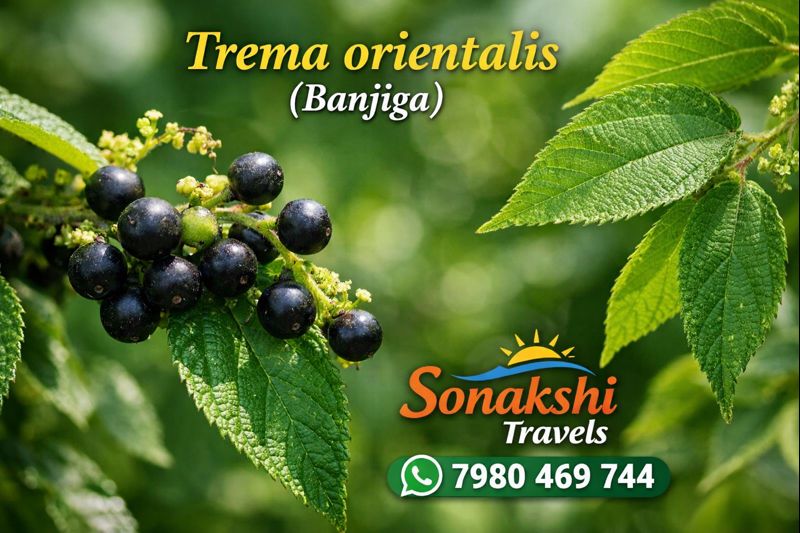
Ecological Significance, Biology, and Presence in the Sundarbans
Trema orientalis, commonly known as Banjiga, Indian charcoal tree, or pigeonwood, is a fast-growing tropical tree species widely distributed across Asia, Africa, and the Pacific. Recognized for its exceptional adaptability, this species plays a vital role in early forest succession, soil stabilization, and biodiversity restoration. In regions like the Sundarbans, where ecological balance is shaped by tidal forces and salinity gradients, Trema orientalis serves as a transitional species bridging terrestrial and mangrove-influenced habitats.
This article provides an in-depth, research-oriented exploration of Trema orientalis, covering its taxonomy, morphology, habitat preferences, ecological functions, and conservation relevance, with particular emphasis on its occurrence in the Sundarbans landscape.
Taxonomy & Classification
The taxonomic placement of Trema orientalis reflects its evolutionary position among early-diverging flowering plants adapted to disturbed tropical environments.
Kingdom: Plantae
Clade: Angiosperms
Clade: Eudicots
Order: Rosales
Family: Cannabaceae
Genus: Trema
Species:Trema orientalis (L.) Blume
Previously classified under the family Ulmaceae, molecular phylogenetic studies have reassigned Trema to Cannabaceae, aligning it with ecologically resilient genera known for rapid growth and adaptability.
Morphology & Field Identification
Growth Habit and Structure
Trema orientalis is a medium-sized, evergreen to semi-deciduous tree, typically attaining heights of 10–20 meters under favorable conditions. The trunk is generally straight, with a moderately spreading crown that provides light shade. Bark texture ranges from smooth to slightly fissured, exhibiting greyish-brown tones that darken with age.
Leaves
The leaves are simple, alternate, and ovate to lanceolate in shape, measuring 5–15 cm in length. Leaf margins are finely serrated, while the upper surface is rough due to minute hairs. The underside is paler and softly pubescent. Prominent lateral veins are clearly visible, making leaf venation a key identification feature in the field.
Flowers and Fruits
The species is monoecious, bearing small, inconspicuous greenish flowers arranged in axillary clusters. Pollination is primarily wind-assisted. The fruits are small, globose drupes that turn black upon ripening. These fruits are highly attractive to birds, facilitating wide seed dispersal.
Habitat & Distribution
Global Range
Trema orientalis exhibits one of the broadest natural distributions among tropical pioneer trees. It is native to:
South and Southeast Asia
Sub-Saharan Africa
Southern China
Northern Australia
Pacific Islands
Its ability to thrive across varied climatic zones, from humid tropics to monsoon-influenced subtropics, underscores its remarkable ecological plasticity.
Preferred Habitat
This species predominantly occupies disturbed or open habitats, including forest edges, secondary woodlands, abandoned agricultural fields, riverbanks, and roadside vegetation. It favors well-drained soils but can tolerate poor, compacted, or nutrient-deficient substrates, making it an effective colonizer of degraded landscapes.
Occurrence
In eastern India, Trema orientalis is frequently encountered in transitional ecological zones where freshwater, brackish influence, and terrestrial systems intersect. It commonly appears as an early successional species following natural disturbances such as cyclones, floods, or human-led land clearance.
Preferred Habitat in the Sundarbans Region
Within the Sundarbans, Trema orientalis does not occupy core mangrove swamps dominated by true mangrove species. Instead, it thrives in:
Village peripheries near mangrove buffers
Embankments and raised levees
Canal banks with reduced salinity
Degraded forest margins transitioning toward mangrove zones
Its tolerance for mild salinity and periodic waterlogging enables it to function as a stabilizing species along ecological gradients, particularly in areas undergoing regeneration or afforestation.
Exploring the fragile plant diversity of deltaic forests becomes more meaningful through responsible travel. Learn more about curated itineraries under the Sundarban Tour experience.
Ecological Role
Trema orientalis plays a crucial ecological role as a pioneer and facilitator species. Its rapid growth and extensive root system help stabilize loose soils, reduce erosion, and improve microhabitat conditions for subsequent plant colonization.
The fruits support avian biodiversity, including bulbuls, mynas, and pigeons, while the foliage serves as fodder for herbivorous insects. Leaf litter decomposition enriches soil organic matter, enhancing nutrient cycling in early-stage ecosystems.
Habitat Alteration
Although resilient, Trema orientalis faces indirect pressures from extensive habitat alteration. Urban expansion, embankment reinforcement, monoculture plantations, and excessive grazing can restrict its natural regeneration. In the Sundarbans, increasing salinity intrusion caused by sea-level rise may further limit suitable zones for establishment.
Conservation Efforts
Currently, Trema orientalis is not listed as threatened due to its wide distribution and adaptive nature. However, it is increasingly recognized in ecological restoration programs. Its inclusion in reforestation and afforestation initiatives helps accelerate soil recovery and biodiversity return in degraded landscapes.
In buffer areas surrounding protected mangrove forests, the species contributes to ecological resilience, offering a natural barrier against erosion and habitat fragmentation.
Nature-focused journeys offer deeper insight into plant ecology and conservation. Discover exclusive itineraries through a customized Sundarban Tour designed for immersive exploration.
Did You Know?
Trema orientalis is often one of the first tree species to colonize landslide zones and cyclone-affected regions.
The wood is traditionally used for making charcoal, hence the name “Indian charcoal tree.”
Its leaves are sometimes employed in folk medicine for treating fevers and skin ailments.
The species is an important host plant for certain butterfly larvae.
External Reference
For further botanical and taxonomic details, consult the publicly available reference: