Updated: March 14, 2026
What is Sundarban Hilsa Festival?
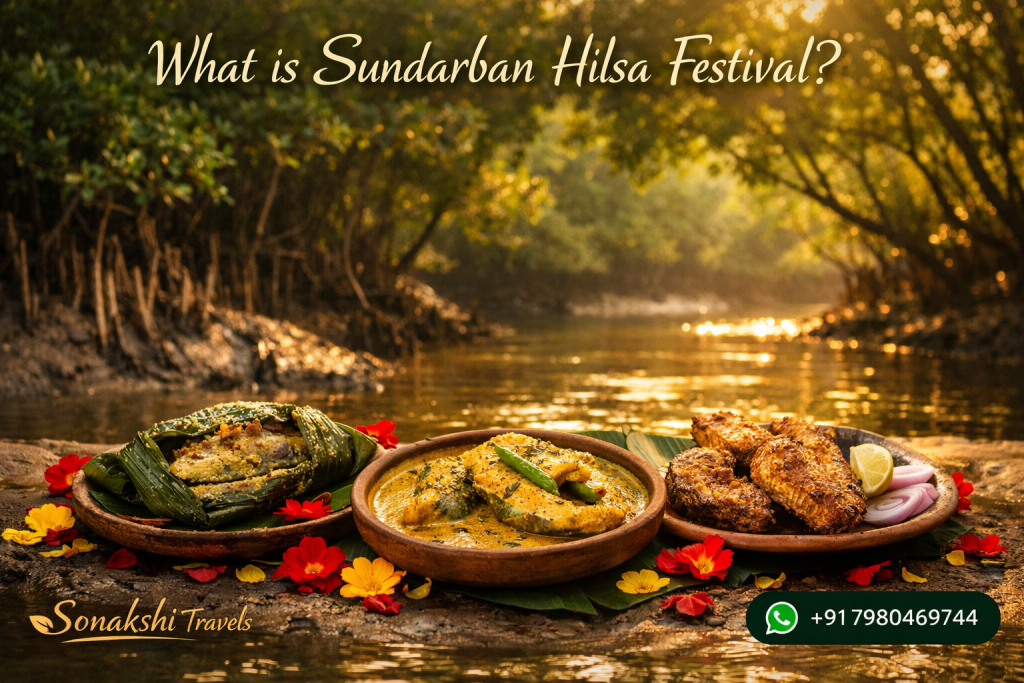
The Sundarban Hilsa Festival is not merely a food event arranged around a famous fish. It is a seasonal cultural experience in which cuisine, river landscape, memory, and regional identity come together in a very particular way. To understand what it is, one has to move beyond the simple idea of a festival menu. The event is built around hilsa, but its deeper meaning lies in the setting in which hilsa is received, cooked, discussed, and remembered. In the Sundarban, food is rarely separate from water, tide, mud, labor, and weathered human adaptation. For that reason, the festival becomes a living expression of Bengal’s riverine civilization rather than a straightforward act of dining.
In its clearest sense, the festival is a curated monsoon-season celebration of hilsa within the mangrove delta environment. The fish itself has long held emotional, culinary, and symbolic importance in Bengali life. Yet in the context of the Sundarban, hilsa acquires another layer of meaning. It is no longer only a prized delicacy placed on a plate. It becomes part of a wider sensory field: the smell of river air, the visual softness of tidal light, the sound of water pressing against the boat, the quiet expectancy of shared meals, and the awareness that the landscape itself shapes appetite. This is why many people who first approach the event as a special meal leave with the impression that they have encountered something closer to a cultural ritual.
The festival as a cultural idea
At its core, the Sundarban ilish utsav is a celebration of belonging. Hilsa in Bengal is not appreciated only for taste. It is tied to monsoon emotion, family memory, hospitality, and a long literary and domestic tradition in which food carries meaning beyond nutrition. The festival brings those inherited associations into an organized shared setting. Guests do not simply consume a popular fish; they enter a cultural mood shaped by anticipation, reverence, and conversation.
This is one reason the event feels more layered than an ordinary themed gathering. Hilsa is a fish that invites interpretation. Its oil, softness, bones, aroma, and regional prestige have inspired generations of cooks and diners to treat it with unusual care. During the festival, different preparations often reveal how one ingredient can speak in different culinary voices. A mustard-based preparation expresses sharpness and heat; a steamed version reveals delicacy and balance; a leaf-wrapped preparation adds fragrance and depth; a lightly fried piece emphasizes texture and elemental purity. The result is not excess, but variation within a disciplined culinary tradition.
In this sense, the festival is also an act of preservation. It protects a way of eating that depends on patience, skilled handling, and cultural knowledge. Hilsa is not casual food. It demands attention from the cook and attentiveness from the eater. The festival gives that attention public form. It invites people to experience hilsa not as a commercial label or urban luxury item, but as part of a larger Bengali relationship with river ecology and seasonal rhythm.
Why hilsa matters so deeply here
To ask what the festival is, one must also ask why hilsa occupies such a revered position. Hilsa has historically been associated with estuarine and river systems, with migration, monsoon cycles, and culinary prestige. In Bengal, it is often treated as both food and memory. It appears in households as celebration, in literature as metaphor, and in conversation as something almost impossible to describe adequately to those who have never tasted it at the right moment and in the right setting.
Within the Sundarban delta, this emotional weight becomes even more pronounced. The landscape is amphibious in character. Land and water are never entirely separate. Human life here has always depended upon reading rivers, understanding tide, and living with uncertainty. In such an environment, a fish like hilsa is not simply another ingredient in the kitchen. It belongs to the larger emotional geography of Bengal’s waterways. That is why the Sundarban hilsa festival 2026 is best understood as a meeting point between culinary heritage and ecological imagination.
Research on food culture repeatedly shows that certain ingredients become symbols because they condense history into sensory form. Hilsa does precisely that. It represents seasonality, migration, domestic ritual, and regional distinction. The festival therefore functions as a concentrated site of cultural meaning. The fish is central, but what is truly being celebrated is a whole civilization of taste.
More than a meal in the mangrove world
One of the most distinctive aspects of the event is the setting. A meal served in an enclosed urban dining room behaves differently from a meal served within or beside a tidal landscape. In the Sundarban, the environment modifies attention. The openness of the river, the shifting color of the water, the sudden appearance of quiet banks and dense mangrove margins, and the intervals of silence between human voices all create a different psychological condition for eating. Food seems less isolated. It enters into relation with everything around it.
That is why the festival is often remembered not only for flavor but for atmosphere. The fragrance of cooked hilsa does not stand alone. It mingles with the scent of moisture, boat wood, river breeze, and monsoon heaviness. The visual experience also matters. Silver fish, yellow mustard, white rice, green banana leaf, and the muted brown-green world of the delta create a deeply Bengali palette. Such visual integration is one of the reasons the event feels rooted rather than staged.
In a broader sense, this is also what separates the festival from a generic food promotion. It is not only about offering a famous dish to visitors. It is about allowing landscape and cuisine to interpret each other. Even a person arriving through a broader Sundarban travel context often comes to recognize that the festival has its own atmosphere, its own emotional density, and its own rhythm of attention.
The role of culinary craftsmanship
The festival depends greatly on method. Hilsa is a fish that punishes careless cooking. Its texture is tender, its oil rich, and its flavor easily damaged by imbalance. For that reason, skilled preparation is central to the event’s identity. The value of the festival lies not in the number of dishes alone, but in the intelligence with which each dish is handled.
A mustard preparation, for instance, must preserve the fish’s own sweetness while allowing pungency to remain controlled. A steamed version must hold softness without becoming dull. A fried preparation must achieve crispness while respecting the interior richness of the flesh. In leaf-wrapped or yogurt-based versions, fragrance and restraint are more important than spectacle. The best festival experiences do not overwhelm the fish. They reveal it.
This culinary discipline matters because the festival presents hilsa as a subject worthy of interpretation. It is not being turned into novelty cuisine. Instead, different preparations illustrate how tradition refines taste through measured variation. That quality of restraint is one reason the event feels serious in the best sense. It is pleasurable, but not careless. It is abundant, but not vulgar.
Ecology, river memory, and edible identity
The Sundarban setting gives the festival an ecological dimension that should not be ignored. Even when one is focused on food, the surrounding environment quietly reminds the mind that all taste begins elsewhere. Hilsa does not emerge from abstraction. It belongs to a living aquatic system shaped by salinity gradients, estuarine movement, river flow, and seasonal change. The festival therefore has an educational value, even when it is not formally presented as one. It invites people to think about how ecology enters culture through the mouth.
In the delta, nothing feels completely static. Light moves, water shifts, banks erode, and silence itself seems mobile. Within that world, the act of eating hilsa becomes an act of recognition. One understands that regional cuisine is never detached from landscape. The fish on the plate carries a geography within it. This is why the event is especially meaningful in relation to Sundarban eco tourism as an idea of respectful experience rather than superficial sightseeing. The festival can deepen ecological awareness precisely because it begins with pleasure and leads quietly toward understanding.
There is also a moral lesson in this. Food festivals are sometimes dismissed as indulgent spectacles. Yet when responsibly framed, they can preserve local knowledge, honor culinary labor, and remind audiences that regional identity is sustained through careful transmission. In that sense, the Sundarban hilsa festival is not only about appetite. It is also about continuity.
The psychological experience of the festival
An important part of the answer to “What is Sundarban Hilsa Festival?” lies in how it affects the mind. The event is memorable because it combines pleasure with stillness. Unlike loud urban food gatherings, the emotional register here is often more reflective. The delta environment creates a slower interior pace. People speak differently near water. They wait differently. They notice sound differently. This altered quality of attention changes the meaning of the meal.
Many experiences in the modern world are consumed quickly and forgotten quickly. The festival tends to work in the opposite direction. It slows perception. It allows anticipation to build before the meal, deepens awareness during the act of eating, and lingers afterward as a mood rather than merely a memory of dishes. This lingering quality is important. It explains why many people describe the event in emotional rather than technical terms.
The fish becomes a medium for returning to something older and quieter in oneself. Smell evokes memory. Soft bones demand patience. Rich oil invites slower eating. Shared serving patterns encourage conversation. Meanwhile, the river remains present at the edge of consciousness, reminding everyone that nourishment here is inseparable from place. That is why the festival can feel unexpectedly intimate, even when experienced in a group setting.
How it differs from an ordinary themed event
The distinction between this festival and a simple culinary promotion is essential. A themed event may display food as attraction. The Sundarban version, at its best, does something subtler. It situates food inside cultural landscape. It connects the fish to the emotional imagination of Bengal. It gives culinary tradition enough room to breathe. It does not ask the guest only to taste. It asks the guest to notice.
That difference becomes visible in the way the event is discussed afterward. People rarely speak only of recipes. They speak of the atmosphere of the river, the stillness around the meal, the sense of season, the unusual harmony between food and setting, and the feeling that hilsa somehow belonged more fully to that environment than to a conventional restaurant plate. Even visitors arriving through a wider Sundarban tourism lens often discover that the festival changes their understanding of what regional cuisine can communicate.
It is also distinct because it does not need theatrical excess. The fish itself is powerful enough. The environment is expressive enough. The cultural background is rich enough. When these elements are allowed to remain balanced, the event becomes quietly profound. It speaks through texture, fragrance, rhythm, and setting rather than through noise.
A living symbol of Bengal in the delta
Ultimately, the festival is best understood as a living symbol. It stands at the meeting point of food heritage, river civilization, monsoon feeling, and mangrove atmosphere. Hilsa serves as the center, but the real subject is Bengal’s way of transforming ecology into culture and culture into shared experience.
That is why the event continues to hold such resonance for people who value depth in travel and food alike. For some, it is a gateway into the emotional world of the delta. For others, it is a reminder that certain traditions survive not through museums or textbooks, but through repeated acts of cooking, serving, tasting, and remembering. Even someone whose larger journey begins as a Sundarban travel guide inquiry may come away understanding that the festival is one of the most intimate ways to encounter Bengal’s edible memory.
So, what is the Sundarban ilish utsav 2026? It is a seasonal celebration of hilsa, certainly. But that definition is only the beginning. In fuller truth, it is a cultural ritual of taste in the mangrove delta, a carefully shaped encounter between fish and landscape, and a deeply Bengali experience in which memory, ecology, and cuisine meet at the same table. It is not simply about eating hilsa in the Sundarban. It is about understanding why, in that landscape, hilsa becomes more than food.