Updated: March 18, 2026
When crocodiles smile and kingfishers dive – Sundarban Tour is alive
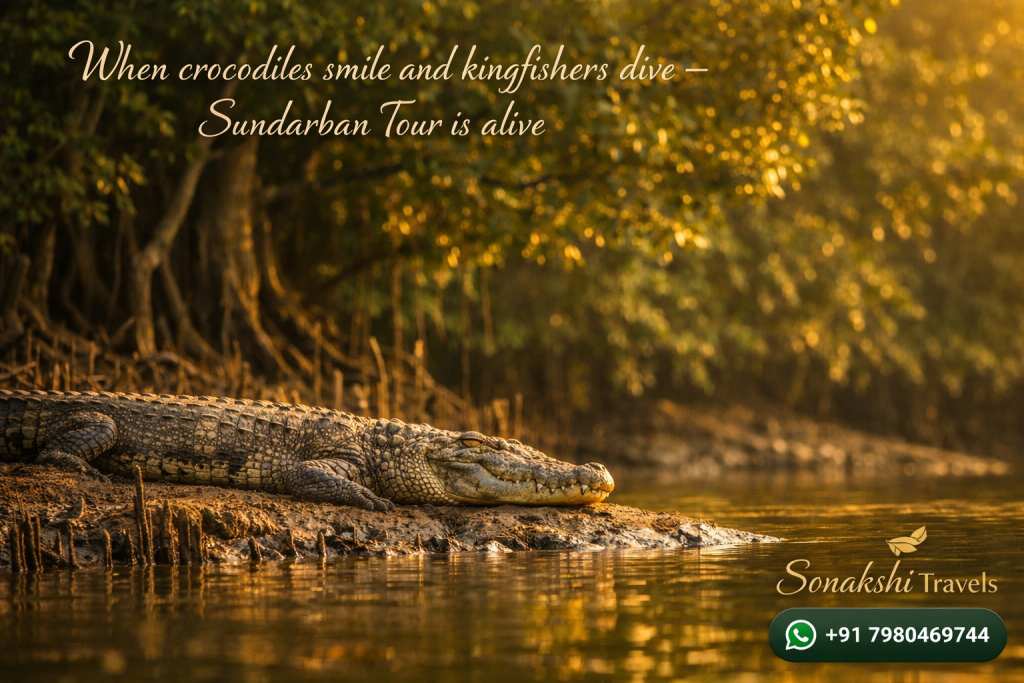
There are landscapes that impress the eye, and there are landscapes that seem to breathe beside the traveler. The tidal forest belongs to the second kind. In this river country, life does not stay hidden inside a distant background. It appears suddenly, quietly, and with great precision. A floating branch becomes a resting reptile. A still line of mud becomes the edge of a hunting ground. A flash of blue light becomes a bird entering water with complete certainty. That is why a serious Sundarban tour is never only about movement through a famous mangrove region. It is about entering a living field of attention where every shape, pause, ripple, and sound carries meaning.
The title speaks of two very different beings: the crocodile and the kingfisher. One seems ancient, deliberate, heavy, and silent. The other seems quick, bright, exact, and almost musical in its movement. Yet both belong perfectly to the same world. The crocodile teaches the traveler how stillness can hold force. The kingfisher teaches how speed can emerge from patience. Together they reveal a truth about the delta: life here is not random decoration. It is pattern, behavior, adaptation, and presence. In the finest moments of Sundarban travel, the visitor does not merely observe animals. The visitor begins to understand how the whole environment thinks through them.
The riverbank as a stage of quiet intelligence
At first glance, a mudbank in the mangrove delta may look simple. It appears flat, brown, and silent, interrupted only by exposed roots and the retreat of water. But the apparent simplicity is deceptive. The riverbank is one of the most active surfaces in the forest. Tracks mark passage. Small crabs work continuously. Birds scan from branches and low edges. Reptiles use the bank as a place of rest, heat exchange, and watchfulness. This is why the riverbank is not empty space in a meaningful Sundarban tourism experience. It is one of the clearest places where the living intelligence of the ecosystem becomes visible.
A crocodile resting on the bank often appears calm in a way that can mislead the inexperienced eye. The body seems heavy and relaxed. The mouth may remain slightly open, giving an impression almost like a smile. Yet that appearance is not softness. It is functional stillness. Crocodilians regulate their body temperature through position, exposure, and timing. Their motion is economical because wasted movement costs energy. The stillness, therefore, is not inactivity. It is a refined biological decision. When one sees such an animal in the Sundarbans, the moment feels ancient because it is ancient. It carries a design shaped over immense spans of evolutionary time.
That experience adds depth to a thoughtful Sundarban travel guide approach to the region. The forest becomes richer when the traveler understands that visible calm may contain intense readiness. The crocodile does not perform for the viewer. It remains within its own order. Its presence alters the emotional quality of the river. Water is no longer only reflective and beautiful. It becomes inhabited, interpreted, and morally serious. The traveler senses that beauty here is never separate from alertness.
Why the crocodile changes the meaning of stillness
Most people are trained by modern spaces to think of stillness as emptiness. In cities, stillness often means inactivity, delay, or absence. In the mangrove delta, stillness means concentration. A crocodile on the mudbank demonstrates this with extraordinary authority. Its body is nearly motionless, yet everything about it suggests control. The eyes remain placed for vigilance. The surface texture of the skin seems built from the same language as bark, shadow, and wet earth. The animal does not fight against the landscape. It completes it.
This is one reason why a well-written account of Sundarban eco tourism must treat wildlife not as isolated spectacle but as part of a full behavioral environment. The crocodile teaches the viewer to slow down. It demands a different kind of seeing. The eye must become patient enough to understand what is not moving. In that shift, the traveler’s own mind begins to change. Attention becomes more disciplined. Noise inside the head becomes less important. One starts to notice edges, textures, pauses, and intervals. The forest does not become dramatic by becoming louder. It becomes dramatic by becoming more precise.
The emotional effect is profound. Fear may be present, but it is no longer crude fear. It becomes respect. Respect leads to concentration, and concentration leads to a more honest encounter with place. That is why the living atmosphere of a Sundarban tour often remains in memory long after the journey ends. The traveler remembers not only what was seen, but how perception itself was reorganized by the presence of creatures whose survival depends on exactness.
The kingfisher and the grammar of sudden light
If the crocodile teaches the power of restraint, the kingfisher teaches the brilliance of decision. In the same landscape where one animal can remain still for long stretches, another can transform a quiet branch into a line of movement in less than a second. A kingfisher does not merely fly. It announces a different tempo in the ecosystem. The color alone can feel startling against mangrove greens, browns, and tidal reflections. Blue, copper, white, or chestnut appears for an instant, and then the bird is already elsewhere.
The dive is the most unforgettable act. It is not chaotic. It is measured. The bird studies water, calculates depth and angle, and then enters the surface with astonishing efficiency. To witness such a moment during Sundarban tour packages centered on close environmental observation is to understand that the forest is not built only from grand scenes. It is built from exact actions. The kingfisher’s dive is a sentence written in speed, balance, and confidence.
That action also changes the meaning of beauty. The bird is beautiful, certainly, but its beauty is not decorative. It comes from functional perfection. The beak, posture, perch choice, and timing all serve one purpose. This makes the sight more satisfying than simple color alone. The traveler sees not just a lovely bird, but a life fully suited to its conditions. In a refined Sundarban travel package, such observations often become the deepest rewards because they reveal the logic of nature rather than only its appearance.
When two forms of attention meet in one landscape
The crocodile and the kingfisher seem opposite in almost every visible way. One is heavy, low, armored, and patient. The other is light, elevated, bright, and sudden. Yet the forest holds both without contradiction. This coexistence explains why the delta feels so alive. Life here is not organized around one mood. It contains slowness and speed, concealment and display, density and flight. The traveler who understands this begins to see the forest not as a static destination but as a system of balanced contrasts.
Such balance lies at the heart of a true Sundarban trip package built around serious observation rather than superficial sightseeing. The mudbank must exist for the reptile. The overhanging branch must exist for the bird. The waterline must support fish, current, light, and changing depth. The mangrove roots must stabilize soil while also creating habitat. Nothing stands alone. The life of one creature depends upon the structure created by many other forces.
When a traveler begins to notice this, the phrase “the forest is alive” stops sounding poetic and starts sounding exact. The aliveness is not a vague feeling. It is measurable through movement, reaction, adaptation, and relationship. A small splash may signal prey movement. A bird’s fixed gaze may reveal hidden motion beneath the surface. A reptile’s position on the bank may indicate a carefully chosen thermal balance. These are not random images. They are parts of a coherent ecological language.
Color, camouflage, and the discipline of seeing
One of the most remarkable features of the Sundarbans is the way it trains the eye to notice difficult truths. The crocodile is often hard to detect because its form belongs so naturally to mud, water, and shadow. The kingfisher is easy to notice after it moves, but difficult to predict before it does. This means the traveler must learn two different kinds of visual discipline: the discipline of identifying camouflage and the discipline of anticipating sudden action.
That is why a meaningful Sundarban tourism experience depends not only on what appears but on how one learns to look. Seeing becomes slower, more layered, and more respectful. The eye stops demanding constant spectacle and begins to appreciate partial revelation. A ripple, a color fragment, a line of scale, or a sharpened posture can be enough to change the meaning of the entire scene. In this way, the forest educates perception.
The crocodile’s camouflage is a lesson in continuity with earth. The kingfisher’s brightness is a lesson in contrast with surrounding tones. Together they show that survival may require disappearing into the world or briefly commanding it with speed and precision. Such contrast deepens the intellectual pleasure of the journey. The traveler is not simply pleased by beauty, but instructed by it. That instructional quality gives lasting dignity to the finest best Sundarban tour packages that are built around attentive immersion.
The soundscape behind visible life
Although the title centers on visible action, the life of the delta is equally carried by sound. The kingfisher’s call may cut lightly through the air, while the edges of water speak in softer ways through small collapses of mud, surface taps, and the quiet friction of current against roots. Even the crocodile, silent in itself, changes the soundscape through the hush it imposes on human attention. People speak less when they sense such presence nearby. They listen more carefully. The environment becomes acoustically sharper.
This matters because perception in the mangroves is never limited to the eye alone. A serious Sundarban travel agency narrative should recognize that the sense of aliveness emerges through combined signals: color, stillness, ripple, call, reflection, pause, and sudden displacement of air or water. The traveler understands the forest not as a picture but as an event. That event unfolds across many sensory channels at once.
In such moments, the river becomes more than scenery. It becomes an active medium carrying information. A kingfisher’s dive breaks the surface and briefly writes a circle into the water. A crocodile’s entry or withdrawal alters the edge in another manner, heavier and more secretive. These are traces, and traces are part of how one reads life in the Sundarbans. The traveler learns that what disappears may be as meaningful as what remains visible.
Ecological truth behind the beauty
It is important to say clearly that the beauty of these encounters is not separate from ecology. Crocodiles and kingfishers do not make the landscape interesting by accident. They are indicators of functioning relationships between water, food, shelter, and breeding conditions. The kingfisher depends on aquatic life and suitable perches. The crocodile depends on stable habitat edges, prey availability, and specific environmental balances. To witness both within one living zone is to understand that the scene has biological depth.
For this reason, the most serious form of Sundarban travel guide writing must move beyond decorative description. It should explain, even in simple language, that every memorable sight rests on ecological order. The diving bird is not only a colorful attraction. It is part of a food web. The resting reptile is not only a thrilling sight. It is part of a system of predation, balance, and habitat use. The traveler who understands this does not love the forest less. The traveler loves it more honestly.
This honesty changes tone. It removes the cheap excitement that often surrounds wildlife writing and replaces it with steadier admiration. The forest does not need exaggeration. Its truth is already powerful. A crocodile holding still above the tide and a kingfisher entering water with perfect timing are enough. They represent ancient adaptation, environmental intelligence, and the difficult beauty of survival.
Why this experience stays in memory
Many journeys are forgotten because they offer only scenery without relationship. The Sundarbans remains in memory because it offers relationship through attention. The crocodile and the kingfisher are unforgettable not merely because they are interesting animals, but because they change the viewer’s inner pace. One slows the mind. The other sharpens it. One teaches endurance. The other teaches instant decision. Both teach humility.
That is why a reflective Sundarban private tour or a carefully observed Sundarban luxury tour can become far more than a comfortable journey through a beautiful landscape. It can become a lesson in how life organizes itself without waste. The traveler returns carrying not only photographs or isolated memories, but a stronger sense of what attention feels like when it is properly used. In a distracted age, that may be one of the rarest gifts a landscape can offer.
To say that the forest is alive, then, is not a slogan. It is an exact conclusion drawn from patient observation. The crocodile resting with ancient calm, the kingfisher diving with electric certainty, the mudbank holding traces, the water carrying brief signs, and the mangrove edge receiving all of this into one breathing world—together they create an experience that is both beautiful and intellectually serious. A fine Sundarban tour reveals that life in the delta is never passive. It waits, watches, calculates, moves, and disappears. It smiles through reptilian stillness. It flashes through feathered speed. And in that union of silence and motion, the traveler understands that the Sundarbans is not merely seen. It is felt as a complete living presence.