There are very few places in India where river and forest hold equal authority over the landscape. The Sundarban is one of those rare regions. It is not a conventional wildlife park with open tracks and predictable viewing points. It is a vast tidal wilderness of creeks, mudflats, and mangrove islands where every movement is shaped by water. Those who begin their journey after understanding the ecological framework presented through Sundarban Travel quickly realize that wildlife sightings here are never staged. They are discovered through patience, quiet observation, and respect for the rhythm of the delta.
A Sundarban tour is not driven by speed or checklist-style tourism. The animals of this region are adapted to shifting tides and narrow channels. Many remain concealed for long hours. That very uncertainty gives meaning to each sighting. A ripple in still water may signal a dolphin. A sudden alarm call from deer may hint at a predator moving beyond the tree line. What first appears to be a dark patch on a mudbank may slowly take shape as a crocodile warming under the winter sun.
Understanding the Unique Ecosystem Before Wildlife Sightings
Wildlife sightings during a Sundarban tour are deeply influenced by geography. This region forms part of the immense Ganges delta, where freshwater from inland rivers merges with saline tides from the Bay of Bengal. Mangrove trees dominate the terrain, their aerial roots rising above the mud like breathing structures. These roots prevent erosion and create shelter for fish, crustaceans, birds, and mammals.
Because the terrain is tidal, water levels shift dramatically every few hours. A sandbank visible in the morning may disappear by afternoon. Animals respond to these cycles. Deer gather where fresh vegetation is exposed during low tide. Crocodiles select sunlit mudbanks that will soon be submerged again. Visitors who explore the region through a structured Sundarban tour experience often learn that timing, rather than distance covered, determines the quality of wildlife encounters.
The forest is divided into protected core and buffer zones, including the Sundarban Tiger Reserve. Entry is carefully regulated. Boats follow designated routes and maintain controlled speeds. This measured system protects fragile habitats and allows wildlife to behave naturally. Sightings that occur under such conditions feel authentic and undisturbed.
The Royal Bengal Tiger: The Most Anticipated Wildlife Sighting
The most anticipated wildlife sighting during a Sundarban tour is undoubtedly the tiger. The mangrove forests are home to the Royal Bengal Tiger, an apex predator known for its ability to swim across wide tidal channels. Unlike tigers in dry deciduous forests, these animals navigate saline water and soft mud with remarkable ease.
Yet seeing a tiger here is never guaranteed. The forest is dense, visibility is limited, and the network of creeks is extensive. Tigers often move silently and prefer early or late hours. When a sighting occurs, it usually unfolds along an exposed bank during low tide. The animal may appear briefly, pause to observe its surroundings, and retreat into the mangroves within moments. Travelers who choose a more focused Sundarban private tour sometimes value the quieter setting, which allows longer periods of patient waiting in promising zones.
Even without a confirmed sighting, the knowledge that a tiger inhabits the surrounding forest heightens awareness. The silence feels deeper. Every rustle carries weight. Alarm calls from deer echo across the water, reminding visitors that the predator may be close, even if unseen.
Spotted Deer, Wild Boar, and Other Land Mammals
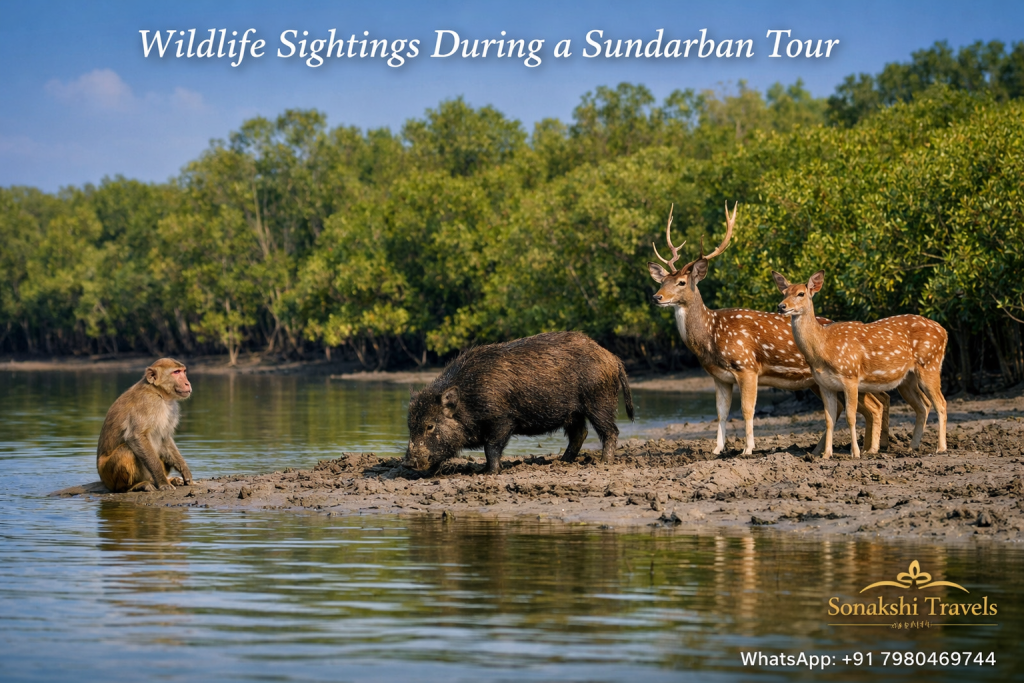
Not every wildlife sighting during a Sundarban tour is dramatic. Many are subtle and quietly fascinating. Spotted deer, also called chital, are among the most frequently observed mammals. They graze along open stretches near the river and remain alert, constantly scanning their surroundings.
Wild boars forage along muddy edges, turning over soil in search of food. Their movement through soft terrain reveals how well adapted they are to the delta’s shifting ground. Rhesus macaques can also be seen in selected areas, climbing mangrove branches and watching passing boats from a cautious distance.
These animals form the foundation of the food chain. Observing them within a carefully arranged Sundarban tour package offers insight into daily ecological balance. While the tiger captures imagination, these consistent sightings help visitors understand the broader structure of life within the mangrove system.
Saltwater Crocodiles and Reptile Encounters
Reptiles provide another striking dimension to wildlife sightings during a Sundarban tour. The estuarine saltwater crocodile is one of the largest living reptiles in the world. It often rests motionless on mudbanks during low tide. From a distance, it can resemble driftwood. Only a slight shift of its tail or a sudden movement of its jaw reveals its true identity.
Water monitor lizards are also common along narrow creeks. These long-bodied reptiles swim efficiently and climb exposed roots to absorb warmth. They retreat swiftly when disturbed, reminding visitors that observation must remain non-intrusive.
Such encounters underline the raw character of the delta. For travelers who prefer greater comfort while exploring these remote waterways, a Sundarban luxury tour can offer stable viewing decks and quieter navigation without compromising ecological discipline.
Birdwatching: A Colorful Dimension of Wildlife Sightings
Birdlife adds constant motion and color to wildlife sightings during a Sundarban tour. Kingfishers flash brilliant blue and orange against the green backdrop. Egrets stand poised in shallow water before striking at fish. The white-bellied sea eagle glides overhead, scanning the river with focused precision.
Winter attracts migratory species, making the cooler months particularly rewarding for bird enthusiasts. Early mornings offer calm water and soft light, creating ideal conditions for observation and photography. Unlike large mammals that appear briefly, birds often remain visible long enough for detailed viewing.
Many travelers discover that avian diversity becomes one of the most memorable aspects of their Sundarban experience. The variety of calls, flight patterns, and feeding behaviors brings the forest canopy to life.
Gangetic Dolphins and Life in the Water
Not all wildlife sightings during a Sundarban tour take place on land. The rivers themselves are alive. Gangetic dolphins surface briefly before slipping beneath the water again. Their curved backs break the surface quietly, leaving only ripples behind.
These sightings are often fleeting. A visitor may see only a quick arc of movement before the animal disappears. Yet such moments confirm that beneath the brown tidal currents exists a thriving aquatic ecosystem.
The presence of dolphins signals ecological health. It also reinforces the understanding that conservation in the Sundarban extends beyond trees and land mammals to include the delicate balance of river systems.
Best Time and Conditions for Wildlife Sightings
Wildlife sightings during a Sundarban tour are strongly influenced by season and tide. Winter months from November to February offer clearer visibility and comfortable temperatures. Animals are generally more active during cooler hours of the day.
Low tide increases the likelihood of spotting crocodiles and deer along exposed banks. Early morning safaris provide softer light and reduced disturbance. Midday heat often slows animal movement, making patience essential.
Visitors planning a longer stay, such as a 2 nights 3 days Sundarban tour package, often benefit from multiple tidal cycles. Extended time in the forest improves the chances of varied sightings while allowing deeper immersion in the delta’s rhythm.
A Moment on the River: A Short Story
One winter morning, a small group gathered quietly on the upper deck of their boat. The tide was low, and broad mudbanks stretched under a pale sky. Nearly an hour passed without unusual movement. A few egrets lifted off from the shallows. A monitor lizard slipped into the creek.
Then the guide signaled gently. On the far edge of the bank stood a tiger. It was motionless, its reflection wavering in shallow water. No one spoke. Cameras moved slowly. Within seconds, the tiger turned and disappeared into the forest.
The sighting lasted less than half a minute. Yet it defined the journey. Not because it was dramatic, but because it was authentic, silent, and entirely unforced.
From the Mangrove Edge
Where river bends through shifting sand,
And roots rise thin from breathing land,
A shadow steps, then fades away,
Between the tide and break of day.
Wings scatter light across the sky,
A dolphin arcs, then slips by.
Deer pause still in guarded grace,
Wind moves softly through the place.
In fleeting seconds, wild and true,
The forest shows a glimpse to you.
Respecting Wildlife During a Sundarban Tour
Wildlife sightings during a Sundarban tour should never result from disturbance. Boats maintain distance. Engines operate at controlled speeds. Loud noise and sudden movement are avoided. Feeding wildlife or attempting to attract attention is strictly prohibited.
Responsible travel supports conservation. By following forest regulations and respecting protected zones, visitors contribute to long-term preservation. Ethical observation ensures that future generations can experience the same raw beauty.
The Sundarban is not a staged environment. It is a fragile tidal ecosystem where survival depends on balance. Watching quietly is both a privilege and a duty.
Why Wildlife Sightings Here Feel Different
Wildlife sightings during a Sundarban tour feel distinct because they emerge from uncertainty. There are no land tracks cutting through open grasslands. Safaris unfold by boat along water routes shaped by lunar cycles. The forest conceals more than it reveals.
When an animal appears, even briefly, it feels like a shared secret between river and traveler. The encounter is quiet, unscripted, and deeply personal.
Many visitors return home without seeing a tiger, yet they carry vivid memories of dawn light over mangroves, a crocodile resting on warm mud, or the quick rise of a dolphin’s back in tidal water. In the Sundarban, wildlife sightings are not measured solely by rarity. They are measured by awareness and presence.
A Sundarban tour teaches patience and attention. When the forest finally reveals one of its inhabitants, even for a fleeting moment, that moment feels genuinely earned.