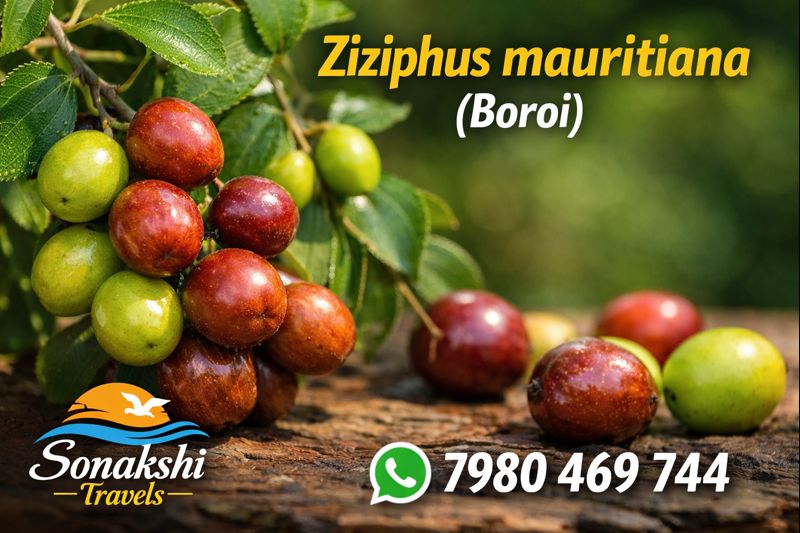
Ziziphus mauritiana, commonly known as Boroi, Indian Jujube, or Ber, is one of the most ecologically adaptable and culturally significant fruit-bearing tree species of the Indian subcontinent. Revered for its resilience under harsh climatic conditions, this species plays a critical role in dryland ecology, rural livelihoods, traditional medicine, and wildlife sustenance. In eastern India, including the lower Gangetic delta and fringe landscapes of the Sundarbans, Boroi stands as a silent indicator of ecological continuity between forest edges, village commons, and semi-wild habitats.
This article presents an in-depth, research-oriented overview of Ziziphus mauritiana, examining its taxonomy, morphology, habitat preferences, global distribution, ecological functions, and conservation relevance, with special emphasis on its occurrence and role within the Sundarbans region.
Taxonomy & Classification
Systematic Position
Ziziphus mauritiana belongs to the family Rhamnaceae, a group widely known for woody shrubs and trees adapted to arid and semi-arid environments. The genus Ziziphus includes over 40 species distributed across tropical and subtropical regions.
Kingdom: Plantae
Clade: Angiosperms
Clade: Eudicots
Order: Rosales
Family: Rhamnaceae
Genus: Ziziphus
Species: Ziziphus mauritiana Lam.
The species shows extensive phenotypic variation, largely due to centuries of domestication, natural hybridization, and environmental selection across diverse ecological zones of South Asia.
Morphology & Field Identification
Growth Habit and Structure
Ziziphus mauritiana is a medium-sized, evergreen to semi-deciduous tree, typically attaining a height of 6–12 meters under natural conditions. The trunk is often short, irregular, and heavily branched, forming a dense, rounded canopy. Young branches are characteristically zigzag in appearance and armed with paired thorns—one straight and one curved—providing effective defense against browsing herbivores.
Leaves
Leaves are simple, alternate, and broadly ovate to elliptic in shape. The upper surface is glossy green, while the underside is pale and finely pubescent. A distinctive feature is the presence of three prominent veins arising from the base, aiding easy field identification. The leaf texture reflects strong xerophytic adaptation, reducing moisture loss in dry environments.
Flowers and Fruits
The flowers are small, greenish-yellow, and borne in axillary cymes. Although inconspicuous, they are rich in nectar and attract a wide range of insect pollinators. The fruit is a drupe, varying greatly in size, shape, and color depending on cultivar and habitat. Ripe fruits range from yellow to reddish-brown, with a sweet to mildly acidic pulp enclosing a hard, woody stone.
Habitat & Distribution
Natural Habitat
Ziziphus mauritiana thrives in open woodlands, scrub forests, village groves, agricultural margins, and degraded forest lands. Its ability to tolerate poor soils, drought, and high temperatures makes it a keystone species in marginal ecosystems where few fruit trees can survive.
Global Range
The species is believed to have originated in the Indo-Malayan region and is now widely distributed across South Asia, Southeast Asia, the Middle East, and parts of Africa. Through human-mediated dispersal, it has also been introduced to Australia, the Caribbean, and parts of the Americas, where it is sometimes considered invasive due to its aggressive growth and adaptability.
Preferred Habitat
Soil and Climate Requirements
Boroi shows remarkable ecological plasticity. It grows well in sandy, loamy, and even saline soils, provided drainage is adequate. Optimal growth occurs in regions receiving annual rainfall between 300 and 1000 mm. The species tolerates high summer temperatures and brief flooding, making it particularly suited to transitional zones between dry uplands and deltaic plains.
Occurrence
In eastern India, Ziziphus mauritiana occurs both as a cultivated fruit tree and as a semi-wild species along roadsides, embankments, village commons, and forest edges. Its persistence in human-dominated landscapes highlights its importance as a bridge species between natural ecosystems and rural livelihoods.
Preferred Habitat in the Sundarbans Region
Ecological Position in the Delta
Within the Sundarbans fringe areas, Boroi is commonly found on elevated village lands, river embankments, and reclaimed zones where salinity levels are moderate. While it does not dominate core mangrove forests, it forms an important component of the transitional vegetation belt between mangroves and agricultural settlements.
Its deep root system helps stabilize soil, reduce erosion, and improve microhabitat conditions for associated plant species. The presence of Boroi trees near human settlements also reflects traditional agroforestry practices adapted to the deltaic environment.
Planning a guided mangrove adventure? Explore our
Sundarban Tour Package Packages and choose the best itinerary for your dates.
Ecological Role
Food Web Contribution
The fruits of Ziziphus mauritiana are a vital food source for birds, small mammals, and insects. In the Sundarbans landscape, frugivorous birds play a key role in seed dispersal, ensuring natural regeneration across fragmented habitats.
Human and Livestock Use
Beyond wildlife, Boroi fruits are consumed fresh, dried, or processed into traditional foods. Leaves serve as fodder for livestock during lean seasons, while the hard wood is valued as fuel. These multiple uses underscore the species’ importance in sustaining rural economies.
Habitat Alteration
Impact of Land Use Change
Rapid agricultural expansion, urbanization, and infrastructure development have reduced natural habitats suitable for semi-wild Boroi populations. In the Sundarbans, increasing soil salinity and embankment modifications further influence its distribution and health.
Conservation Efforts
Sustainable Management
Although Ziziphus mauritiana is not globally threatened, local conservation through community-based agroforestry and mixed planting systems is essential. Promoting native and traditional cultivars helps maintain genetic diversity and ecological resilience.
Planning a guided mangrove adventure? Explore our
Sundarban Private Tour Packages and choose the best itinerary for your dates.
Did You Know?
Ethnobotanical Insights
In traditional Indian medicine, Boroi is valued for its cooling, digestive, and immunity-boosting properties. The fruit is rich in vitamin C and antioxidants, making it nutritionally comparable to several commercially important fruits.
External Reference
For further botanical details and global taxonomic notes, readers may consult the following source: