A Comprehensive Botanical and Ecological Profile of a Hardy Climbing Shrub
Ziziphus oenopolia, locally known as Bon Boroi, is a thorny, scrambling shrub or woody climber belonging to the family Rhamnaceae. Widely distributed across tropical and subtropical Asia, the species is particularly valued for its ecological resilience and its ability to thrive in marginal habitats. Despite its modest appearance, Ziziphus oenopolia plays an important role in stabilizing soil, supporting wildlife, and maintaining ecological balance in dry, semi-moist, and coastal transitional ecosystems.
In eastern India and regions adjoining the Sundarbans, Ziziphus oenopolia is frequently encountered along forest edges, embankments, village thickets, and degraded lands. Its tolerance to drought, salinity fluctuations, and physical disturbance allows it to persist where many other species fail. This article presents a detailed, research-oriented account of Ziziphus oenopolia, covering taxonomy, morphology, habitat preferences, distribution, ecological functions, and conservation considerations, with special emphasis on the Sundarbans region.
Taxonomy & Classification
Ziziphus oenopolia belongs to the Rhamnaceae family, a group of woody plants that includes trees, shrubs, and climbers adapted to diverse climatic conditions. The genus Ziziphus is well known for its hardy species, many of which bear edible fruits and possess strong adaptive traits.
Kingdom: Plantae
Clade: Angiosperms
Clade: Eudicots
Order: Rosales
Family: Rhamnaceae
Genus:Ziziphus
Species:Ziziphus oenopolia
The species epithet oenopolia is derived from Greek roots, referring to the vine-like growth habit of the plant. Taxonomically, the species is clearly distinguished by its climbing form, paired spines, and small globose fruits.
Morphology & Field Identification
Ziziphus oenopolia is a scrambling shrub or woody climber that can reach lengths of 5–10 meters when supported by surrounding vegetation. Its thorny branches and flexible stems enable it to climb over shrubs and small trees.
Stem and Thorns
The stems are slender, green to brown, and armed with paired spines at the nodes. Typically, one spine is straight while the other is curved or hooked, aiding the plant in climbing and anchoring itself. Older stems become woody and slightly rough in texture.
Leaves
Leaves are simple, alternate, and ovate to elliptic, measuring 4–8 cm in length. The leaf margins are finely serrated, and the surface is glossy green with three prominent basal veins. Petioles are short, and stipules are modified into spines.
Flowers and Fruits
Flowers are small, greenish-yellow, and borne in axillary cymes. Though inconspicuous, they are rich in nectar and attract a variety of insects. Flowering typically occurs during the warmer months.
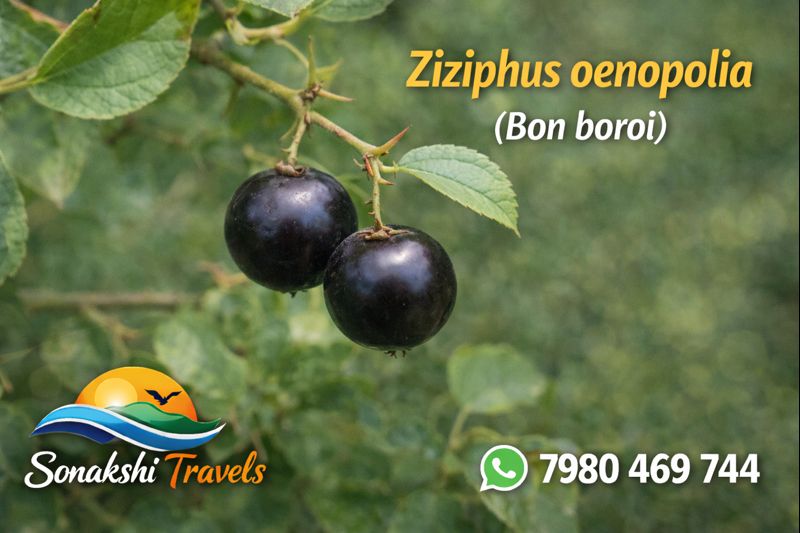
The fruits are small, globose drupes, turning from green to reddish-brown or black upon maturity. Each fruit contains a single hard seed. These fruits are consumed by birds and small mammals, aiding in seed dispersal.
Habitat & Distribution
Ziziphus oenopolia demonstrates remarkable ecological adaptability, occurring across a wide range of habitats from dry scrublands to moist forest margins. Its ability to withstand environmental stress makes it a characteristic species of disturbed and transitional ecosystems.
Global Range
The species is widely distributed across South and Southeast Asia, including India, Bangladesh, Sri Lanka, Nepal, Myanmar, Thailand, Malaysia, and parts of southern China. Its presence across varied climatic zones reflects its broad ecological tolerance.
Preferred Habitat
Preferred habitats include dry deciduous forests, scrublands, forest edges, village thickets, roadside vegetation, and coastal plains. The plant grows well in well-drained soils but can tolerate poor, rocky, and slightly saline substrates.
Discovering hardy native plants becomes more engaging through immersive nature experiences. Carefully curated Sundarban Tour Package itineraries allow visitors to observe such resilient species in their natural surroundings.
Occurrence
In India, Ziziphus oenopolia is commonly found across eastern, central, and southern regions. It often colonizes degraded lands, abandoned fields, and forest margins, forming dense thickets that provide shelter to wildlife.
Preferred Habitat in the Sundarbans Region
Within the Sundarbans landscape, Ziziphus oenopolia occurs primarily in peripheral zones rather than in core mangrove forests. It is commonly found along embankments, village borders, elevated forest patches, and areas with reduced salinity influence.
These transitional zones offer suitable conditions for growth, allowing the species to persist despite periodic flooding and salinity fluctuations.
Ecological Role
Ziziphus oenopolia plays a vital ecological role in maintaining habitat stability. Its extensive root system helps bind soil and prevent erosion, particularly on slopes and embankments. The dense thorny growth provides refuge for birds, reptiles, and small mammals.
Flowers serve as a nectar source for insects, while fruits support avian seed dispersers. The plant also contributes organic matter through leaf litter, enhancing soil fertility over time.
Habitat Alteration
Although resilient, Ziziphus oenopolia is not immune to habitat alteration. Large-scale land clearing, excessive grazing, and urban expansion can reduce population density. However, the species often recolonizes disturbed sites rapidly.
In deltaic regions such as the Sundarbans, increasing salinity and changes in land use may influence local distribution patterns.
For travelers interested in understanding thorny scrub vegetation and transitional ecosystems, thoughtfully designed Sundarban Private Tour experiences provide guided ecological insight.
Conservation Efforts
Ziziphus oenopolia is not currently considered threatened due to its wide distribution and adaptive nature. Conservation efforts focus primarily on maintaining habitat heterogeneity and preventing excessive land degradation.
In the Sundarbans region, community-based land management and preservation of buffer zones indirectly support the continued survival of this species.
Did You Know?
Ziziphus oenopolia is armed with paired spines that assist in climbing.
The fruits are consumed by birds, aiding natural seed dispersal.
The plant is highly tolerant of drought and poor soils.
It often forms dense protective thickets along forest edges.
External Reference
For additional botanical classification and species information, consult the relevant entry on Wikipedia.