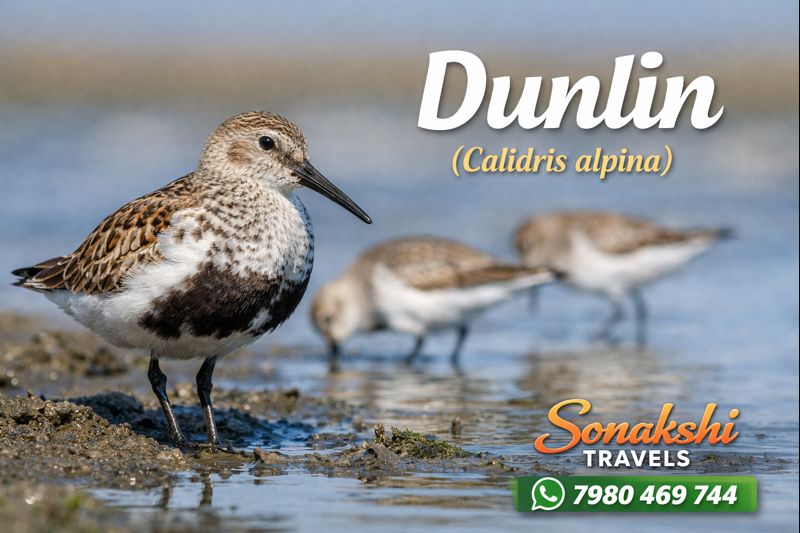
The Dunlin (Calidris alpina) is one of the most widespread and scientifically studied small shorebirds of the Northern Hemisphere. Belonging to the sandpiper group, this species is particularly renowned for its extraordinary migratory endurance, complex plumage variation across seasons, and strong ecological association with coastal mudflats, estuaries, and tidal wetlands. As a regular winter visitor to South Asia, including the eastern Indian coastline and the Sundarbans delta, the Dunlin represents an important biological indicator of wetland health and intertidal ecosystem stability.
Taxonomy & Classification
Scientific Classification
The Dunlin is taxonomically classified within the order Charadriiformes, a diverse group of birds adapted to aquatic and semi-aquatic habitats. It belongs to the family Scolopacidae, which includes sandpipers, snipes, and phalaropes—species characterized by slender bodies, elongated bills, and probing foraging techniques.
Multiple subspecies of Calidris alpina have been recognized across its circumpolar range, reflecting geographical variation in body size, bill length, and migratory behavior. These subspecies distinctions are critical for ornithological research, particularly in migration studies and conservation assessments.
Morphology & Field Identification
General Appearance
The Dunlin is a compact, short-necked shorebird with a slightly down-curved bill. In non-breeding plumage, it appears largely grey-brown above with whitish underparts, making it relatively inconspicuous against mudflat substrates. During the breeding season, adults develop a striking black belly patch, a diagnostic feature unique among many small sandpipers.
Male Features
Breeding males typically exhibit more intense coloration than females, including a well-defined black ventral patch, rich rufous tones on the scapulars, and darker facial markings. These features play a role in mate attraction and territorial display during the Arctic breeding season.
Female Features
Females are generally slightly larger than males and show comparatively subdued plumage. The black belly patch may be smaller or less sharply defined. Such sexual dimorphism, though subtle, is significant for field researchers conducting population and breeding studies.
Size & Wingspan
Adult Dunlins measure approximately 16–22 cm in body length, with a wingspan ranging from 32 to 39 cm. Body mass varies seasonally, increasing substantially prior to long-distance migration as fat reserves are accumulated.
Flight Characteristics
In flight, Dunlins form dense, fast-moving flocks that twist and turn in synchronized patterns. Their rapid wingbeats and cohesive group movements serve as an effective anti-predator strategy, particularly in open coastal landscapes.
Habitat & Distribution
Global Range
The Dunlin has a circumpolar breeding distribution across the Arctic and sub-Arctic regions of Europe, Asia, and North America. During the non-breeding season, it migrates southward to temperate and tropical coastlines, including Africa, South Asia, Southeast Asia, and parts of Australasia.
Preferred Habitat
Outside the breeding season, Dunlins strongly prefer intertidal mudflats, estuaries, coastal lagoons, and salt marshes. These habitats provide abundant benthic invertebrates essential for sustaining large migratory populations.
Exploring tidal mudflats and mangrove ecosystems offers remarkable birdwatching opportunities. Discover a professionally curated Sundarban Tour designed around the region’s unique wildlife and seasonal avifauna.
Diet & Feeding Ecology
Primary Diet
The Dunlin feeds predominantly on small invertebrates, including polychaete worms, mollusks, crustaceans, and insect larvae. Diet composition varies with habitat type and seasonal availability, demonstrating the species’ ecological flexibility.
Foraging Technique
Foraging is typically conducted by rapid probing of soft mud using the sensitive bill tip, which contains specialized nerve endings capable of detecting prey beneath the surface. This tactile feeding method allows efficient exploitation of intertidal substrates even in low-visibility conditions.
Breeding & Reproduction
Breeding Season
Breeding occurs during the short Arctic summer. Dunlins establish territories on tundra landscapes characterized by mosses, sedges, and shallow wetlands. Courtship displays involve aerial flights and vocalizations that reinforce pair bonds.
Nesting Sites
Nests are shallow scrapes on the ground, often lined with plant material and strategically placed to minimize detection by predators. The cryptic coloration of eggs provides effective camouflage against the tundra substrate.
Unique Adaptations & Behavioral Ecology
Speed & Agility
Dun remember that Dunlins exhibit remarkable aerial agility, allowing them to evade predators such as falcons. Their flocking behavior enhances survival by reducing individual predation risk.
Camouflage and Nesting Strategy
Both adults and chicks rely heavily on camouflage. Chicks are precocial and leave the nest shortly after hatching, blending seamlessly into the tundra environment.
Social Behavior
Outside the breeding season, Dunlins are highly gregarious. Large flocks form at roosting and feeding sites, sometimes numbering in the tens of thousands, reflecting the species’ strong social cohesion.
Occurrence & Seasonal Movement
The Dunlin is a long-distance migrant, with some populations traveling over 10,000 kilometers annually. Seasonal movements are finely timed with tidal cycles and prey abundance, underscoring the species’ ecological specialization.
Preferred Habitat in the Sundarbans Region
In the Sundarbans, Dunlins are primarily observed during the winter months along exposed mudflats, creek edges, and estuarine islands. The nutrient-rich sediments of the delta support abundant invertebrate prey, making the region an important wintering ground.
Seasonal shorebirds such as Dunlins can often be observed during guided mangrove explorations. Plan an immersive Sundarban Tour to experience the delta’s rich avian diversity firsthand.
Ecological Role
As benthic predators, Dunlins play a crucial role in regulating invertebrate populations within intertidal ecosystems. They also serve as prey for higher trophic-level predators, contributing to the overall energy flow of coastal food webs.
Habitat Alteration
Coastal development, pollution, and climate-driven sea-level rise pose significant threats to Dunlin habitats. The loss of intertidal mudflats directly impacts feeding efficiency and migratory success, making habitat conservation a priority.
Conservation Efforts
International conservation frameworks emphasize the protection of migratory flyways and critical stopover sites. Wetland restoration, monitoring programs, and sustainable coastal management are essential for maintaining stable Dunlin populations.
Did You Know?
Dunlins can double their body weight before long migratory flights.
The species has one of the most extensive global distributions among small shorebirds.
Flocking behavior creates mesmerizing aerial patterns often referred to as “shorebird murmurations.”
External Reference
For further scientific details, taxonomy updates, and global population data, consult the authoritative reference: