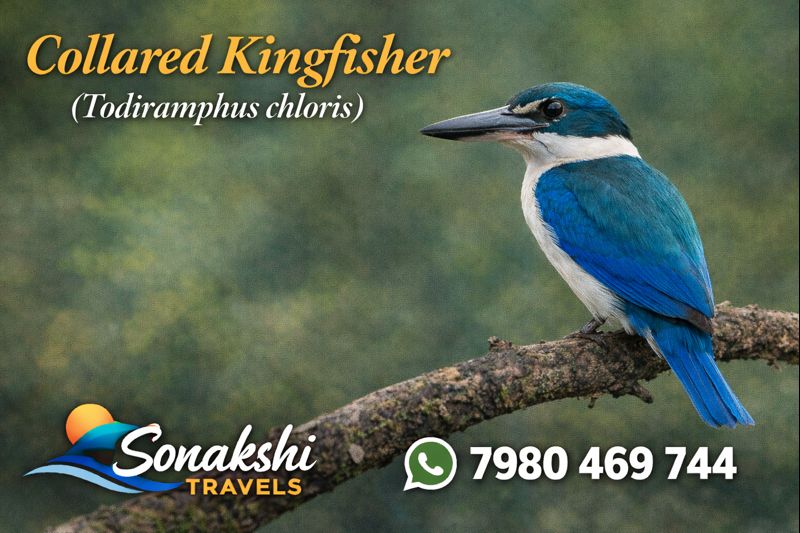
The Collared Kingfisher (Todiramphus chloris) is one of the most widespread and ecologically versatile kingfishers of the Indo-Pacific region. Known for its striking turquoise-blue upperparts, white collar and underparts, and strong black bill, this species is especially associated with coastal environments, mangroves, and island ecosystems. Unlike many kingfishers that rely heavily on freshwater systems, the Collared Kingfisher has successfully adapted to saline and brackish habitats, making it a dominant avian predator in tropical shorelines and estuarine landscapes.
Its adaptability, broad diet, and tolerance of human presence have allowed the Collared Kingfisher to thrive across an immense geographic range. At the same time, its dependence on coastal trees, mangroves, and intertidal prey links its survival closely to the health of shoreline ecosystems. In ecologically rich regions such as the Sundarbans, the species plays a vital role in maintaining coastal food-web balance.
Taxonomy & Classification
The Collared Kingfisher belongs to the order Coraciiformes, which includes kingfishers, bee-eaters, rollers, and hornbills. Within this order, it is placed in the family Alcedinidae, encompassing all true kingfishers.
The genus Todiramphus consists of medium-sized tree kingfishers primarily distributed across Australasia, Southeast Asia, and the Pacific Islands. The species name chloris is derived from Greek, referring to greenish or pale tones, an allusion to its turquoise and green-blue plumage. The Collared Kingfisher complex includes numerous regional forms, some of which were historically treated as separate species due to island isolation and plumage variation.
Morphology & Field Identification
The Collared Kingfisher is a medium-sized, robust bird with a large head, thick neck, and straight, powerful bill. The crown, wings, and back are vivid blue to turquoise, often with a greenish wash depending on light conditions. The face, throat, and collar are bright white, forming a bold contrast with the darker upperparts.
The underparts are white to pale buff, while the bill is heavy and black, well-adapted for seizing hard-bodied prey. Legs and feet are short and dark, reflecting its preference for perching rather than ground foraging. In flight, the bird presents a strong profile with broad wings and steady wingbeats.
Male Features
Male Collared Kingfishers generally show slightly brighter blue coloration on the wings and crown. The bill may appear marginally thicker, and males are often more vocal, particularly during territorial displays and breeding periods.
Female Features
Females closely resemble males, with only subtle differences in plumage intensity. In some populations, females may show a faint greenish wash on the crown. Sexual dimorphism is minimal and usually indistinguishable in the field.
Size & Wingspan
The species measures approximately 22–24 centimeters in body length. Its wingspan typically ranges from 35 to 38 centimeters, providing strong, controlled flight suitable for coastal and open woodland habitats.
Flight Characteristics
Flight is direct and purposeful, marked by steady wingbeats rather than rapid flapping. The Collared Kingfisher often moves between exposed perches and feeding sites with short, confident flights, frequently accompanied by loud calls.
Habitat & Distribution
Global Range
The Collared Kingfisher has one of the widest distributions among kingfishers, spanning coastal South Asia, Southeast Asia, northern Australia, Melanesia, Micronesia, and Polynesia. Its extensive range reflects exceptional adaptability to island and coastal ecosystems.
Preferred Habitat
This species is strongly associated with coastal habitats, including mangroves, estuaries, tidal creeks, coral islands, beaches with tree cover, and coastal villages. It also inhabits inland open woodlands, plantations, and gardens where suitable perches and prey are available.
Diet & Feeding Ecology
The Collared Kingfisher is an opportunistic carnivore with a highly varied diet. It feeds on crabs, small fish, insects, spiders, lizards, frogs, small rodents, and occasionally nestling birds. In coastal zones, crustaceans form a major component of its diet.
Foraging Technique
Foraging is usually conducted from an exposed perch such as a mangrove branch, pole, or coastal tree. Upon sighting prey, the bird swoops down to seize it with the bill. Prey is typically beaten against a hard surface before being swallowed, especially in the case of crabs and insects.
Mangrove forests and tidal creeks are ideal places to observe coastal kingfishers. Explore these habitats through our immersive Sundarban Tour Packages and experience nature responsibly.
Breeding & Reproduction
Breeding seasons vary across the species’ vast range but generally coincide with warmer months and periods of increased prey availability. The Collared Kingfisher is monogamous during the breeding season and maintains well-defined territories.
Nesting Sites
Nests are typically excavated in tree cavities, termite mounds, earthen banks, or occasionally in man-made structures. Both sexes participate in nest preparation. Clutches usually contain two to five white eggs, incubated by both parents.
Unique Adaptations & Behavioral Ecology
Speed & Agility
The Collared Kingfisher combines moderate flight speed with excellent maneuverability. Its ability to capture mobile prey such as crabs and lizards demonstrates refined coordination and precise strike timing.
Camouflage and Nesting Strategy
The blue and green tones of the plumage blend effectively with coastal vegetation and water reflections. Nesting in cavities or termite mounds provides insulation from heat, protection from predators, and resistance to flooding.
Social Behavior
This species is typically solitary or found in pairs. It is highly territorial, frequently advertising its presence through loud, repetitive calls. Aggressive defense of feeding and nesting sites is common.
Occurrence & Seasonal Movement
Most populations of the Collared Kingfisher are resident throughout the year. On islands and in coastal regions, local movements may occur in response to seasonal changes in food availability, but long-distance migration is rare.
Preferred Habitat in the Sundarbans Region
In the Sundarbans, the Collared Kingfisher is strongly associated with mangrove-lined creeks, estuarine edges, coastal embankments, and village outskirts near tidal waters. The abundance of crabs, insects, and small vertebrates makes this region particularly suitable for sustaining stable populations.
Ecological Role
As a versatile predator, the Collared Kingfisher helps regulate populations of crabs, insects, and small vertebrates within coastal ecosystems. Its feeding activity contributes to maintaining balanced intertidal and mangrove food webs.
Habitat Alteration
Major threats include mangrove deforestation, coastal development, pollution, and loss of nesting trees. While the species shows resilience to moderate habitat change, large-scale degradation of coastal forests can lead to local population declines.
Conservation Efforts
Conservation efforts focus on protecting mangrove ecosystems, preserving coastal tree cover, and maintaining healthy intertidal zones. Due to its wide range and adaptability, the Collared Kingfisher remains common, but habitat conservation remains critical for long-term stability.
Did You Know?
The Collared Kingfisher is one of the most widespread kingfishers in the world.
It frequently feeds on crabs in mangrove ecosystems.
Many island populations have developed unique vocal and plumage traits.
Discover the vibrant coastal birdlife of mangroves and estuaries with our expertly planned Sundarban Tour Packages and explore biodiversity up close.