Updated: March 19, 2026
A Palace of Silence, a Kingdom of Calm—Enter the Sundarban Luxury Tour
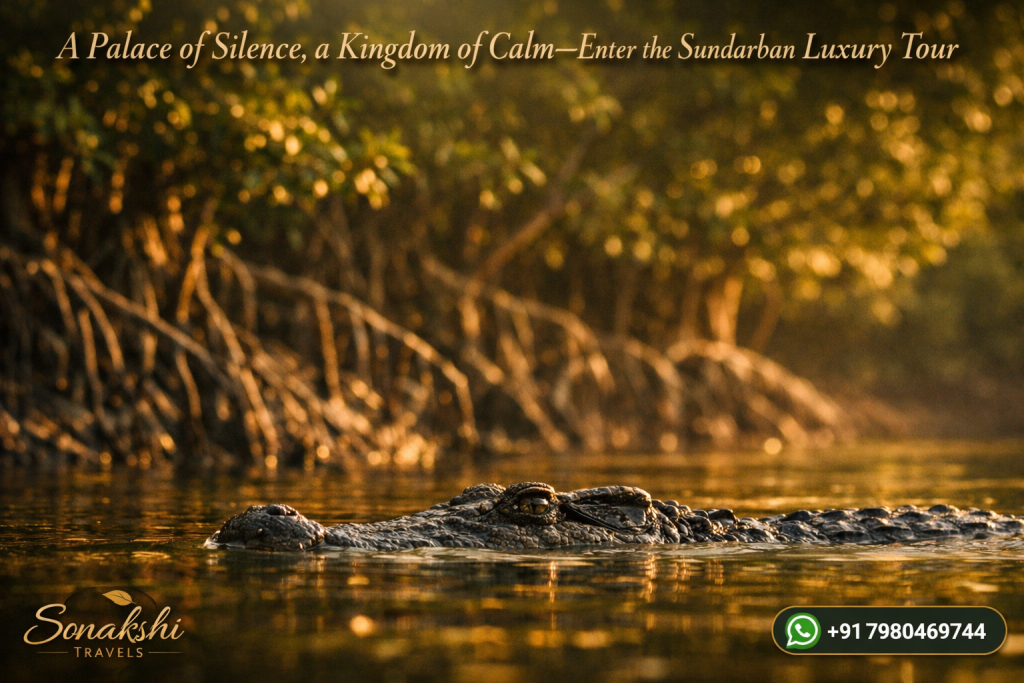
There are landscapes that impress by scale, and there are landscapes that impress by drama, yet the mangrove delta achieves something more unusual. It creates authority through restraint. Its power does not arrive in a sudden spectacle. It gathers slowly through still water, measured sound, filtered light, and a constant sense that the land is thinking in its own patient way. This is why a true Sundarban luxury tour should not be understood as a loud version of travel, decorated with superficial comfort. It is better understood as a disciplined entry into quietness, where refinement exists to deepen perception rather than distract from it.
The deepest value of luxury in this landscape is not excess. It is clarity. It is the removal of friction, noise, crowding, and haste, so that the mind becomes fully available to what the delta is already saying. When space is private, movement is unhurried, and service is thoughtful, the visitor does not merely pass through the mangroves. The visitor begins to experience the region as a chamber of concentration, a place where observation becomes more exact and inner rest becomes possible. In that sense, a carefully imagined Sundarban luxury private tour is not a departure from nature. It is a more respectful way of meeting it.
Luxury Here Means Quiet Precision
In many destinations, luxury is associated with display. In the mangrove world, such display would feel misplaced. The delta is too subtle for theatrical treatment. It asks instead for elegance of proportion, calm spatial design, and a pace that does not disturb the atmosphere it seeks to admire. A meaningful luxury encounter in the Sundarban is therefore built on quiet precision: a private deck that allows long observation without interruption, a well-composed interior that offers comfort without severing one from the outdoors, and a rhythm of hospitality that feels attentive yet never intrusive.
The mind responds strongly to such conditions. Environmental psychology has repeatedly shown that calm, ordered surroundings can reduce mental overload and improve attentional recovery. In a mangrove landscape, that effect becomes especially powerful because the environment itself is already patterned by repetition and rhythm. Water lines, root systems, shifting reflections, and the restrained movement of birds create a visual field that is rich but not aggressive. A refined luxury Sundarban cruise allows that field to do its work. Instead of overwhelming the senses, it supports them. Instead of competing with the landscape, it frames it.
This distinction matters. True comfort in such a place does not isolate the traveler from the living environment. It gives the traveler better conditions for receiving it. Silence becomes more audible. Distance becomes more legible. The slight movements of the forest become meaningful. Even the pauses between visible events begin to carry substance. One starts to understand that calm is not emptiness. It is structured attention.
The Mangrove as an Architecture of Stillness
The title of this journey suggests a palace and a kingdom, and the metaphor is not decorative. The mangrove world does behave like a form of architecture. Its mudbanks create thresholds. Its creeks form corridors. Its rising roots resemble columns emerging from dark earth. Its overlapping branches produce chambers of shadow and filtered light. Yet unlike built architecture, this one is tidal, breathing, and perpetually revised by water. To move through it with sensitivity is to realize that silence here has form. It is not the silence of vacancy. It is the silence of complex life held in remarkable balance.
That is why a refined Sundarban private tour feels so different from ordinary movement through a landscape. Privacy allows the environment to retain its scale and authority. Without crowd noise, one can notice the soft drag of current against the hull, the precise landing of a bird on a slanting branch, the shimmer of light broken by suspended particles in tidal water, and the odd dignity of mud itself as a living boundary between land and river. Such observations are not minor details. They are the very texture of the Sundarban.
In a loud setting, these subtleties disappear. In a calm setting, they begin to form a complete language. The visitor learns to read small shifts: an opening in the foliage, a sudden alertness among birds, a quiet interval that feels thicker than the one before it. The delta trains attention by requiring modesty from the observer. Nothing here is truly theatrical, yet almost everything is meaningful.
Why Calm Feels So Deep in This Landscape
Human calm is not produced by silence alone. It depends on how the senses are held. The Sundarban creates this effect through layered moderation. Its visual palette is varied but controlled: mineral brown, tidal grey, moss green, bark black, muted gold. Its sounds are intermittent rather than continuous. Its motion is steady but rarely violent. These qualities together produce an environment that neither starves nor assaults attention. They invite immersion. A well-designed Sundarban luxury travel experience should preserve precisely this balance.
Calm also deepens because the delta resists immediate comprehension. One cannot master it in a glance. A mountain announces its mass. An ocean announces its breadth. The mangrove forest remains partially concealed. It gives fragments, not totals. This partial visibility slows the mind in a productive way. Instead of collecting obvious scenes, one begins to dwell inside uncertainty with unusual comfort. That is one of the most sophisticated pleasures of the region. It teaches presence without demanding performance.
Luxury becomes meaningful at exactly this point. The more settled the traveler feels physically, the more capable the mind becomes of inhabiting these subtle conditions. Comfort then serves contemplation. Spaciousness supports patience. Privacy protects concentration. Graceful service allows the landscape to remain central. In this sense, the finest Sundarban premium tour package is not merely comfortable. It is interpretive. It helps the visitor understand what kind of attention the delta deserves.
Water, Reflection, and the Psychology of Slow Movement
To travel through the mangroves is to travel through reflection in more than one sense. The water carries mirrored images, broken images, and unstable images, all of which influence the mind. Reflection slows visual certainty. It complicates the boundary between above and below, surface and depth, branch and shadow. This creates a contemplative atmosphere that many travelers feel before they can explain it. The landscape appears to think in layers, and the viewer begins to think more slowly in response.
Slow movement is therefore not an inconvenience. It is central to the experience. A private vessel, carefully managed and free from unnecessary commotion, gives the traveler time to observe gradations rather than events alone. The forest is not consumed as a sequence of attractions. It unfolds as a prolonged field of relations: water against mud, root against current, bird against stillness, distance against uncertainty. A thoughtful Sundarban private boat tour honors this slowness and transforms it into a form of luxury far more intelligent than haste.
Research on restorative environments often emphasizes soft fascination, the condition in which attention is gently engaged without strain. The Sundarban provides an exceptional example of this. One does not stare with effort. One remains alert without fatigue. The eye follows drifting reflections, layered vegetation, and subtle movement across open channels almost naturally. A superior Sundarban luxury nature tour preserves that state by minimizing interruption and allowing the mind to remain in continuous contact with the environment.
Wildness Without Noise
One of the most striking features of the Sundarban is that its wildness is not announced through constant visible action. It is sensed through tension, concealment, and ecological intelligence. This is a forest of adaptation. Salt-tolerant trees, amphibious margins, shifting sediments, and species shaped by tidal uncertainty create a world whose drama often remains just below the visible threshold. That is precisely why seriousness of observation matters here. The region rewards patience more than excitement.
A refined Sundarban luxury wildlife safari should therefore cultivate respect rather than thrill-seeking. Wildlife in this landscape is part of a larger field of signs. The cry of a bird, the pattern of tracks on exposed mud, the sudden lift of winged movement from the bank, or an unusual silence in a dense patch of green may all carry ecological information. To experience this well is to appreciate that the delta’s authority lies not only in individual sightings but in the total behavior of the environment.
This ecological sophistication also deepens the feeling of calm. Paradoxically, awareness of hidden wildness can make a place feel more serious and more composed at the same time. The traveler becomes humble. Loudness feels inappropriate. Gesture becomes smaller. Thought becomes cleaner. The finest luxury Sundarban safari is therefore one that teaches restraint as a form of appreciation.
Privacy as a Way of Seeing More
Privacy in a natural landscape is often misunderstood as mere exclusivity. In truth, it can be an epistemic advantage. It changes what and how one notices. When observation is not diluted by constant social noise, perception acquires detail. One can remain with a single creek for longer, study a bank without distraction, or watch a changing light pattern until it reveals structure that would otherwise be missed. A carefully arranged Sundarban customized private tour offers precisely this privilege of extended noticing.
Such privacy is especially valuable for couples, families, and reflective travelers who want not just movement through scenery but a sustained emotional encounter with place. A Sundarban couple private tour can feel deeply intimate because the landscape itself encourages inwardness. A Sundarban family private tour can become unusually memorable because children and adults alike begin to share concentrated moments of noticing rather than fragmented distraction. Silence, when gently held, often becomes a form of connection.
The same principle applies to those who value composition, photography, and long looking. The delta does not reward hurried extraction of images. It rewards waiting. Its beauty lies in intervals, alignments, and soft transitions. A quiet Sundarban photography tour or even a focused Sundarban bird photography tour finds its richness in patience, light discipline, and respectful distance rather than in aggressive pursuit.
Comfort That Does Not Break the Spell
Luxury in the Sundarban must be calibrated carefully. Too much ornamental display would sever the relationship with the forest. Too little care would reduce the capacity for sustained experience. The ideal lies in comfort that does not break the spell. Materials should feel soothing rather than ostentatious. Spatial arrangements should provide openness and rest. Service should be anticipatory but restrained. The traveler should feel supported, not enclosed.
This is where the idea of a Sundarban luxury resort or a Sundarban premium resort stay becomes meaningful when approached with seriousness. The purpose is not to replace the landscape with an interior world of distraction. It is to extend the mood of the delta into the spaces of rest. Clean lines, quiet evenings, open views, thoughtful meals, and a gentle continuity between outdoors and indoors allow the calm of the forest to continue working even when one is no longer standing at the rail or watching the banks pass by.
In this setting, refinement serves memory. What remains afterward is often not a single dramatic scene but a sequence of exact impressions: the depth of quiet at dawn, the mirror-like stretch of water under changing light, the dark geometry of roots at the river’s edge, the way the air seemed heavy yet peaceful, and the strange inner spaciousness that emerged in response. These are not minor luxuries. They are among the rarest forms of travel value.
The Emotional Meaning of a Palace of Silence
The phrase “palace of silence” may sound poetic, yet it describes a real emotional condition produced by the delta. The Sundarban has the ability to make a person feel sheltered without making that person feel enclosed. Its silence is spacious. Its calm is expansive. One feels held by the environment, not trapped by it. This emotional architecture is difficult to manufacture elsewhere because it depends on an unusual combination of ecological density and visual openness.
That is why many travelers find that a serious Sundarban tourism encounter leaves behind not only photographs or recollections, but a restructured inner tempo. The mind becomes less fragmented. Perception becomes less impatient. Even memory itself seems to retain the journey differently, not as a checklist of seen things, but as a change in atmosphere that continued to echo afterward.
Such an experience is especially resonant for those who seek not distraction but recalibration. The delta does not entertain in the ordinary sense. It recenters. It reminds the visitor that richness can be quiet, that grandeur can be low and horizontal, and that the most cultivated form of travel may be the one that restores seriousness to attention. In that regard, a deeply considered Sundarban travel guide to luxury is not a guide to excess. It is a guide to better seeing.
A Kingdom of Calm, Properly Understood
To call the Sundarban a kingdom of calm is not to deny its ecological complexity or hidden force. It is to recognize that power here is expressed through composure. The landscape does not rush to prove itself. It remains self-possessed. It allows water, mud, root, shadow, and living silence to create a complete emotional world. A true luxury experience in such a place must follow the same principle. It must be composed, precise, and unforced.
When that principle is honored, the journey becomes something rare. It is no longer merely a Sundarban tour package in the commercial sense, nor merely another variation of a Sundarban travel package. It becomes a studied encounter with quietness, privacy, ecological intelligence, and restorative beauty. It becomes a form of travel in which comfort and consciousness deepen each other.
This is the real promise inside the title. A palace of silence is not an escape from reality. It is a return to finer perception. A kingdom of calm is not inactivity. It is the disciplined harmony of a living environment whose rhythms are older, subtler, and wiser than our ordinary pace. To enter the Sundarban in that spirit is to discover that luxury, at its highest level, is not noise, ornament, or speed. It is the privilege of meeting a profound landscape under conditions worthy of its dignity.