Biology, Ecology, and Its Significance in Wetland Ecosystems
The Great Egret (Ardea alba) is among the most elegant and widely distributed wading birds of the world. Known for its pristine white plumage, elongated neck, and dignified movements, this species has long been associated with wetlands, riverbanks, floodplains, and mangrove forests. Beyond its visual appeal, the Great Egret plays a vital ecological role as a top predator in shallow aquatic environments, making it an important indicator of wetland health. This article presents a comprehensive, research-oriented discussion of the species’ biology, behavior, distribution, and its particular relevance to the Sundarbans mangrove ecosystem.
Taxonomy & Classification
Systematic Position
The Great Egret belongs to the family Ardeidae, which includes herons, egrets, and bitterns. It is classified under the genus Ardea, a group characterized by large body size, long legs, and a predatory lifestyle centered on aquatic prey. Earlier taxonomic systems placed the species in the genus Casmerodius, but modern morphological and molecular studies support its placement within Ardea, highlighting close evolutionary relationships with other large herons.
Morphology & Field Identification
Overall Structure
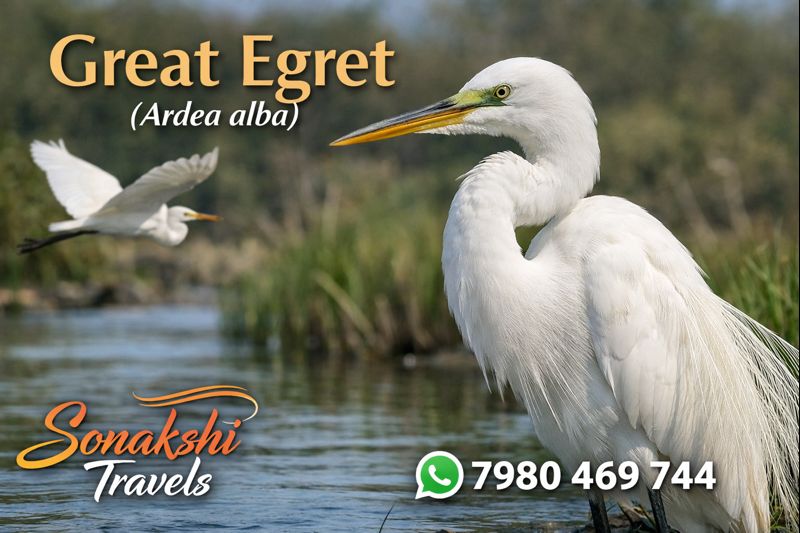
The Great Egret is a tall, slender bird with a commanding presence. Its body is covered in pure white feathers that lack any mottling or secondary coloration, allowing easy separation from smaller egrets at a distance. The neck is long and flexible, often folded into an S-shaped curve when the bird is standing still. The bill is strong, straight, and dagger-like, ideally suited for capturing slippery aquatic prey.
Male Features
Male Great Egrets are marginally larger than females, though the difference is subtle and difficult to detect in the field. During the breeding season, males develop long, delicate ornamental plumes known as aigrettes that extend from the back and tail region. These plumes are used in courtship displays and were historically sought after for the fashion industry, leading to severe population declines before protective legislation was enacted.
Female Features
Female Great Egrets closely resemble males in plumage and coloration. They also develop ornamental plumes during the breeding season, though these may be slightly shorter and less pronounced. Outside the breeding period, both sexes appear nearly identical, with white plumage, yellow bill, and dark legs dominating their appearance.
Size & Wingspan
The Great Egret is one of the largest egret species, measuring approximately 85–102 cm in length. Its wingspan ranges between 130 and 170 cm, enabling efficient soaring and long-distance flight. Adult individuals typically weigh between 700 grams and 1.5 kilograms, depending on geographic location and food availability.
Flight Characteristics
In flight, the Great Egret displays slow, deliberate wingbeats that convey an impression of effortlessness. The neck is retracted, forming a compact silhouette, while the long legs trail straight behind the body. Its broad wings allow it to glide smoothly over wetlands and coastlines, conserving energy during extended movements between feeding and roosting sites.
Habitat & Distribution
Global Range
The Great Egret has an extensive global distribution, occurring across Asia, Africa, Europe, the Americas, and parts of Australia. Its adaptability to diverse wetland habitats has allowed it to colonize both tropical and temperate regions. In many areas, populations are resident, while others exhibit seasonal movements influenced by climate and water availability.
Preferred Habitat
This species shows a strong preference for shallow freshwater and brackish environments. Typical habitats include marshes, lakeshores, riverbanks, flooded grasslands, rice paddies, estuaries, and mangrove creeks. The presence of shallow water is essential, as it facilitates effective foraging by allowing the bird to wade while hunting prey.
Visitors exploring wetland birdlife often combine wildlife observation with a guided mangrove journey. Discover curated itineraries through our Sundarban Tour experiences designed around nature and conservation.
Diet & Feeding Ecology
Primary Diet
The Great Egret is a carnivorous species with a diet dominated by fish. It also consumes amphibians, crustaceans, insects, small reptiles, and occasionally small mammals or birds. Dietary composition varies according to habitat type, seasonal availability, and local prey abundance.
Foraging Technique
Foraging behavior is typically solitary, though multiple individuals may feed in proximity when resources are abundant. The bird employs a patient, motionless stance, standing still for extended periods before delivering a rapid, precise strike with its bill. This ambush-based hunting strategy minimizes energy expenditure while maximizing capture success.
Breeding & Reproduction
Courtship and Pair Formation
Breeding usually coincides with periods of high food availability. Courtship involves visual displays, including plume erection, bill snapping, and ritualized postures. Once paired, the bond typically lasts for a single breeding season.
Nesting Sites
Great Egrets nest colonially, often alongside other herons and egrets. Nests are constructed from sticks and twigs and placed in trees, shrubs, or reed beds, usually over or near water. The female lays two to five pale blue eggs, which are incubated by both parents.
Unique Adaptations & Behavioral Ecology
Speed & Agility
Despite its large size, the Great Egret is capable of swift movements when required. Its long legs allow rapid wading, while its strong wings support quick takeoff in response to threats.
Camouflage and Nesting Strategy
While its white plumage appears conspicuous, it can blend effectively with sunlit water surfaces and sky reflections. Nest placement over water reduces access by terrestrial predators, increasing reproductive success.
Social Behavior
Outside the breeding season, Great Egrets are largely solitary, though they may roost communally. Colonial nesting reflects a balance between social tolerance and individual foraging independence.
Occurrence & Seasonal Movement
In tropical regions, Great Egrets are often resident year-round. In temperate zones, they may migrate short to moderate distances in response to winter conditions. Seasonal dispersal is closely tied to water levels and prey availability.
Preferred Habitat in the Sundarbans Region
Within the Sundarbans, the Great Egret is a familiar presence along tidal creeks, mudflats, and mangrove-lined channels. The region’s complex network of waterways provides abundant feeding opportunities, while mangrove trees offer secure roosting and nesting sites.
For travelers interested in observing elegant wetland birds in their natural habitat, a responsibly planned Sundarban Tour offers immersive exposure to the mangrove ecosystem.
Ecological Role
As a top predator in shallow aquatic systems, the Great Egret helps regulate fish and invertebrate populations. Its presence reflects balanced trophic interactions and healthy wetland conditions. Declines in egret numbers often signal habitat degradation or pollution.
Habitat Alteration
Wetland drainage, pollution, and unregulated development pose ongoing threats to Great Egret habitats. Changes in hydrology and water quality can significantly reduce prey availability, impacting breeding success and survival.
Conservation Efforts
The Great Egret is currently listed as a species of Least Concern, largely due to successful conservation measures implemented over the last century. Legal protection, wetland preservation, and increased public awareness have played key roles in population recovery following historic declines.
Did You Know?
The Great Egret was one of the first bird species protected under modern wildlife conservation laws.
Its ornamental plumes were once more valuable than gold in the fashion trade.
The species is often used as a flagship bird for wetland conservation programs.