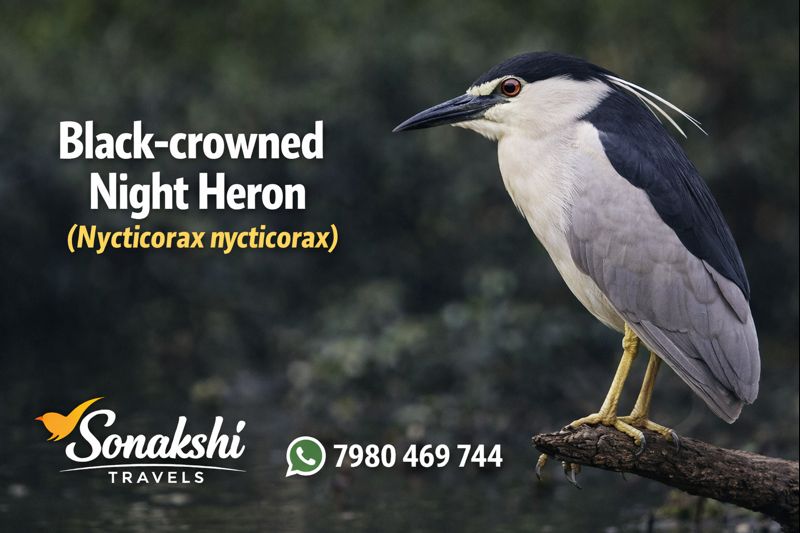
Black-crowned Night Heron (Nycticorax nycticorax):
A Comprehensive Biological and Ecological Study
The Black-crowned Night Heron (Nycticorax nycticorax) is one of the most widely distributed heron species in the world, renowned for its nocturnal habits, robust body structure, and remarkable ecological adaptability. Unlike most herons that forage during daylight hours, this species is primarily crepuscular and nocturnal, emerging at dusk to hunt along wetlands, rivers, estuaries, and mangrove-lined creeks. Its discreet behavior, coupled with excellent camouflage, allows it to thrive across continents, including Asia, Europe, Africa, and the Americas. In India, the species is a familiar yet often overlooked component of wetland ecosystems, including the complex mangrove environment of the Sundarbans.
Taxonomy & Classification
The Black-crowned Night Heron belongs to the family Ardeidae, which encompasses herons, egrets, and bitterns. Within this family, it is placed in the genus Nycticorax, a name derived from Greek words meaning “night raven,” referring to its nocturnal activity and harsh, croaking calls.
Kingdom: Animalia
Phylum: Chordata
Class: Aves
Order: Pelecaniformes
Family: Ardeidae
Genus: Nycticorax
Species: Nycticorax nycticorax
Several subspecies are recognized across its vast range, reflecting minor variations in size and plumage tone. However, the core morphological and behavioral traits remain consistent globally.
Morphology & Field Identification
The Black-crowned Night Heron is a medium-sized, stocky heron with a relatively short neck and legs compared to other members of the heron family. This compact build gives it a hunched appearance when perched, often making it resemble a resting crow or large waterbird at a distance.
Male Features
Adult males exhibit a striking and easily recognizable plumage pattern. The crown and back are glossy black, sharply contrasting with pale grey wings and white underparts. During the breeding season, males develop two to three elongated white occipital plumes that trail elegantly from the back of the head, serving as visual signals during courtship displays.
Female Features
Females closely resemble males in coloration but are generally slightly smaller and may show less pronounced occipital plumes during the breeding season. Sexual dimorphism is subtle, and in most field conditions, males and females are difficult to distinguish without behavioral cues.
Size & Wingspan
Adults typically measure between 58 and 65 centimeters in length. The wingspan ranges from 105 to 112 centimeters, allowing strong, steady flight over wetlands and coastal zones. Body weight generally varies between 800 and 1,000 grams, depending on sex, season, and food availability.
Flight Characteristics
In flight, the Black-crowned Night Heron displays slow, deliberate wingbeats, often flying low over water. The neck is retracted into an S-shaped curve, and the legs trail behind the body. At dusk, individuals can be seen commuting between daytime roosts and nighttime feeding grounds, often in small, loose groups.
Habitat & Distribution
Global Range
The Black-crowned Night Heron has one of the broadest distributions among herons. It occurs across North and South America, Europe, Africa, Asia, and parts of Oceania. This cosmopolitan range highlights its exceptional adaptability to diverse climatic and ecological conditions.
Preferred Habitat
The species favors freshwater and brackish wetlands, including lakes, ponds, marshes, mangroves, rivers, estuaries, and flooded agricultural fields. Dense vegetation, reed beds, and mangrove roots provide essential cover for roosting and nesting.
Diet & Feeding Ecology
The Black-crowned Night Heron is an opportunistic carnivore with a highly flexible diet. It feeds primarily on fish, amphibians, crustaceans, aquatic insects, mollusks, and small reptiles. In some regions, it also consumes small mammals and bird chicks.
Foraging Technique
Foraging typically occurs at night or during twilight hours. The bird employs a sit-and-wait strategy, standing motionless at the water’s edge before striking swiftly with its strong bill. This method conserves energy and is particularly effective in low-light conditions.
Breeding & Reproduction
Breeding seasons vary geographically but are generally synchronized with periods of high food availability. The species is colonial, often nesting alongside other herons and egrets.
Nesting Sites
Nests are typically built in trees, shrubs, reed beds, or mangroves, often over water to reduce predation risk. The nest is a loosely constructed platform of sticks. Females usually lay three to five pale blue-green eggs, which are incubated by both parents.
Unique Adaptations & Behavioral Ecology
Speed & Agility
Despite its stocky appearance, the Black-crowned Night Heron is capable of rapid strikes and agile movements when capturing prey. Its neck musculature allows sudden extension, enabling precise and forceful hunting actions.
Camouflage and Nesting Strategy
The contrasting black, grey, and white plumage provides effective camouflage in low-light conditions. During daylight hours, birds often remain motionless within dense foliage, blending seamlessly into their surroundings.
Social Behavior
Outside the breeding season, individuals may roost communally in large numbers. Vocalizations are most frequent at night, consisting of harsh croaks used for communication within colonies.
Occurrence & Seasonal Movement
In tropical regions, populations are largely resident, while in temperate zones, the species undertakes seasonal migrations to warmer areas during winter. In India, it is generally a year-round resident with some local movements influenced by monsoon-driven water availability.
Preferred Habitat in the Sundarbans Region
Within the Sundarbans, the Black-crowned Night Heron is closely associated with mangrove creeks, tidal mudflats, and freshwater ponds near forest fringes. The intricate network of waterways provides abundant prey and secure roosting sites, making the region an ideal habitat.
Planning a guided mangrove wildlife experience? Discover our expertly curated Sundarban Tour options and explore the region’s rich birdlife.
Ecological Role
As a mid-level predator, the Black-crowned Night Heron plays a vital role in regulating populations of fish and aquatic invertebrates. Its presence indicates healthy wetland ecosystems and balanced trophic interactions.
Habitat Alteration
Wetland degradation, mangrove clearance, pollution, and urban expansion pose localized threats to the species. Although adaptable, sustained habitat loss can lead to population declines, particularly near rapidly developing coastal regions.
Conservation Efforts
The species is currently listed as Least Concern globally, owing to its wide distribution and stable population trends. Conservation measures focus on wetland protection, mangrove restoration, and pollution control, which benefit not only this heron but entire wetland communities.
Looking to observe nocturnal wetland birds in their natural habitat? Choose a responsible Sundarban Tour and experience the Sundarbans after sunset.
Did You Know?
The Black-crowned Night Heron can see exceptionally well in low-light conditions.
Young birds are brown and heavily streaked, taking up to three years to attain full adult plumage.
Its harsh croaking call is often one of the first nocturnal bird sounds heard near wetlands.