Biology, Ecology, and Seasonal Presence in the Sundarbans
The Chinese Sparrowhawk (Accipiter soloensis) is a small yet remarkably agile bird of prey belonging to the family Accipitridae. Despite its modest size, this raptor plays a significant ecological role as an insect and small-vertebrate predator across much of East and Southeast Asia. It is especially notable for its long-distance migratory behavior, undertaking seasonal movements that connect breeding grounds in temperate East Asia with wintering areas in South and Southeast Asia, including parts of eastern India. In recent years, the species has attracted increasing attention among ornithologists and birdwatchers in eastern India due to its regular passage through the lower Gangetic plains and its occasional presence in the Sundarbans landscape.
Taxonomy & Classification
Systematic Position
The Chinese Sparrowhawk is classified within the order Accipitriformes and the family Accipitridae, a diverse group that includes hawks, eagles, kites, and vultures. Within this family, it belongs to the genus Accipiter, which is characterized by forest-adapted raptors possessing short, rounded wings and relatively long tails, features that facilitate rapid maneuvering through dense vegetation.
The species was formally described in the nineteenth century, and its scientific name, soloensis, refers to the Solo (Bengawan Solo) River region of Java, where early specimens were collected. Taxonomically, it is considered a distinct species with no recognized subspecies, although minor regional variation in plumage tone and size has been reported across its wide range.
Morphology & Field Identification
General Appearance
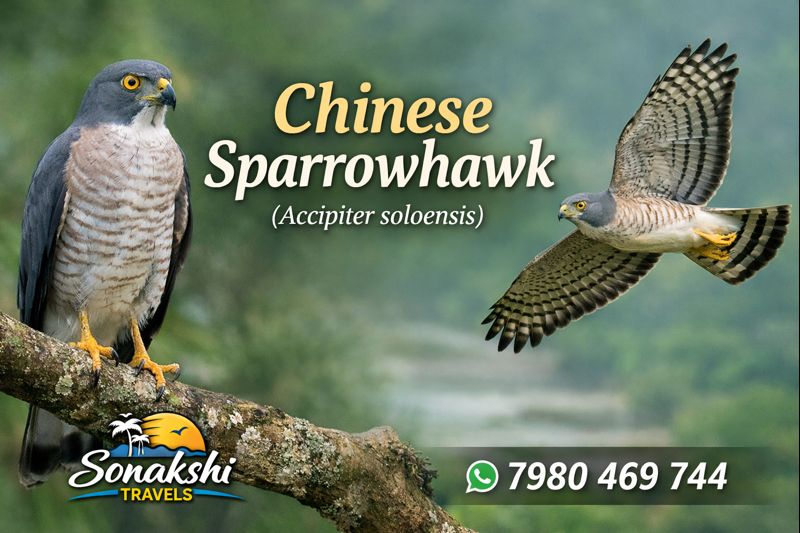
The Chinese Sparrowhawk is a compact raptor with a sleek profile, proportionately long tail, and relatively narrow wings compared to larger hawks. In the field, it often appears delicate, especially when perched, but its swift and purposeful flight quickly reveals its predatory nature. Its plumage is generally subdued, dominated by shades of grey, brown, and white, allowing effective camouflage in wooded environments.
Male Features
Adult males typically exhibit a bluish-grey upperparts coloration, with a pale grey head and nape. The underparts are whitish, often finely barred with light grey or brown. The eyes are strikingly yellow to orange-yellow, lending the bird an alert and intense expression. The legs and cere are yellow, consistent with many members of the genus Accipiter.
Female Features
Females are noticeably larger than males, a common trait among raptors. Their upperparts tend to be browner rather than bluish-grey, and the barring on the underparts is usually more pronounced. This sexual dimorphism is useful in field identification, particularly when observing pairs or mixed groups during migration.
Size & Wingspan
The Chinese Sparrowhawk is among the smaller members of its genus. Adults typically measure between 25 and 30 centimeters in length. The wingspan ranges from approximately 55 to 65 centimeters. Despite its small stature, the species is capable of sustained flight over long distances, a testament to its efficient wing structure and muscular endurance.
Flight Characteristics
Style and Pattern
In flight, the Chinese Sparrowhawk displays a characteristic combination of rapid wingbeats interspersed with short glides. During migration, it may soar at moderate heights, often taking advantage of thermal currents. When hunting or moving through forested areas, its flight becomes low, fast, and highly maneuverable, enabling it to pursue agile prey among foliage.
Habitat & Distribution
Global Range
The species has a broad geographic range extending across East Asia, Southeast Asia, and parts of South Asia. It breeds primarily in eastern China, the Korean Peninsula, and parts of the Russian Far East. During the non-breeding season, it migrates southward to regions including Indonesia, the Philippines, Thailand, Myanmar, Bangladesh, and eastern India.
Preferred Habitat
The Chinese Sparrowhawk shows a strong preference for wooded and semi-wooded landscapes. During the breeding season, it inhabits deciduous and mixed forests, often near clearings or forest edges. In wintering areas, it adapts to a variety of habitats, including secondary forests, plantations, mangrove fringes, and wooded agricultural landscapes.
Diet & Feeding Ecology
Primary Food Sources
Unlike many other Accipiter species that focus heavily on birds, the Chinese Sparrowhawk feeds predominantly on large insects, particularly grasshoppers, crickets, beetles, and cicadas. It also consumes small reptiles, amphibians, and occasionally small birds, especially during the breeding season when energy demands are high.
Foraging Technique
This raptor employs a combination of perch-and-pounce and active aerial pursuit strategies. It often hunts from concealed perches, launching sudden attacks on unsuspecting prey below. During insect swarms, it may be observed catching prey mid-air, demonstrating impressive agility and coordination.
Breeding & Reproduction
Breeding Season
The breeding season typically occurs between May and July in the northern parts of its range. Pairs establish territories within forested habitats, where they engage in aerial displays and vocalizations to reinforce pair bonds and deter rivals.
Nesting Sites
Nests are usually constructed high in trees, often at the junction of strong branches. The structure is made from twigs and lined with leaves or softer plant material. Females typically lay two to four eggs, which are incubated primarily by the female while the male provides food.
Unique Adaptations & Behavioral Ecology
Speed & Agility
The Chinese Sparrowhawk is exceptionally agile, capable of rapid directional changes in mid-air. This agility is crucial for capturing fast-moving insect prey and navigating dense vegetation.
Camouflage and Nesting Strategy
Its muted plumage provides effective camouflage against tree bark and foliage, reducing detection by both prey and potential predators. Nest placement high within the canopy further enhances reproductive success by minimizing disturbance.
Social Behavior
Outside the breeding season, the species is generally solitary. However, during migration, individuals may be observed traveling in loose flocks or aggregations, particularly at well-known raptor migration bottlenecks.
Occurrence & Seasonal Movement
Migration Patterns
The Chinese Sparrowhawk is a long-distance migrant. Large numbers pass through Southeast Asia during autumn migration, with smaller but regular numbers reaching eastern India. Spring migration follows a similar route in reverse, although observations in South Asia during this period are comparatively fewer.
Preferred Habitat in the Sundarbans Region
Local Occurrence
Within the Sundarbans region, the Chinese Sparrowhawk is most often recorded during the winter months and migration periods. It favors mangrove edges, forest clearings, and nearby agricultural fields where insect prey is abundant. Although not a permanent resident, its seasonal presence adds to the avian diversity of this unique mangrove ecosystem.
Exploring winter birdlife along the mangrove creeks can be deeply rewarding. Discover a guided Sundarban Tour designed for nature and bird enthusiasts.
Ecological Role
Ecosystem Function
By preying on large insects and small vertebrates, the Chinese Sparrowhawk contributes to regulating prey populations and maintaining ecological balance. Its presence is often an indicator of healthy insect communities and relatively undisturbed habitats.
Habitat Alteration
Threats and Challenges
Habitat loss due to deforestation, agricultural expansion, and urban development poses a long-term threat to the species, particularly in its breeding range. Pesticide use can also reduce insect prey availability, indirectly affecting survival and reproductive success.
Conservation Efforts
Current Status
The Chinese Sparrowhawk is currently assessed as a species of Least Concern at the global level, owing to its wide range and relatively stable population. Nevertheless, continued monitoring is essential, especially along migratory routes and wintering grounds where habitat changes are rapid.
Nature-focused travel supports conservation awareness. Consider a responsible Sundarban Tour to experience seasonal raptors and mangrove biodiversity.
Did You Know?
Interesting Facts
Despite being a hawk, the Chinese Sparrowhawk relies more on insects than birds for food. During peak migration, thousands may pass through narrow geographic corridors in Southeast Asia, creating spectacular raptor-watching opportunities.
External Reference
Further Reading
For additional taxonomic details, distribution maps, and global conservation assessments, readers may consult the Wikipedia entry on the Chinese Sparrowhawk.