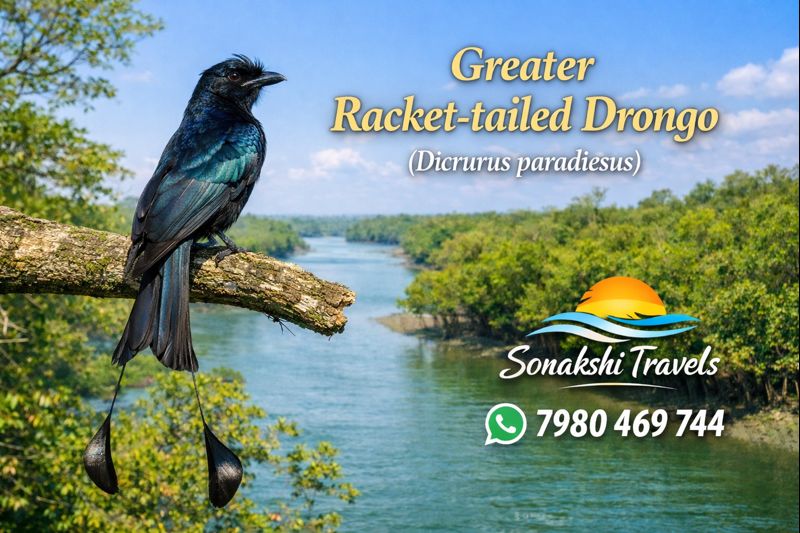
The Greater Racket-tailed Drongo (Dicrurus paradiseus) is among the most visually striking and behaviorally sophisticated passerine birds of tropical Asia. Renowned for its elongated racket-shaped tail feathers, remarkable vocal mimicry, and fearless territorial behavior, this species occupies a unique ecological niche within forest ecosystems. Often described as both a skilled aerial predator and an acoustic virtuoso, the Greater Racket-tailed Drongo represents a compelling subject for ornithological study, particularly within biodiverse landscapes such as the Sundarbans.
Taxonomy & Classification
Systematic Position
The Greater Racket-tailed Drongo belongs to the order Passeriformes and the family Dicruridae, a lineage of insectivorous birds distributed across Africa and Asia. The genus Dicrurus comprises numerous species noted for glossy plumage, aggressive defense behavior, and aerial feeding strategies. Dicrurus paradiseus has historically been part of a complex taxonomic group, with several regional forms once treated as subspecies.
The Greater Racket-tailed Drongo is a medium-sized bird with a sleek, glossy black body exhibiting subtle blue-green iridescence under strong sunlight. Its most defining feature is the long, wire-like outer tail feathers terminating in flattened, paddle-shaped tips, known as rackets. This dramatic tail structure makes the species unmistakable in the field.
Male Features
Adult males display fully developed racketed tail feathers, often exceeding the body length. The plumage is uniformly glossy black with metallic highlights. Males are highly vocal, producing a diverse range of whistles, harsh calls, and complex mimicked sounds, which play a critical role in territorial defense and mate attraction.
Female Features
Females closely resemble males in overall coloration but typically possess shorter tail streamers with less pronounced rackets. Vocal activity is also present in females, though generally less elaborate than that of males. Sexual dimorphism is subtle and most apparent during the breeding season.
Size & Wingspan
The species measures approximately 30 to 35 centimeters in total length, including the elongated tail streamers. The wingspan ranges between 38 and 42 centimeters, supporting agile and sustained flight within forested habitats.
Flight Characteristics
Flight is strong, buoyant, and highly maneuverable. The Greater Racket-tailed Drongo frequently performs aerial sallies, sudden dives, and rapid directional changes, enabling efficient capture of flying insects. The elongated tail feathers trail gracefully during flight without significantly impairing maneuverability.
Habitat & Distribution
Global Range
The Greater Racket-tailed Drongo is widely distributed across South and Southeast Asia, including India, Bangladesh, Sri Lanka, Myanmar, Thailand, Malaysia, Indonesia, and parts of southern China. Its broad range reflects high ecological adaptability across tropical forest systems.
Preferred Habitat
This species inhabits dense evergreen forests, moist deciduous forests, mangrove fringes, and well-wooded riverine corridors. It is commonly observed along forest edges, clearings, and canopy gaps where insect abundance is high.
Diet & Feeding Ecology
Diet Composition
The Greater Racket-tailed Drongo is primarily insectivorous, feeding on beetles, butterflies, moths, dragonflies, ants, termites, and other arthropods. Opportunistically, it may also consume small reptiles, nectar, and fruits during periods of reduced insect availability.
Foraging Technique
Foraging involves perch-and-sally tactics, aerial hawking, and occasional ground foraging. The species is known to follow larger animals or mixed-species bird flocks, capturing insects flushed by their movement.
Breeding & Reproduction
Breeding Season
Breeding typically coincides with the pre-monsoon and monsoon periods, when insect prey is most abundant. Increased vocalization and aerial displays are prominent during this time.
Nesting Sites
Nests are shallow, cup-shaped structures constructed from twigs, rootlets, and plant fibers. They are usually placed on horizontal branches at moderate heights, often overhanging open spaces or water bodies to reduce predation risk.
Unique Adaptations & Behavioral Ecology
Speed & Agility
Exceptional flight agility allows the species to pursue fast-moving prey and evade predators. Strong pectoral muscles and flexible wing joints support rapid acceleration and precise maneuvering.
Camouflage and Nesting Strategy
The glossy black plumage blends effectively with shaded forest canopies, while nest placement on thin branches limits access by arboreal predators. Strategic nesting over open areas further enhances nest security.
Social Behavior
Outside the breeding season, the Greater Racket-tailed Drongo is typically solitary or found in pairs. It is, however, highly interactive within mixed-species flocks, often acting as an early-warning system through alarm calls.
Occurrence & Seasonal Movement
This species is largely resident throughout its range, with limited local movements influenced by food availability and breeding requirements. Seasonal altitudinal movements may occur in hilly regions.
Preferred Habitat in the Sundarbans Region
Within the Sundarbans, the Greater Racket-tailed Drongo is most frequently observed in elevated mangrove forests, forest edges, and transitional zones between dense mangroves and inland woodlands. Its presence reflects healthy insect populations and structurally complex vegetation.
Planning an immersive mangrove wildlife experience? Discover curated itineraries through our Sundarban Tour options designed for nature enthusiasts.
Ecological Role
As a dominant insect predator, the Greater Racket-tailed Drongo contributes to regulating arthropod populations. Its alarm calls also provide indirect protection to other species, enhancing overall community resilience.
Habitat Alteration
Deforestation, mangrove degradation, and habitat fragmentation pose localized threats. While adaptable, prolonged loss of forest structure can negatively impact breeding success and population stability.
Conservation Efforts
The species is currently classified as of Least Concern, yet conservation strategies focusing on forest preservation, mangrove restoration, and sustainable land use remain essential for long-term population security.
Planning a guided mangrove exploration? Browse thoughtfully crafted Sundarban Tour programs and select the itinerary that suits your schedule.
Did You Know?
The Greater Racket-tailed Drongo is one of the most accomplished vocal mimics among birds, capable of imitating alarm calls of multiple species—a strategy that may help it steal food or deter competitors.