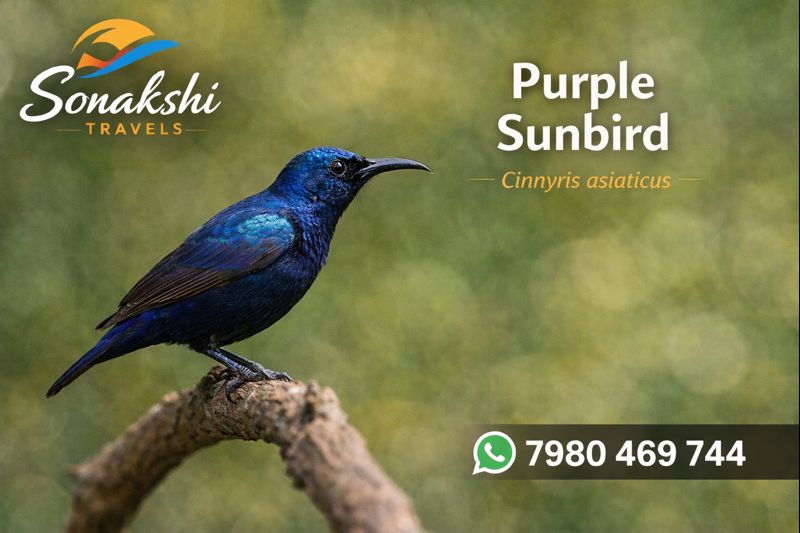
Purple Sunbird (Cinnyris asiaticus):
Biology, Behavior, and Ecological Significance
The Purple Sunbird (Cinnyris asiaticus ) is a small yet remarkably vibrant passerine bird widely distributed across South Asia. Renowned for the male’s iridescent plumage that shifts between deep purple, blue, and black depending on light angle, this species is a prominent representative of nectar-feeding birds in tropical ecosystems. Despite its diminutive size, the Purple Sunbird plays a disproportionately important ecological role as both a pollinator and an insect predator. Its adaptability to natural forests, mangroves, gardens, and urban green spaces makes it an excellent model species for understanding avian resilience in changing landscapes.
Taxonomy & Classification
Systematic Position
The Purple Sunbird belongs to the order Passeriformes and the family Nectariniidae, a group commonly referred to as sunbirds. These birds occupy an ecological niche similar to that of hummingbirds in the Americas, though they are not closely related. The genus Cinnyris comprises numerous Old World sunbird species adapted for nectar feeding.
Kingdom: AnimaliaPhylum: ChordataClass: AvesOrder: PasseriformesFamily: NectariniidaeGenus: CinnyrisSpecies: Cinnyris asiaticus
Morphology & Field Identification
General Appearance
The Purple Sunbird is a slender, short-tailed bird with a downcurved bill adapted for nectar extraction. Its compact body, rapid wingbeats, and frequent darting movements make it instantly recognizable in flowering habitats. Field identification is facilitated by its active behavior and strong association with blooming plants.
Male Features
Adult males exhibit glossy, iridescent plumage that appears blackish in low light but transforms into shimmering shades of purple, blue, and metallic violet under direct sunlight. During the breeding season, males may display elongated central tail feathers and heightened territorial behavior around flowering trees.
Female Features
Females are markedly different in appearance, displaying olive-brown upperparts and pale yellowish underparts. This subdued coloration provides effective camouflage, particularly during nesting and incubation. Females lack the iridescent sheen characteristic of males.
Size & Wingspan
The Purple Sunbird measures approximately 9 to 10 centimeters in body length. Its wingspan ranges from 12 to 14 centimeters, supporting rapid, agile flight rather than sustained gliding.
Flight Characteristics
Flight is fast, direct, and buzzing, with rapid wingbeats that allow hovering for brief moments while feeding on nectar. Although not capable of prolonged hovering like hummingbirds, the Purple Sunbird compensates with agility and precise control.
Habitat & Distribution
Global Range
The species is widely distributed across the Indian subcontinent, including India, Bangladesh, Sri Lanka, Nepal, and parts of Southeast Asia. Its broad range reflects exceptional ecological flexibility.
Preferred Habitat
Purple Sunbirds inhabit open woodlands, forest edges, mangroves, scrublands, gardens, agricultural landscapes, and urban parks. Availability of flowering plants is the primary determinant of habitat suitability.
Diet & Feeding Ecology
Diet Composition
The diet consists primarily of nectar obtained from a wide variety of flowering plants. In addition, the species consumes small insects, spiders, and larvae, which provide essential proteins, particularly during breeding.
Foraging Technique
Foraging involves probing flowers with the curved bill and extensible tongue. The bird frequently perches while feeding but may also hover briefly. Insect prey is captured through aerial sallies or gleaned from foliage.
Breeding & Reproduction
Breeding Season
Breeding typically occurs between February and August, varying regionally with rainfall and flowering cycles. Males establish and defend nectar-rich territories during this period.
Nesting Sites
The nest is a delicate, pouch-like structure suspended from thin branches, often concealed among leaves. It is constructed primarily by the female using plant fibers, spider silk, and fine grasses.
Unique Adaptations & Behavioral Ecology
Speed & Agility
The Purple Sunbird exhibits remarkable maneuverability, enabling it to exploit complex floral structures and evade predators. Rapid wingbeats and lightweight body structure facilitate quick directional changes.
Camouflage and Nesting Strategy
Female plumage coloration blends seamlessly with surrounding foliage, reducing nest detectability. Nest placement among dense leaves further enhances concealment from predators.
Social Behavior
The species is generally solitary or found in pairs. Males are highly territorial during the breeding season and aggressively chase intruders from feeding areas.
Occurrence & Seasonal Movement
The Purple Sunbird is largely resident throughout its range. Local movements may occur in response to seasonal flowering patterns, but long-distance migration is absent.
Preferred Habitat in the Sundarbans Region
In the Sundarbans, Purple Sunbirds are commonly observed along mangrove edges, village gardens, forest clearings, and flowering shrubs near human settlements. They favor areas with continuous floral resources and sheltered perching sites.
Planning a floral-rich mangrove exploration? Discover curated itineraries through our
Sundarban Tour experiences designed for nature lovers.
Ecological Role
The Purple Sunbird serves as an important pollinator for numerous flowering plant species. Its insectivorous habits also contribute to regulating small arthropod populations.
Habitat Alteration
Loss of flowering vegetation, pesticide use, and urban expansion can negatively affect local populations. However, the species’ adaptability allows it to persist in modified habitats where floral resources remain available.
Conservation Efforts
Currently classified as Least Concern, conservation focus remains on preserving native flowering plants, reducing pesticide usage, and maintaining green spaces within urban and rural landscapes.
Planning a guided mangrove adventure? Explore detailed
Sundarban Tour programs and choose the itinerary that matches your interests.
Did You Know?
The Purple Sunbird can appear almost completely black in shade, yet flash brilliant purple and blue hues in sunlight—an effect caused by microscopic feather structures rather than pigment alone.
External Reference
For detailed scientific information, consult: Wikipedia – Purple Sunbird
... read more are very well organised to set up this Sunderban tour in terms of fooding lodging and irrespective every things which relates to this particular tour. Me and my family has a mind blowing experience. Thanks Subhabrata Talukdar to you and to your team for giving us a memorable experience.
Sagar BanerjeeJanuary 17, 2023
... read more staff ( Bapida, Bhaskarda and Uttamda). Special thanks to Talukdar Babu for taking care of everything. Highly recommended.
rupendu banerjeeMarch 17, 2022
... read more boat as well as car was also good. We thank you very much and want to refer in future to our friends n relatives.
K. MadhuNovember 17, 2022
... read more in a single word. Those who want fresh oxygen I suggest they should go Sundarbon and stay in Sabujdeep. Also get good village experience.
Sounava SamantaMarch 17, 2022
... read more package. Here are few points I would like to mention regarding the tour. PROS: 1) The tour organiser, Mr Talukdar gave us a very clear account of the package and there were no hidden cost. 2) We were appointed a manager ( Mr Subrata) during the tour, who was very polite in his dealings. Since I was travelling with my 4 yr old daughter, I had requested him to make few extra arrangements ( in meal) for her ….for which I never had to remind him again and all my requirements were taken care off. 3 ) since we were only 3 families travelling on one boat, we had enough space to ourselves as compared to other boats I saw during the trip were overly crowded. 4) Food was good and the preparation was quite homely. 5)As we had to spend considerable amount of time on the boat…. I was little apprehensive about the cleanliness of the washroom on the boat. But to my surprise, the washroom was sparkling clean. CONS: 1) Though the hotel we were made to stay was very well located… but the rooms were very basic. Rooms are newly made but not very well maintained. The floor of the rooms felt like they were not dusted and mopped in days.There were cobwebs here and there and bathroom had few centipedes. To my opinion..rooms could have been better than what was provided. Overall, it was a well organised trip and Mr Talukdar kept checking on us during the trip which I truly appreciate. We thoroughly enjoyed. And I would certainly recommend Sundarban Travel to my friends and family.
Vaishali SenguptaMarch 17, 2022
... read more customised their programme for our convenience at their best. The boat waiting for us at Gadkhali was decent, neat & clean. The cooperation and helpful gesture of the Boatman Bapibabu and crew Pulak charmed us. The trip through the creeks and distributaries of the rivers of Sunderban became more enjoyable with the excellent taste of food cooked by Bhaskar in the running boat. The property named “Sabuj Dwip” under Lahiripur Gram Panchayat where we were parked at the day-end, was a resort having cottages with clean Rooms, modern Bathrooms & standard amenities including Generator along with a few shortfalls like lack of Geyser, AC, Toilet-shower, Kitchen/Kitchenet, Waste paper bin, Wall Hangers etc., though all such lacuna were covered by the sincere and hearty efforts of the servicemen. The owner may solve these minor problems by purchasing items of trivial value like Emersion Heater, Toilet-shower, Electric Cattle, Waste paper basket & Wall hangers. On 5th December, when the cyclone turned its face to Sunderban, the superb teamwork of Sonakshi rescued us through an alternative safe land-route maintaining our all urbane comfort upto the satisfaction. The courteous behaviour and delicious tasty food are the value-added satisfaction of this trip over the honest, humble and sincere approach of the owner Shuvabratababu which is highly appreciable. I highly recommend Sunderban Trip through this Travels.
Snehansu GangopadhyayMarch 17, 2022
... read more served us very well. Thank you for all your services.
Shaily GuptaMarch 17, 2022
... read more trip of Sundarban ( 3D&2N).The trip was tailor made for our need.The staff members were very courteous & looked after all the nitty gritty to make the trip a memorable one.The food used to be prepared as per our requests & was relished by all members.The night stay arranged in the 5 star resort was superb and in an hospitable atmosphere.The resort has the added feature of being located in a natural surroundings of flora and fauna. It provided attractive play areas for kids. On top of everything, it was pocket friendly & no hidden cost was involved. Would strongly recommend SonakshiTravel for this riverine trip.
Arun BiswasJanuary 17, 2023
... read more date of departure our resort also exceptionally good I sincerely thanks to all cruise staff and manager to Mr. Talukdar.
Ashis RoySeptember 17, 2022
... read more group tours were available Mr Talukder arranged a customized tour for us & we were a little apprehensive as the two of us would be traveling alone . But he assured us about our safety & other facilities & truly everything was beyond our expectations. Right from our pickup, boat tours, hotel accommodation & food everything was well arranged. We have come back with sweet memories. Thank you Mr Talukder & every one at Sonakshi tours.
Leena MhatreMarch 17, 2022
Tripti DasJanuary 17, 2023
Sandhya BhideDecember 17, 2022
... read more staff is always up to the mark. Thank you all.
Rupak BhattacharjeeJanuary 17, 2023
... read more people, beautiful presentation of dance and songs to beautiful boat and boatmen with guide. A journey with100% fulfilment. Willing to go again and again. Thanks a lot Sundarban Travel Jyotirmoy Chakraborty Chairman Ispat Cooperative Hospital
JYOTIRMOY CHAKRABORTYMarch 17, 2022
... read more family including senior citizens and kids and had a nice experience. Thank you Mr. Talukdar and team.
Koushik PandaApril 17, 2022
Gourav GhoshJanuary 17, 2023
... read more tour confirmation 7/10. I paid advance for booking after checking the availability. But after making the payment, I was informed the required dates are not available and I had to change my dates. Communication of programs are also not up to the mark. 2. Transfer from Kolkata to Gadkhali & Return 8/10. Onward journey driver was new and not carrying proper documents for Vehicle. Stuck at Ghatakpukur for more than 30 minutes in a police checking. Return journey was better but the vehicle given was too old. 3. Boat Arrangements from Gadkhali 10/10. Good & comfortable. Well decorated boat with well behaved staffs. 4. Accommodation 10/10. Very good place selection and enjoyed the staying. This point you will get a bonus point. 5. Food 8/10. First day lunch was awesome but next meals were just below par. Lacking variety. I came to know few other agencies are offering more variants in their service. Finally thanks to all your staffs in the boat and in the hotel. Specially mentioning Tapas, Bapi, your cook and Subrata for their service.
Sibagi GhoshMarch 17, 2022
... read more bus that was allotted to us for taking us to the boat and we boarded it from Science City. It was a traveller and its was quite spacious and we travelled witout any problem. One thing that need to be looked upon is that there should be a helper with the driver in orderto contact the tourist for boarding the bus. The driver was speaking in his mobile while which can lead to a few problems. 2) Launch/Boat - It was quite big, spacious, the bathrooms were clean and the crews on board are very welll behaved. My 3 year old son really enjoyed the boat ride throughout the journey. 3) Resort - Some maintenance work is required in the rooms of the resort where we stayed at night. Things like ceiling fan regulator was not working, the flush in the wash room was not working and the room are not properly cleaned. It seemed to me that the room where I stayed was cleaned a long time back. 4) Food - The foods that were served to us was very well cooked. They were not at all spicy, not at all stale. Every time we were served hot and fresh foods. They also arranged food for my 3 year old son as per his requirement. 5) Employees/Crews - They are very well behaved, helpfull and always serving us by giving their level best.
20th Millenium KidMarch 17, 2022
HRITURAJ CHAKRABORTYOctober 17, 2022
... read more local people was truly a fun filled surprise.
Pronami SarkarMarch 17, 2022
... read more on board were very cordial and co-operative. The food served was abundant and of good quality and taste. We didn't felt when the whole day passed away. Complete value for money. I would recommend everyone should have a try with Sonakshi Travels.
S DGMarch 17, 2022
... read more and the boat ride were upto another level. Thank you so much for this wonderful treat. Looking forward to visit again. 😊
CHANDNI NASKARDecember 17, 2022
... read more homely environment, mainly we are extremely impressed the condition of the boat, cleanliness and food quality was superb. Except the chilli chicken preparation ( not upto the mark), the taste of the food was just like home made food. Resort location was good but not in good quality, need to look into this to provide the best service. Also the car condition is not good. Apart from these we enjoyed a lot throughout the tour. Special thanks to Mr.Talukdar and Team for organizing our memorable trip.
Amit SasmalMarch 17, 2022
pramod tembhurnikarFebruary 17, 2023
... read more the stuff were very polite (Special mention- dipankar da).They did everything with professional manner with touch of heart. Strongly recommend them.
ataur rahamanMarch 17, 2022
Partha Sarathi MajumderFebruary 17, 2023
... read more recommend their package
Sanghita RoyMarch 17, 2022
... read more end point by professional guides who displayed very courteous behavior. definitely talukdar ji will be my preferred choice for all trips in future as well.
Auditro Hi-Fi SystemsDecember 17, 2022
... read more 10th to 12th of December, 2021 ( 2 nights 3 days package). I take pleasure in sharing my/ our experience with Mr Suvabrata ( Sonakshi Travels to us means Mr Suvabrata). # Mr Suvabrata, a perfect gentleman, with polite behaviour, understanding/ empathetic & extremely helpful nature. # Well organized & hastle free tour. # Polite & helpful staffs. # Punctuality is a batch.... whether it's transport, food, sight seeing, arrival or departure, everywhere time schedule was perfectly maintained. # Well designed itinerary & all places covered providing flexibility to the visitors. # Neat & clean car & boat. We were lucky to have a boat for ourselves. Hearty thanks to Mr Suvabrata for the unexpected surprise. # Place of stay was clean, beautiful & comfortable with all basic necessities including hot water. # Delicious food was served both veg & non-veg. # Pocket friendly package. No hidden charges or extra money demanded. Words will fall short to express my appreciation for MR SUVABRATA (SONAKSHI TRAVELS) & his TEAM. No one ( staffs) wore a frown throughout the trip & left not a single area for complaint. Once again I, on behalf of my family & friends, convey my wholehearted thanks to Mr Suvabrata & team. Looking forward to join you for some other trip.
Manisha Roy Chowdhury GhantiMarch 17, 2022
... read more food with rustic touch...You're at a right place..Being at a place which is remote, Dinner variety options may be limited but enough to satisfy you..I had Aged people n kid travelling with me and they were taken good care..The accommodation & boat ride were very comforting n all the staffs, tour guide were helpful..I will recommend them to Families, friends for sure.
Arunima RoyMarch 11, 2023
... read more staff. Just one regret with the govt to allow more routes inside core jungle to increase footfall at Sunderbans. All you can see is Deer. However i would surely visit again.
navin jayaramanMarch 17, 2022
... read more team members for making our trip memorable one.
Alaya NayakMarch 17, 2022
Dr. Sikka & associatesJanuary 17, 2023
... read more for the tour. They provide us a car and launch for this trip. It was very organised trip.
Faiz AhmedMarch 17, 2022
... read more care of every group member as per the need, especially the elderly ones. I travelled with the parents and the staff members made the trip super comfortable for them as well. Thanks to each one of them!! 😊🙏 Would highly recommend Sonakshi Travels for the Sundarban trip.
Shuchita MitraMarch 17, 2022
... read more boat is undercover with green carpet,so it'is looking beautiful,all management are peaceful Jumur dance is wonderful our all member danced with Jumur dancers we are all coming a sweet memories. Thanks to continue Mr Talukder.
Avijit SarkarMarch 17, 2022
... read more very beautiful ❤️👍🏻
Sandeep MukherjeeMarch 17, 2022
Dipanjan BiswasMarch 17, 2022
... read more did a fantastic job. Wish them all the very best.
Avik RoyJanuary 17, 2023
... read more of staff was very good
DEV KUMAR PYNEDecember 17, 2022