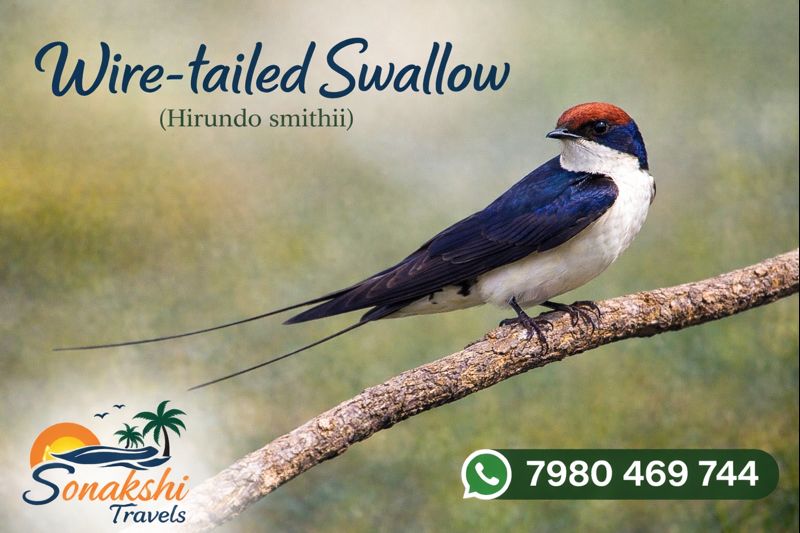
An In-depth Study of Biology, Ecology and Aerial Adaptations
The Wire-tailed Swallow (Hirundo smithii) is among the most visually striking members of the swallow family, instantly recognizable by its elongated filament-like outer tail feathers, from which its common name is derived. Graceful in flight and highly specialized for aerial feeding, this species is widely distributed across South Asia and sub-Saharan Africa. Its close association with freshwater habitats, bridges, and riverine landscapes makes it an important ecological indicator of aquatic and riparian ecosystem health. This comprehensive article presents a detailed, research-oriented account of the Wire-tailed Swallow’s taxonomy, morphology, behavior, habitat preferences, and ecological significance, with special reference to its occurrence in eastern India and the Sundarbans region.
Taxonomy & Classification
The Wire-tailed Swallow belongs to the order Passeriformes, which encompasses more than half of all known bird species. Within this order, it is a member of the family Hirundinidae, a lineage of aerial insectivores adapted for sustained flight and mid-air foraging. The species is currently placed within the genus Hirundo, although taxonomic revisions have occasionally proposed alternative generic placements based on morphological and molecular evidence.
Kingdom: Animalia
Phylum: Chordata
Class: Aves
Order: Passeriformes
Family: Hirundinidae
Genus: Hirundo
Species: Hirundo smithii
Two primary subspecies are generally recognized, corresponding to African and Asian populations. These subspecies exhibit minor variations in plumage tone and tail length, shaped by geographic separation and local ecological conditions.
Morphology & Field Identification
The Wire-tailed Swallow is a slender, medium-sized swallow characterized by glossy blue-black upperparts, clean white underparts, and a contrasting chestnut or rufous crown. Its most distinctive feature is the pair of elongated, wire-like outer tail feathers that trail conspicuously behind the bird in flight, especially in adult males.
Male Features
Adult males display exceptionally long, filamentous outer tail streamers that can exceed the length of the body itself. These wire-like extensions are thin, flexible, and highly conspicuous, serving as visual signals during courtship. Males also tend to exhibit slightly richer coloration on the crown and upperparts, enhancing their overall contrast.
Female Features
Females closely resemble males in plumage pattern but have noticeably shorter tail filaments. The difference in tail length is the most reliable external indicator of sex in the field. Females may also appear marginally duller in overall sheen, though this distinction is subtle.
Size & Wingspan
The Wire-tailed Swallow measures approximately 14–17 cm in body length, excluding the elongated tail filaments. When including these streamers, total length can exceed 22 cm in adult males. The wingspan typically ranges between 30 and 34 cm, allowing for agile and energy-efficient flight.
Flight Characteristics
Flight is smooth, buoyant, and highly controlled. The species often flies low over water surfaces, tracing gentle arcs as it hunts for insects. Despite the apparent drag created by the long tail filaments, flight efficiency remains high due to finely tuned wing morphology and muscular coordination.
Habitat & Distribution
Global Range
The Wire-tailed Swallow has a broad but discontinuous distribution. In Africa, it occurs widely south of the Sahara, while in Asia it is found across the Indian subcontinent, Sri Lanka, parts of Southeast Asia, and southern China. Asian populations are largely resident, whereas some African populations exhibit seasonal movements linked to rainfall.
Preferred Habitat
This species shows a strong affinity for freshwater habitats. Rivers, lakes, reservoirs, canals, and wetlands form the core of its habitat range. Human-made structures such as bridges, culverts, and dams are frequently used for nesting, provided they are located near suitable feeding areas.
Diet & Feeding Ecology
The Wire-tailed Swallow is an obligate insectivore, feeding almost exclusively on small flying insects. Its diet includes flies, mosquitoes, midges, beetles, and winged ants, many of which emerge in large numbers near water bodies.
Foraging Technique
Foraging occurs on the wing, typically at low altitude above water surfaces or open ground. The bird captures prey mid-air using rapid bill snaps, often flying in loose groups that exploit localized insect swarms. This feeding strategy maximizes efficiency while minimizing competition.
Breeding & Reproduction
Breeding seasons vary regionally but are generally aligned with periods of high insect abundance. In the Indian subcontinent, breeding often coincides with the post-monsoon and early summer months, when food resources are plentiful.
Nesting Sites
The Wire-tailed Swallow constructs shallow, open cup-shaped nests made primarily of mud pellets, plant fibers, and saliva. These nests are typically placed on vertical surfaces beneath bridges, culverts, and overhanging structures close to water. Nest placement minimizes disturbance and provides protection from direct rainfall and predators.
Unique Adaptations & Behavioral Ecology
Speed & Agility
Although not among the fastest swallows, the Wire-tailed Swallow exhibits exceptional agility and fine-scale maneuverability. Its ability to execute tight turns at low altitude is particularly advantageous when foraging over narrow water channels.
Camouflage and Nesting Strategy
Mud nests closely resemble the surrounding substrate, providing effective camouflage. Nest placement in shaded, sheltered locations further reduces visibility and exposure to predators, contributing to higher breeding success.
Social Behavior
The species is moderately social. Outside the breeding season, individuals often gather in small flocks and may roost communally. During breeding, pairs defend the immediate vicinity of their nests but tolerate close neighbors, especially in optimal nesting sites.
Occurrence & Seasonal Movement
In South Asia, the Wire-tailed Swallow is largely resident, with local movements influenced by water availability and insect abundance. Seasonal dispersal may occur during extreme dry periods, but long-distance migration is uncommon in Asian populations.
Preferred Habitat in the Sundarbans Region
Within the Sundarbans, the Wire-tailed Swallow is frequently observed along tidal rivers, creeks, embankments, and near bridges connecting islands. The region’s vast network of waterways supports dense insect populations, making it an ideal feeding environment, particularly during the dry winter and early summer months.
Visitors exploring riverine birdlife can encounter elegant aerial species during a carefully planned Sundarban Tour, especially along open waterways and embankments.
Ecological Role
By consuming large quantities of flying insects, the Wire-tailed Swallow contributes significantly to natural insect population regulation. Its role is particularly important in wetland ecosystems, where insect outbreaks can otherwise become problematic.
Habitat Alteration
Alterations to freshwater systems through pollution, river channel modification, and pesticide use pose localized threats. Loss of suitable nesting structures during infrastructure renovation can also impact breeding success in certain areas.
Conservation Efforts
Currently listed as a species of least concern, conservation measures emphasize the protection of freshwater habitats and the maintenance of insect-rich environments. Public awareness and bird-friendly infrastructure planning can further support stable populations.
Nature-focused travel programs highlighting birds and wetlands are available through curated Sundarban Tour itineraries designed for wildlife enthusiasts.
Did You Know?
The wire-like tail filaments of adult males are among the most extreme tail modifications seen in swallows.
The species frequently nests under bridges, benefiting from human-made structures near water.
Despite their long tail streamers, Wire-tailed Swallows maintain excellent flight efficiency.
External Reference
Additional scientific and taxonomic details can be found at Wikipedia.