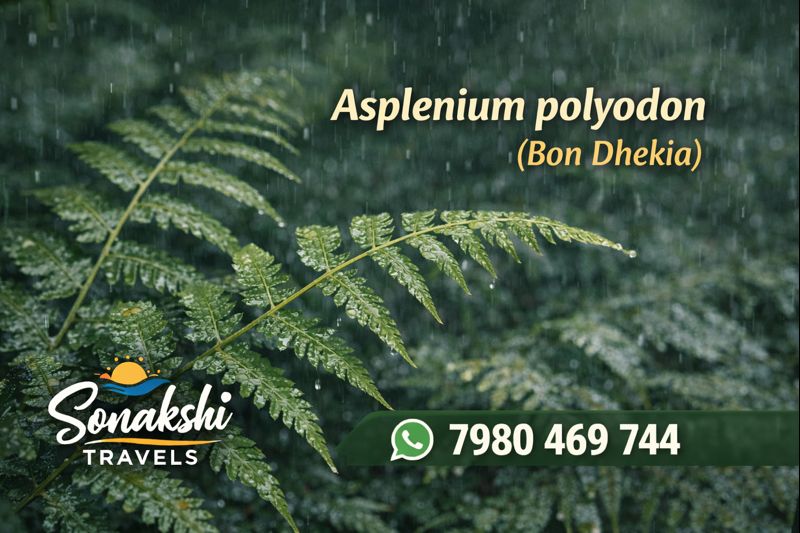
Asplenium polyodon (Bon Dhekia):
A Comprehensive Botanical and Ecological Study
Asplenium polyodon Bon Dhekia in parts of eastern India and Bangladesh, is a graceful evergreen fern belonging to the family Aspleniaceae. Distinguished by its elongated fronds, glossy leaf surface, and preference for shaded, moisture-rich habitats, this species is a characteristic component of tropical forest understories and riparian ecosystems. Unlike marsh-dwelling dhekia ferns, Asplenium polyodon is primarily a forest-associated species, reflecting a distinct ecological strategy.
Bon Dhekia plays a subtle yet essential role in forest microclimates, soil stability, and moisture retention. Its presence often indicates undisturbed or moderately intact habitats with consistent humidity. This article presents a detailed, research-based examination of Asplenium polyodon , focusing on its taxonomy, morphology, habitat preferences, distribution, ecological role, and conservation considerations, with particular reference to its occurrence in the Sundarbans region.
Taxonomy & Classification
Asplenium polyodon belongs to one of the largest fern genera, Asplenium , which comprises species adapted to a wide range of ecological niches, from forest floors to rock crevices and epiphytic habitats.
Kingdom: PlantaeDivision: Polypodiophyta (Pteridophyta)Class: PolypodiopsidaOrder: PolypodialesFamily: AspleniaceaeGenus: AspleniumSpecies: Asplenium polyodon
Members of the Aspleniaceae family are characterized by linear or oblong sori arranged along veins, a feature that is clearly expressed in Asplenium polyodon .
Morphology & Field Identification
Growth Habit and Rhizome
Asplenium polyodon is a medium-sized, evergreen fern with a tufted growth habit. It arises from a short, erect or slightly creeping rhizome that is densely covered with brown to dark chestnut-colored scales. These scales protect the rhizome from desiccation and mechanical damage.
Frond Structure
The fronds are simple to shallowly lobed, lanceolate to narrowly elliptic in shape, and can reach lengths of 40–90 cm. The stipe is relatively short compared to the lamina and is dark green to brownish near the base.
The lamina is glossy, leathery, and deep green, with a pronounced midrib and numerous oblique lateral veins. Margins are finely toothed, a characteristic reflected in the species epithet polyodon , meaning “many-toothed.”
Reproductive Features
Sori are elongated and linear, arranged obliquely along the veins on the underside of the fronds. Each sorus is protected by a narrow, membranous indusium that opens toward the midrib. Spore production occurs primarily during humid seasons, ensuring optimal conditions for germination.
Habitat & Distribution
Global Range
Asplenium polyodon is distributed widely across tropical and subtropical Asia. Its range includes India, Bangladesh, Nepal, Bhutan, Myanmar, Thailand, Laos, Vietnam, southern China, Malaysia, Indonesia, and parts of the western Pacific.
The species is especially abundant in regions with monsoon-driven climates, where high humidity and shaded environments prevail for much of the year.
Preferred Habitat
This fern prefers shaded forest floors, rocky slopes, stream banks, moist ravines, and occasionally tree bases. It thrives in humus-rich soils with good drainage yet consistent moisture availability.
Asplenium polyodon is intolerant of prolonged waterlogging and high salinity, which distinguishes it ecologically from wetland dhekia ferns.
Occurrence
The occurrence of Asplenium polyodon is closely tied to seasonal moisture regimes. Frond growth is most vigorous during the monsoon and post-monsoon periods, while growth slows during extended dry spells.
As an evergreen species, it retains functional fronds throughout the year in favorable microclimates, contributing to stable ground cover in forested habitats.
Preferred Habitat in the Sundarbans Region
Within the Sundarbans, Asplenium polyodon is confined to non-saline, shaded microhabitats. These include elevated embankments, freshwater forest patches, village groves, and areas along freshwater canals where salinity influence is minimal.
The fern is absent from core mangrove zones but may occur in transitional landscapes where terrestrial forest elements intersect with deltaic systems.
Explore the diverse ecological transitions of the delta through curated journeys. Discover our
Sundarban Tour experiences designed for nature enthusiasts.
Ecological Role
Asplenium polyodon contributes significantly to forest-floor ecology. Its dense frond canopy helps regulate soil temperature and moisture, reducing evaporation and creating favorable conditions for microorganisms and invertebrates.
The fern also plays a role in soil formation by trapping organic debris and leaf litter, which decomposes to enrich the forest substrate.
Habitat Alteration
Anthropogenic Pressure
Deforestation, land conversion, and infrastructure development reduce shaded forest habitats essential for Asplenium polyodon . Removal of canopy cover leads to increased light exposure and soil drying, which negatively affects fern populations.
Environmental Stress
Altered rainfall patterns and prolonged dry periods associated with climate variability further threaten suitable microhabitats, particularly in fragmented landscapes.
Conservation Efforts
Although Asplenium polyodon is not globally threatened, localized conservation measures are important. Protecting forest understory vegetation, maintaining riparian buffers, and preserving freshwater forest patches contribute to population stability.
Community-based forest stewardship and awareness of fern diversity can further support conservation outcomes in ecologically sensitive regions.
Experience the hidden green layers of the delta responsibly. Plan your journey with our curated
Sundarban Tour itineraries focused on ecology and heritage.
Did You Know?
The genus Asplenium includes over 700 species worldwide.
Bon Dhekia prefers stable humidity and avoids open, sun-exposed habitats.
Its glossy fronds help reduce water loss in shaded forest environments.
The species often grows alongside mosses and liverworts.
External Reference
For additional botanical and taxonomic information, consult: https://en.wikipedia.org/wiki/Asplenium
... read more food with rustic touch...You're at a right place..Being at a place which is remote, Dinner variety options may be limited but enough to satisfy you..I had Aged people n kid travelling with me and they were taken good care..The accommodation & boat ride were very comforting n all the staffs, tour guide were helpful..I will recommend them to Families, friends for sure.
Arunima RoyMarch 11, 2023
... read more and the boat ride were upto another level. Thank you so much for this wonderful treat. Looking forward to visit again. 😊
CHANDNI NASKARDecember 17, 2022
... read more for the tour. They provide us a car and launch for this trip. It was very organised trip.
Faiz AhmedMarch 17, 2022
... read more end point by professional guides who displayed very courteous behavior. definitely talukdar ji will be my preferred choice for all trips in future as well.
Auditro Hi-Fi SystemsDecember 17, 2022
... read more tour confirmation 7/10. I paid advance for booking after checking the availability. But after making the payment, I was informed the required dates are not available and I had to change my dates. Communication of programs are also not up to the mark. 2. Transfer from Kolkata to Gadkhali & Return 8/10. Onward journey driver was new and not carrying proper documents for Vehicle. Stuck at Ghatakpukur for more than 30 minutes in a police checking. Return journey was better but the vehicle given was too old. 3. Boat Arrangements from Gadkhali 10/10. Good & comfortable. Well decorated boat with well behaved staffs. 4. Accommodation 10/10. Very good place selection and enjoyed the staying. This point you will get a bonus point. 5. Food 8/10. First day lunch was awesome but next meals were just below par. Lacking variety. I came to know few other agencies are offering more variants in their service. Finally thanks to all your staffs in the boat and in the hotel. Specially mentioning Tapas, Bapi, your cook and Subrata for their service.
Sibagi GhoshMarch 17, 2022
... read more are very well organised to set up this Sunderban tour in terms of fooding lodging and irrespective every things which relates to this particular tour. Me and my family has a mind blowing experience. Thanks Subhabrata Talukdar to you and to your team for giving us a memorable experience.
Sagar BanerjeeJanuary 17, 2023
... read more people. The jungle visit was great and we could see so many animals
Kunal BasuMarch 17, 2022
... read more cottage were excellent. Subrat dada was extremely well informed about the forests. His knowledge helped us a lot. Extremely grateful🙏
Shradha Suman SatpathyMarch 17, 2022
... read more a 21 heads office tour for two days and one night . Basically, it was a farewell to our General Manager. Ministry of Defence. Government of India. Following may noted for further: Promised were executed 💯% Timely availability of traveler on pick-up point. Food quality and quantity was very good. Comfortable night stay. Room condition was good. Arrangment of Folk dance 💃 was supab. Recommended for the tour.
Umesh PaswanJanuary 17, 2023
... read more boat as well as car was also good. We thank you very much and want to refer in future to our friends n relatives.
K. MadhuNovember 17, 2022
... read more date of departure our resort also exceptionally good I sincerely thanks to all cruise staff and manager to Mr. Talukdar.
Ashis RoySeptember 17, 2022
prabhat kumar banerjeeSeptember 17, 2022
Raghavendra MunghateDecember 17, 2022
... read more team, tour manager Subrata, boat captain Bapi da and our guide Tanmoy da was very cooperative and helpful. Our stay was in Sobuj Deep Resort, the location is next to the river and rooms are quite good in size, there 4 bedrooms can accommodate 2 families with one kid comfortably. The facilities and services of boat and resort was excellent. My objective was to spend some time with family in the nature, and a wild wish if we could spot the graceful royal Bengal tiger in the wild was 100% fulfilled. When I was researching for this tour, I found Sundarbans travel (Sonakshi travel) rated 4.5 among all, and I am not disappointed as well. Next time when I will visit Sundarbans again my choice will be Sundarbans travel. All over experience “The tour is mind blowing”.
Kaustav ChatterjeeMarch 17, 2022
... read more was excellent..inspite some language problem staff were very very humble n cooperative n always willing to serve to our satisfaction...i surely will recommend my friends/ relatives to visit the place once in lifetime through Sonakshi Travels...🙏🙏🙏
Munna DewanJanuary 17, 2023
... read more served us very well. Thank you for all your services.
Shaily GuptaMarch 17, 2022
Dr. Sikka & associatesJanuary 17, 2023
... read more family including senior citizens and kids and had a nice experience. Thank you Mr. Talukdar and team.
Koushik PandaApril 17, 2022
... read more customised their programme for our convenience at their best. The boat waiting for us at Gadkhali was decent, neat & clean. The cooperation and helpful gesture of the Boatman Bapibabu and crew Pulak charmed us. The trip through the creeks and distributaries of the rivers of Sunderban became more enjoyable with the excellent taste of food cooked by Bhaskar in the running boat. The property named “Sabuj Dwip” under Lahiripur Gram Panchayat where we were parked at the day-end, was a resort having cottages with clean Rooms, modern Bathrooms & standard amenities including Generator along with a few shortfalls like lack of Geyser, AC, Toilet-shower, Kitchen/Kitchenet, Waste paper bin, Wall Hangers etc., though all such lacuna were covered by the sincere and hearty efforts of the servicemen. The owner may solve these minor problems by purchasing items of trivial value like Emersion Heater, Toilet-shower, Electric Cattle, Waste paper basket & Wall hangers. On 5th December, when the cyclone turned its face to Sunderban, the superb teamwork of Sonakshi rescued us through an alternative safe land-route maintaining our all urbane comfort upto the satisfaction. The courteous behaviour and delicious tasty food are the value-added satisfaction of this trip over the honest, humble and sincere approach of the owner Shuvabratababu which is highly appreciable. I highly recommend Sunderban Trip through this Travels.
Snehansu GangopadhyayMarch 17, 2022
HRITURAJ CHAKRABORTYOctober 17, 2022
... read more members of the group were also very social and supportive. Thanks for gifting a pleasant memory for a long time.
Biplab SarkarJanuary 17, 2023
... read more the stuff were very polite (Special mention- dipankar da).They did everything with professional manner with touch of heart. Strongly recommend them.
ataur rahamanMarch 17, 2022
... read more bus that was allotted to us for taking us to the boat and we boarded it from Science City. It was a traveller and its was quite spacious and we travelled witout any problem. One thing that need to be looked upon is that there should be a helper with the driver in orderto contact the tourist for boarding the bus. The driver was speaking in his mobile while which can lead to a few problems. 2) Launch/Boat - It was quite big, spacious, the bathrooms were clean and the crews on board are very welll behaved. My 3 year old son really enjoyed the boat ride throughout the journey. 3) Resort - Some maintenance work is required in the rooms of the resort where we stayed at night. Things like ceiling fan regulator was not working, the flush in the wash room was not working and the room are not properly cleaned. It seemed to me that the room where I stayed was cleaned a long time back. 4) Food - The foods that were served to us was very well cooked. They were not at all spicy, not at all stale. Every time we were served hot and fresh foods. They also arranged food for my 3 year old son as per his requirement. 5) Employees/Crews - They are very well behaved, helpfull and always serving us by giving their level best.
20th Millenium KidMarch 17, 2022
... read more local people was truly a fun filled surprise.
Pronami SarkarMarch 17, 2022
Dipanjan BiswasMarch 17, 2022
... read more trip of Sundarban ( 3D&2N).The trip was tailor made for our need.The staff members were very courteous & looked after all the nitty gritty to make the trip a memorable one.The food used to be prepared as per our requests & was relished by all members.The night stay arranged in the 5 star resort was superb and in an hospitable atmosphere.The resort has the added feature of being located in a natural surroundings of flora and fauna. It provided attractive play areas for kids. On top of everything, it was pocket friendly & no hidden cost was involved. Would strongly recommend SonakshiTravel for this riverine trip.
Arun BiswasJanuary 17, 2023
... read more on board were very cordial and co-operative. The food served was abundant and of good quality and taste. We didn't felt when the whole day passed away. Complete value for money. I would recommend everyone should have a try with Sonakshi Travels.
S DGMarch 17, 2022
... read more boat is undercover with green carpet,so it'is looking beautiful,all management are peaceful Jumur dance is wonderful our all member danced with Jumur dancers we are all coming a sweet memories. Thanks to continue Mr Talukder.
Avijit SarkarMarch 17, 2022
... read more staff ( Bapida, Bhaskarda and Uttamda). Special thanks to Talukdar Babu for taking care of everything. Highly recommended.
rupendu banerjeeMarch 17, 2022
Gourav GhoshJanuary 17, 2023
pramod tembhurnikarFebruary 17, 2023
... read more dismantled as the driver uses it impulsively :) Definitely recommended...
Indraneil GhoshJanuary 17, 2023
... read more with Mr.Suvabrata Talukder.We were 13 heads (including 3 senior citizen and 2 child of 5 years old).It was a programme from Howrah to Howrah (railway station). Yesterday (13th November 2021) we returned from our trip. Overall experience was awesome.Communication with Mr. Talukder over phone before journey came in reality through the entire tour in every respect. Manager Subrata and other staff of boat along with the staff of the resort was very helpful and polite . Behaviour of the staff was very good. Food quality was really good .Not to much spicy but tasty , quantity was sufficient.The resort we stayed (Sabujdieep) was good /clean/safe and a small walking from jetty where we dropped from boat.One evening we enjoyed tribal music and dance in the resort. We along with my co- travellers enjoyed the tour with amazing experience ,kept beautiful moments and memories for life time with us. Everything was perfect. Arrangements in every angle was Wonderful. I strongly suggest and recommend everyone to enjoy your tour with this Sonakshi Travel (Sonarpur).
Anjan RayMarch 17, 2022
... read more homely environment, mainly we are extremely impressed the condition of the boat, cleanliness and food quality was superb. Except the chilli chicken preparation ( not upto the mark), the taste of the food was just like home made food. Resort location was good but not in good quality, need to look into this to provide the best service. Also the car condition is not good. Apart from these we enjoyed a lot throughout the tour. Special thanks to Mr.Talukdar and Team for organizing our memorable trip.
Amit SasmalMarch 17, 2022
... read more staff is always up to the mark. Thank you all.
Rupak BhattacharjeeJanuary 17, 2023
... read more 10th to 12th of December, 2021 ( 2 nights 3 days package). I take pleasure in sharing my/ our experience with Mr Suvabrata ( Sonakshi Travels to us means Mr Suvabrata). # Mr Suvabrata, a perfect gentleman, with polite behaviour, understanding/ empathetic & extremely helpful nature. # Well organized & hastle free tour. # Polite & helpful staffs. # Punctuality is a batch.... whether it's transport, food, sight seeing, arrival or departure, everywhere time schedule was perfectly maintained. # Well designed itinerary & all places covered providing flexibility to the visitors. # Neat & clean car & boat. We were lucky to have a boat for ourselves. Hearty thanks to Mr Suvabrata for the unexpected surprise. # Place of stay was clean, beautiful & comfortable with all basic necessities including hot water. # Delicious food was served both veg & non-veg. # Pocket friendly package. No hidden charges or extra money demanded. Words will fall short to express my appreciation for MR SUVABRATA (SONAKSHI TRAVELS) & his TEAM. No one ( staffs) wore a frown throughout the trip & left not a single area for complaint. Once again I, on behalf of my family & friends, convey my wholehearted thanks to Mr Suvabrata & team. Looking forward to join you for some other trip.
Manisha Roy Chowdhury GhantiMarch 17, 2022
... read more team members for making our trip memorable one.
Alaya NayakMarch 17, 2022
... read more people, beautiful presentation of dance and songs to beautiful boat and boatmen with guide. A journey with100% fulfilment. Willing to go again and again. Thanks a lot Sundarban Travel Jyotirmoy Chakraborty Chairman Ispat Cooperative Hospital
JYOTIRMOY CHAKRABORTYMarch 17, 2022
... read more package. Here are few points I would like to mention regarding the tour. PROS: 1) The tour organiser, Mr Talukdar gave us a very clear account of the package and there were no hidden cost. 2) We were appointed a manager ( Mr Subrata) during the tour, who was very polite in his dealings. Since I was travelling with my 4 yr old daughter, I had requested him to make few extra arrangements ( in meal) for her ….for which I never had to remind him again and all my requirements were taken care off. 3 ) since we were only 3 families travelling on one boat, we had enough space to ourselves as compared to other boats I saw during the trip were overly crowded. 4) Food was good and the preparation was quite homely. 5)As we had to spend considerable amount of time on the boat…. I was little apprehensive about the cleanliness of the washroom on the boat. But to my surprise, the washroom was sparkling clean. CONS: 1) Though the hotel we were made to stay was very well located… but the rooms were very basic. Rooms are newly made but not very well maintained. The floor of the rooms felt like they were not dusted and mopped in days.There were cobwebs here and there and bathroom had few centipedes. To my opinion..rooms could have been better than what was provided. Overall, it was a well organised trip and Mr Talukdar kept checking on us during the trip which I truly appreciate. We thoroughly enjoyed. And I would certainly recommend Sundarban Travel to my friends and family.
Vaishali SenguptaMarch 17, 2022
... read more recommend their package
Sanghita RoyMarch 17, 2022