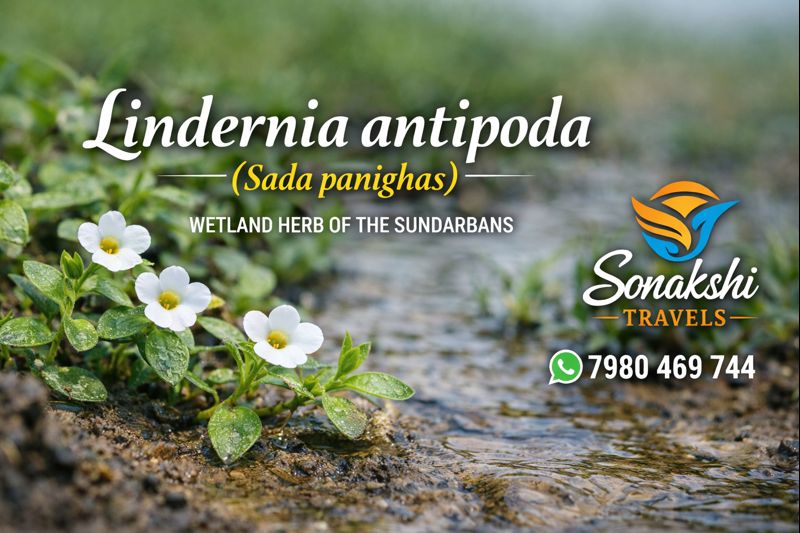
Lindernia antipoda, locally known as Sada Panighas, is a delicate wetland herb belonging to the family Linderniaceae. Though modest in size and often unnoticed amidst dense seasonal vegetation, this species holds considerable ecological importance in freshwater and semi-aquatic habitats. It thrives in low-lying landscapes shaped by monsoonal flooding, shallow water retention, and fluctuating soil moisture, making it a characteristic component of tropical wetland flora.
In eastern India and the lower Gangetic plains, Lindernia antipoda is commonly observed along the margins of ponds, canals, agricultural wetlands, and seasonal marshes. Its short life cycle, rapid germination, and ability to adapt to temporary inundation enable it to occupy ecological niches that are often unsuitable for larger or woody plants. In deltaic regions such as the Sundarbans periphery, this species contributes to the subtle botanical diversity that supports wetland stability and resilience.
Taxonomy & Classification
The classification of Lindernia antipoda reflects modern botanical understanding of herbaceous wetland plants within the order Lamiales. Earlier taxonomic systems grouped many species of this genus under broader families; however, contemporary molecular and morphological studies have refined its placement.
Systematic Position
Kingdom: Plantae
Clade: Angiosperms
Clade: Eudicots
Order: Lamiales
Family: Linderniaceae
Genus: Lindernia
Species:Lindernia antipoda
The genus Lindernia comprises numerous small herbs adapted to wet or periodically flooded environments. Species within this genus share structural similarities but are distinguished by subtle variations in floral morphology, leaf shape, and growth habit.
Morphology & Field Identification
Field identification of Lindernia antipoda requires close observation due to its diminutive size and resemblance to other wetland herbs. However, certain morphological traits provide reliable diagnostic features.
Growth Habit and Stem
This species is a low-growing, creeping to ascending annual herb. Stems are slender, soft, and green, often rooting at the nodes when in prolonged contact with moist soil. The plant typically forms spreading mats over damp substrates, allowing it to rapidly cover exposed mudflats after receding water levels.
Leaves
Leaves are arranged oppositely along the stem and are ovate to oblong in shape. The leaf margins are smooth, and the surface is glabrous, giving a fresh, tender appearance. Leaves are thin yet resilient, enabling efficient photosynthesis even under fluctuating light and moisture conditions.
Flowers
The flowers of Lindernia antipoda are small, axillary, and solitary. The corolla is typically pale lavender to whitish-blue, occasionally marked with faint yellow or purple tinges near the throat. Flowering occurs during periods of optimal soil moisture, ensuring effective pollination by small insects.
Fruit and Seed Structure
The fruit is a minute capsule containing numerous tiny seeds. These seeds are lightweight and easily dispersed by water movement, an adaptation that facilitates colonization of newly formed or disturbed wetland habitats.
Habitat & Distribution
Lindernia antipoda is primarily associated with freshwater and mildly waterlogged habitats. It is particularly common in areas subjected to seasonal flooding, where soil moisture remains high but water depth is shallow.
Common Habitat Types
Margins of ponds and lakes
Seasonal marshlands
Irrigation channels and ditches
Rice field boundaries
Riverine floodplains
Global Range
The global distribution of Lindernia antipoda extends across tropical and subtropical regions of Asia and parts of Australasia. It has been recorded in India, Bangladesh, Nepal, Sri Lanka, Southeast Asia, and northern Australia. Its broad range reflects a high degree of ecological adaptability, particularly to monsoon-driven wetland systems.
Preferred Habitat
This species shows a strong preference for open, sunlit wetlands with soft, fine-textured soils. It thrives in environments where water availability fluctuates seasonally, allowing periods of both inundation and exposure. Such conditions reduce competition from taller vegetation and enable Lindernia antipoda to complete its life cycle efficiently.
Occurrence
In eastern India, Lindernia antipoda typically emerges during the monsoon season and persists into the early winter months. Germination is closely linked to rainfall patterns, and populations often expand rapidly following floods or heavy precipitation. Once moisture levels decline, the plant completes seed production and gradually senesces.
Preferred Habitat in the Sundarbans Region
Within the Sundarbans region, Lindernia antipoda is most commonly found in freshwater-influenced zones near villages, canals, and seasonal ponds. While the core mangrove forest is dominated by salt-tolerant woody species, transitional freshwater pockets provide suitable niches for this herb.
These habitats are ecologically significant, as they serve as buffers between saline mangrove ecosystems and human-modified landscapes. The presence of Lindernia antipoda often indicates relatively low salinity and stable freshwater input during the monsoon period.
Understanding wetland plants enriches any mangrove journey. Discover thoughtfully designed Sundarban Tour experiences that highlight both flora and fauna.
Ecological Role
Lindernia antipoda plays a subtle yet important role in wetland ecosystems. Its dense, low-growing mats help stabilize muddy substrates, reducing erosion caused by water flow. The plant also contributes organic matter to the soil upon decomposition, enriching nutrient cycles.
Additionally, its flowers provide nectar for small insects, while its foliage offers shelter for microfauna. Such interactions support overall wetland biodiversity, even though the plant itself remains inconspicuous.
Habitat Alteration
Alterations to wetland habitats pose significant challenges to the persistence of Lindernia antipoda. Drainage of marshes, conversion of wetlands to agriculture or infrastructure, excessive use of agrochemicals, and changes in freshwater flow regimes can all reduce suitable habitat availability.
In deltaic landscapes, increased salinity intrusion due to embankments and reduced upstream freshwater discharge further threatens populations dependent on low-salinity conditions.
Conservation Efforts
Although Lindernia antipoda is not currently classified as threatened on a global scale, its conservation is inherently linked to wetland protection. Preserving seasonal ponds, maintaining natural hydrological cycles, and promoting sustainable agricultural practices are essential for ensuring the survival of this species.
In regions such as the Sundarbans, integrated landscape management that balances human use with ecological integrity indirectly supports populations of small wetland herbs like Lindernia antipoda.
Did You Know?
Lindernia antipoda can germinate within days of soil saturation.
The plant’s seeds are capable of dispersal over long distances through floodwaters.
Its presence often indicates healthy seasonal freshwater wetlands.
Seasonal wetlands reveal their beauty to attentive travelers. Plan your next Sundarban Tour and explore the delicate ecology of the delta.
External Reference
For further botanical details and taxonomic notes, consult the Wikipedia entry on Lindernia antipoda.