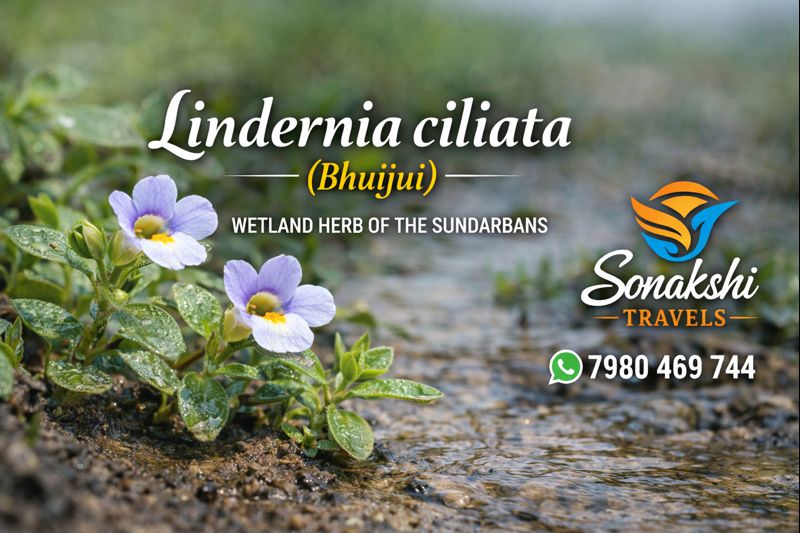
A Detailed Botanical and Ecological Study of a Wetland Herb
Lindernia ciliata, commonly known as Bhuijui in several parts of eastern India, is a small yet ecologically important herbaceous plant associated with wetlands, moist agricultural fields, and seasonally flooded landscapes. Although it rarely attracts attention due to its low stature and inconspicuous habit, this species forms an integral component of freshwater ecosystems, particularly in monsoon-influenced regions. Its presence reflects delicate hydrological balance, soil fertility, and ecological continuity in lowland habitats.
The species is especially prominent in tropical and subtropical Asia, where monsoon rainfall creates transient aquatic and semi-aquatic environments. In deltaic systems, including the lower Gangetic plains and areas surrounding the Sundarbans, Lindernia ciliata emerges as part of the seasonal herb layer that stabilizes soils, supports microfauna, and contributes to nutrient cycling. Understanding its biology and ecological role offers insight into the subtle yet essential functioning of wetland ecosystems.
Taxonomy & Classification
The taxonomic placement of Lindernia ciliata has evolved with advances in plant systematics. Once broadly grouped within Scrophulariaceae, the genus Lindernia is now recognized under the family Linderniaceae based on morphological and molecular evidence. This reclassification reflects a more accurate understanding of evolutionary relationships among wetland-adapted herbs.
Systematic Position
Kingdom: Plantae
Clade: Angiosperms
Clade: Eudicots
Order: Lamiales
Family: Linderniaceae
Genus: Lindernia
Species:Lindernia ciliata
Within the genus, Lindernia ciliata is distinguished by its ciliate leaf margins and particular floral characteristics. These features aid botanists in separating it from closely related species that often coexist in similar habitats.
Morphology & Field Identification
Despite its modest size, Lindernia ciliata displays a suite of morphological traits that allow reliable identification in the field when observed carefully. Its growth form reflects adaptations to waterlogged and periodically inundated environments.
Growth Habit and Stem
This species is an annual, prostrate to ascending herb. The stems are slender, soft, and green, often branching profusely near the base. In persistently moist conditions, stems may root at the nodes, allowing the plant to spread laterally and form loose mats over wet soil surfaces.
Leaves
Leaves are opposite, ovate to elliptic, and characterized by fine hair-like cilia along the margins, a defining feature of the species. The leaf surface is generally smooth and tender, with a short petiole or sometimes sessile attachment. This structure facilitates efficient gas exchange and photosynthesis in humid microclimates.
Flowers
Flowers are solitary and borne in the axils of leaves. The corolla is small, tubular, and typically pale blue, lilac, or whitish, often with subtle markings near the throat. Flowering coincides with peak soil moisture availability, ensuring reproductive success before habitats dry out.
Fruit and Seeds
The fruit is a minute capsule containing numerous tiny seeds. These seeds are well adapted for dispersal by water, enabling the species to colonize newly exposed substrates following floods or seasonal water recession.
Habitat & Distribution
Lindernia ciliata is strongly associated with freshwater wetlands and moist lowland habitats. It thrives in environments where soils remain saturated for extended periods, though it can tolerate short phases of drying.
Typical Habitat Types
Seasonally flooded agricultural fields
Pond and lake margins
Marshy grasslands
Irrigation channels and roadside ditches
Riverine floodplains
Global Range
The global range of Lindernia ciliata spans much of tropical and subtropical Asia. It has been documented across India, Bangladesh, Nepal, Sri Lanka, Southeast Asia, southern China, and parts of northern Australia. Its wide distribution reflects strong ecological plasticity and adaptability to monsoon-driven hydrological regimes.
Preferred Habitat
This species shows a clear preference for open, sunlit areas with soft, nutrient-rich soils. Shallow water depth and seasonal flooding are critical factors influencing its growth. Such conditions minimize competition from taller vegetation and allow Lindernia ciliata to complete its life cycle efficiently within a short growing season.
Occurrence
In eastern India, Lindernia ciliata typically appears with the onset of the monsoon and persists until early winter. Germination occurs rapidly following rainfall, and population density often peaks after floodwaters recede, exposing moist soil surfaces ideal for seedling establishment.
Preferred Habitat in the Sundarbans Region
Within the Sundarbans region, Lindernia ciliata is most frequently encountered in freshwater-influenced zones such as village ponds, canals, and seasonally inundated fields bordering mangrove forests. While the core mangrove ecosystem is dominated by saline-tolerant woody species, peripheral freshwater pockets provide suitable niches for this herb.
The presence of Lindernia ciliata in these transitional zones often indicates relatively low salinity and stable freshwater input during the monsoon months, making it a subtle ecological indicator species.
Exploring wetland flora adds depth to any mangrove journey. Choose a thoughtfully curated Sundarban Tour to experience these subtle ecosystems firsthand.
Ecological Role
Lindernia ciliata contributes significantly to wetland ecosystem functioning despite its small size. Its shallow root system helps bind fine sediments, reducing erosion caused by water movement. As the plant decomposes, it adds organic matter to the soil, enhancing nutrient availability for other organisms.
The flowers provide nectar for small pollinating insects, while the foliage offers shelter for invertebrates and microfauna. Collectively, these interactions support food webs and biodiversity within wetland habitats.
Habitat Alteration
Alteration of wetlands poses a substantial threat to populations of Lindernia ciliata. Drainage for agriculture or development, excessive use of chemical fertilizers and pesticides, and disruption of natural flooding cycles reduce suitable habitats. In deltaic regions, increasing salinity intrusion further restricts areas where this freshwater-dependent species can survive.
Conservation Efforts
Although Lindernia ciliata is not currently considered globally threatened, its conservation depends on the protection of freshwater wetlands. Sustainable water management, preservation of seasonal ponds, and environmentally responsible agricultural practices indirectly support the survival of this and other wetland herbs.
In the Sundarbans landscape, maintaining freshwater inflow and protecting transitional wetland zones are essential steps toward conserving delicate herbaceous species that form the foundation of wetland biodiversity.
Did You Know?
Lindernia ciliata completes its life cycle within a single monsoon season.
The fine hairs along its leaf margins help reduce water loss in fluctuating moisture conditions.
Its presence often signals healthy, seasonally flooded freshwater habitats.
Seasonal wetlands reveal their beauty to attentive travelers. Plan your next Sundarban Tour and explore the living landscape of the delta.
External Reference
Additional botanical and distributional information can be found on the Wikipedia page dedicated to Lindernia ciliata.