A Comprehensive Botanical and Ecological Study of a Wetland Herb
Lindernia procumbens, widely known in parts of eastern and northeastern India as Bakpuspa, is a delicate, low-growing herb that occupies a unique ecological niche within freshwater wetlands, seasonally inundated plains, and moist grasslands. Though often overlooked due to its modest size and creeping habit, this species represents an important component of tropical wetland biodiversity, particularly in monsoon-driven landscapes such as the lower Gangetic delta.
Bakpuspa is adapted to environments characterized by fluctuating water availability, soft alluvial soils, and periodic disturbance. Its life cycle, growth form, and reproductive strategy reflect long evolutionary adjustment to ephemeral wetland habitats. In regions like the Sundarbans and adjoining floodplains, Lindernia procumbens emerges as a seasonal indicator of freshwater stability and ecological renewal following monsoon rains.
Beyond its ecological role, the species also holds modest ethnobotanical significance. In traditional knowledge systems, small wetland herbs such as Bakpuspa have often been associated with folk remedies or symbolic associations, although their uses remain localized and sparsely documented in formal literature.
Taxonomy & Classification
The taxonomic placement of Lindernia procumbens reflects its membership within a group of flowering plants adapted to wet and semi-aquatic conditions. Advances in molecular systematics have refined its classification, separating it from historically broader groupings and highlighting its evolutionary relationships within the order Lamiales.
Taxonomic Hierarchy
Kingdom: Plantae
Clade: Angiosperms
Clade: Eudicots
Clade: Asterids
Order: Lamiales
Family: Linderniaceae
Genus:Lindernia
Species:Lindernia procumbens (Krock.) Borbás
The family Linderniaceae, once included under Scrophulariaceae, is now recognized as a distinct lineage based on floral structure and genetic evidence. Members of this family typically exhibit creeping or prostrate growth habits, shallow root systems, and bilabiate flowers—traits that support survival in saturated soils.
Morphology & Field Identification
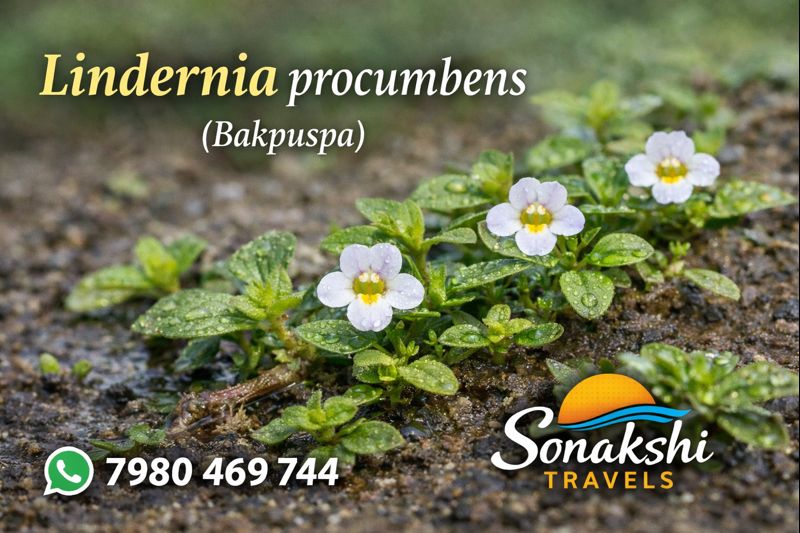
Lindernia procumbens is a small, creeping to prostrate annual herb, rarely exceeding a few centimeters in height. Its growth habit allows it to spread horizontally across damp substrates, forming thin mats that closely follow the contours of the soil surface.
Vegetative Features
The stems are slender, soft, and often reddish or pale green, rooting readily at the nodes when in contact with moist soil. This nodal rooting enables vegetative expansion and helps anchor the plant during shallow flooding or water flow.
Leaves are opposite, small, ovate to elliptic, with smooth margins and a slightly fleshy texture. Their surface is generally glabrous, reflecting an adaptation to high-moisture environments where excessive hairiness may be disadvantageous. Leaf size and thickness vary depending on water availability and nutrient conditions.
Floral Characteristics
Flowers are solitary or paired in the axils of leaves, small but distinct, usually pale bluish, lilac, or violet, sometimes with yellow markings on the throat. The corolla is bilabiate, facilitating pollination by small insects adapted to ground-level flowering plants.
Flowering typically coincides with the monsoon and immediate post-monsoon period, when soil moisture is optimal. Fruits are small capsules containing numerous minute seeds, which are easily dispersed by water movement.
Habitat & Distribution
Lindernia procumbens is intrinsically associated with moist and waterlogged habitats. It thrives in areas subject to seasonal flooding, shallow standing water, or persistent soil saturation. Common habitats include paddy fields, marsh edges, irrigation channels, wet fallow lands, and low-lying grasslands.
The species exhibits high tolerance to disturbance, allowing it to colonize areas periodically affected by grazing, agriculture, or sediment deposition. This ecological flexibility contributes to its widespread presence across tropical and subtropical regions.
Global Range
The global distribution of Lindernia procumbens spans South Asia, Southeast Asia, parts of East Asia, and extends into tropical Africa and southern Europe. Its presence across multiple continents underscores its adaptability to diverse wetland conditions.
In Asia, the species is recorded from India, Bangladesh, Nepal, Sri Lanka, Myanmar, Thailand, Vietnam, and southern China. In Europe, it occurs sporadically in warmer regions, often as a rare or localized wetland plant.
Preferred Habitat
Bakpuspa prefers open, sunlit areas with soft, fine-textured soils rich in organic matter. It grows best in freshwater environments with low salinity and minimal shading. Temporary wetlands that retain moisture for several months provide ideal conditions for its complete life cycle.
Occurrence
Lindernia procumbens is primarily a seasonal species, appearing prominently during the monsoon months and persisting until the early dry season. Its abundance fluctuates annually, influenced by rainfall patterns, flooding duration, and land-use practices.
The plant often occurs in scattered patches rather than continuous stands, reflecting microhabitat variability. Newly exposed wet soil following flood recession frequently supports dense but short-lived populations.
Preferred Habitat in the Sundarbans Region
Within the Sundarbans delta, Lindernia procumbens is most commonly found in freshwater-dominated zones away from direct tidal salinity. It inhabits village ponds, rain-fed depressions, embankment margins, and seasonally flooded grasslands bordering mangrove forests.
The dynamic hydrology of the Sundarbans, characterized by monsoon-driven freshwater influx and dry-season salinity intrusion, restricts the species to microhabitats where freshwater persists long enough for growth and reproduction. These habitats often serve as refugia for non-mangrove wetland flora.
Exploring freshwater wetlands alongside mangrove landscapes offers a deeper understanding of deltaic biodiversity. A guided Sundarban Tour provides opportunities to observe such seasonal herbs in their natural setting.
Ecological Role
Despite its small size, Lindernia procumbens contributes to wetland ecosystem stability. Its creeping growth helps bind surface soils, reducing erosion during rainfall and shallow flooding events. The plant also plays a role in nutrient cycling by incorporating organic matter into wetland soils.
The species supports microfaunal communities, offering shelter and foraging grounds for small invertebrates. Its flowers provide nectar resources for insects, contributing to pollinator diversity within wetland ecosystems.
Habitat Alteration
Habitat alteration poses a growing challenge to the persistence of Lindernia procumbens. Drainage of wetlands, conversion of fallow lands into intensive agriculture, and excessive use of agrochemicals can significantly reduce suitable habitats.
In deltaic regions, climate-induced changes such as increased salinity intrusion, altered rainfall patterns, and embankment construction further threaten freshwater-dependent species. While Bakpuspa shows some resilience, prolonged habitat degradation may lead to local population declines.
Conservation Efforts
Lindernia procumbens is not currently listed as threatened at a global scale. However, its conservation is closely tied to the protection and sustainable management of wetlands. Maintaining seasonal flooding regimes and reducing chemical pollution are essential for supporting its populations.
Wetland conservation initiatives, particularly those focused on small freshwater bodies within larger landscapes, indirectly benefit this species. Recognizing the ecological value of minor wetland herbs is vital for holistic biodiversity conservation.
Understanding the subtle layers of wetland biodiversity enhances any nature-focused journey. A thoughtfully designed Sundarban Tour allows travelers to appreciate both iconic mangroves and lesser-known freshwater flora.
Did You Know?
Lindernia procumbens can reproduce rapidly due to its ability to root at stem nodes.
The species often appears immediately after monsoon flooding recedes.
Its tiny seeds are easily dispersed by shallow water movement.
The plant serves as an indicator of freshwater stability in deltaic regions.