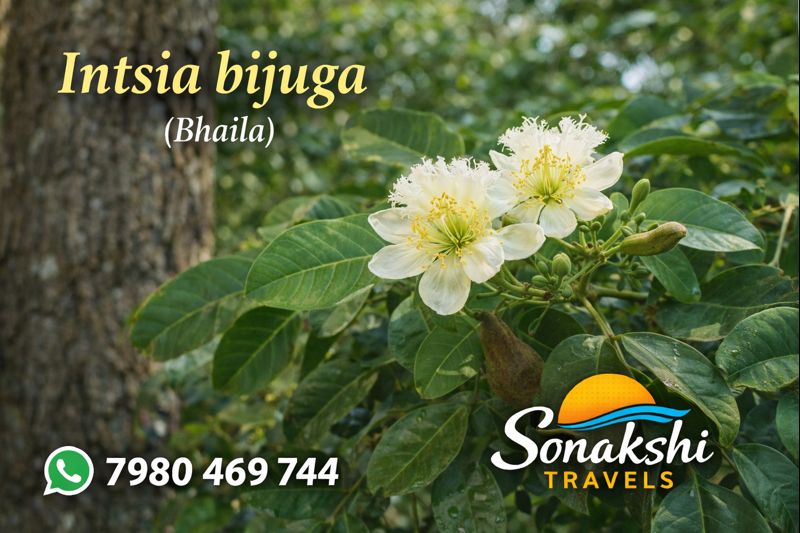
A Detailed Botanical, Ecological, and Conservation Study
Intsia bijuga, locally known in parts of eastern India and the Sundarbans as Bhaila, is a large, slow-growing tropical tree renowned for its massive stature, dense hardwood, and ecological importance within coastal and island forests. Belonging to the legume family, this species has long been valued for its durable timber while simultaneously serving as a keystone element in certain lowland and coastal forest ecosystems.
The tree is particularly notable for its adaptability to coastal conditions, including saline air, sandy substrates, and periodic inundation. Although not a true mangrove species, Intsia bijuga often occurs near mangrove fringes and in mixed coastal forests, forming a transitional vegetation type between inland evergreen forests and tidal mangrove ecosystems. Its presence in the Sundarbans region adds to the structural and biological diversity of the deltaic landscape.
Beyond its economic importance, Bhaila contributes to long-term forest stability through its deep-rooting system, expansive canopy, and long lifespan. Its ecological role becomes especially significant in the context of coastal resilience, where large trees buffer wind, stabilize soils, and provide habitat continuity in environments exposed to cyclonic disturbances.
Taxonomy & Classification
The taxonomic classification of Intsia bijuga reflects its placement among tropical hardwood-producing legumes. Its systematic position has remained relatively stable, supported by both morphological characteristics and molecular evidence.
Taxonomic Hierarchy
Kingdom: Plantae
Clade: Angiosperms
Clade: Eudicots
Clade: Rosids
Order: Fabales
Family: Fabaceae
Subfamily: Caesalpinioideae
Genus:Intsia
Species:Intsia bijuga (Colebr.) Kuntze
The genus Intsia includes only a small number of species, all of which are large trees native to tropical regions. Intsia bijuga is the most widely distributed and best-known member of the genus, often associated with high-quality timber and ecological longevity.
Morphology & Field Identification
Intsia bijuga is an imposing evergreen to semi-evergreen tree that can reach heights of 30–40 meters under favorable conditions. Its massive trunk, spreading crown, and dense foliage make it easily distinguishable in coastal and lowland forests.
Trunk and Bark
The trunk is typically straight and cylindrical, often buttressed at the base in mature individuals. Bark is greyish-brown to dark brown, rough and fissured with age, providing protection against mechanical damage and environmental stress.
The wood is extremely dense and heavy, contributing to the tree’s resistance to windthrow and decay. This density, while ecologically advantageous, has historically made the species a prime target for logging.
Leaves and Canopy
Leaves are compound and paripinnate, bearing opposite leaflets that are leathery, glossy, and dark green. The thick texture of the leaves reflects an adaptation to high light intensity and salt-laden coastal air.
The canopy is broad and spreading, creating deep shade beneath the tree. This shaded microenvironment influences understory composition, favoring shade-tolerant herbs and seedlings.
Flowers and Fruits
Flowers are large, showy, and creamy white to pale yellow, often appearing in clusters. Flowering usually occurs seasonally and attracts a variety of insects, contributing to local pollination networks.
The fruit is a large, woody pod containing a few hard seeds. These pods may persist on the tree or fall to the ground, where seed dispersal occurs through gravity and, occasionally, water movement.
Habitat & Distribution
Intsia bijuga is primarily associated with tropical coastal forests, lowland evergreen forests, and island ecosystems. It is commonly found near shorelines, estuaries, and river mouths where soils are deep, well-drained, and periodically influenced by saline conditions.
The species shows a preference for stable substrates that allow for deep root penetration, enabling it to withstand strong winds and storms common in coastal zones.
Global Range
The natural distribution of Intsia bijuga extends across the Indo-Pacific region. It is native to parts of South and Southeast Asia, including India, Bangladesh, Myanmar, Thailand, Malaysia, and Indonesia, and extends eastward to Papua New Guinea and the Pacific islands.
In island ecosystems, the tree often plays a dominant role in coastal forests, forming large, long-lived stands that shape local vegetation structure.
Preferred Habitat
Bhaila thrives in warm, humid tropical climates with high annual rainfall. It prefers lowland areas below 300 meters in elevation and grows best in deep alluvial or sandy-loam soils with good drainage.
Although tolerant of salt spray and occasional brackish influence, the species does not survive prolonged tidal inundation, distinguishing it from true mangrove species.
Occurrence
Intsia bijuga occurs sporadically rather than in dense stands in many parts of its range. Its slow growth rate and selective logging pressure have contributed to its scattered distribution in several regions.
Natural regeneration is often limited, as seedlings require stable, undisturbed conditions to establish successfully. As a result, mature trees are often isolated individuals or small clusters.
Preferred Habitat in the Sundarbans Region
Within the Sundarbans landscape, Intsia bijuga is found mainly along the freshwater-influenced margins of the delta and in elevated areas beyond direct tidal reach. It occupies transitional zones where mangrove forests gradually merge with inland coastal woodlands.
These habitats experience reduced salinity compared to core mangrove zones and provide the stable soil conditions required for long-term growth. The presence of Bhaila in such areas enhances vertical forest structure and supports diverse faunal communities.
Observing large coastal trees in their natural deltaic setting offers valuable insight into forest resilience. A guided Sundarban Tour allows visitors to explore these transitional forest zones responsibly.
Ecological Role
Intsia bijuga plays a significant ecological role as a canopy-forming species. Its large size provides nesting and roosting sites for birds, while its flowers and seeds contribute to food availability for insects and other fauna.
The tree’s extensive root system stabilizes coastal soils, reducing erosion and enhancing resilience against cyclonic winds. Leaf litter from Bhaila enriches forest soils, supporting nutrient cycling and microbial activity.
Habitat Alteration
Habitat alteration represents a major threat to Intsia bijuga. Coastal development, deforestation, and conversion of forest land for agriculture or infrastructure have reduced suitable habitats across its range.
In deltaic regions, embankment construction and changes in freshwater flow further restrict regeneration opportunities. The species’ slow growth makes recovery from disturbance particularly challenging.
Conservation Efforts
Intsia bijuga is recognized as vulnerable in several parts of its range due to overexploitation for timber. Conservation efforts focus on habitat protection, regulated harvesting, and restoration planting in degraded coastal forests.
Long-term conservation success depends on protecting mature seed-bearing trees and ensuring suitable conditions for natural regeneration. Integrating the species into coastal afforestation programs can enhance ecosystem stability while preserving biodiversity.
Learning about conservation-linked landscapes deepens appreciation of the delta. A responsible Sundarban Tour highlights both iconic mangroves and lesser-known coastal trees like Bhaila.
Did You Know?
Intsia bijuga produces one of the hardest and most durable tropical hardwoods.
The tree can live for several centuries under stable conditions.
It is highly resistant to termites and marine borers.
Despite its strength, the species regenerates very slowly.