Coastal Ecology, Biological Adaptations, and Conservation Significance
Sesuvium portulacastrum, locally known in parts of eastern India and the Sundarbans as Sagornunia, is a perennial halophytic herb of immense ecological importance in coastal and estuarine ecosystems. Commonly referred to as sea purslane, this plant is a classic example of botanical resilience, thriving in environments characterized by high salinity, intense sunlight, periodic inundation, and nutrient-poor substrates. Its presence along shorelines, mangrove fringes, and salt marshes reflects a highly specialized evolutionary strategy that enables survival under extreme environmental stress.
Beyond its ecological role, Sesuvium portulacastrum has attracted significant scientific interest due to its remarkable physiological adaptations, including salt tolerance, succulence, and rapid vegetative spread. These traits make it an essential stabilizing species in fragile coastal landscapes. In regions such as the Sundarbans delta, where land and sea continuously interact, Sagornunia plays a subtle yet crucial role in maintaining habitat integrity and supporting biodiversity.
This article presents a comprehensive, research-oriented exploration of Sesuvium portulacastrum, covering its taxonomy, morphology, habitat preferences, distribution patterns, ecological functions, and conservation relevance, with special emphasis on its occurrence in the Sundarbans region.
Taxonomy & Classification
The taxonomic placement of Sesuvium portulacastrum situates it within a group of flowering plants adapted to arid and saline environments. Its classification reflects both its evolutionary lineage and ecological specialization.
Taxonomic Hierarchy
Kingdom: Plantae
Clade: Angiosperms
Clade: Eudicots
Order: Caryophyllales
Family: Aizoaceae
Genus: Sesuvium
Species: Sesuvium portulacastrum (L.) L.
The family Aizoaceae is well known for succulent plants adapted to drought-prone and saline habitats. Members of this family often exhibit specialized tissues for water storage and salt regulation. Within this family, the genus Sesuvium comprises species predominantly associated with coastal and inland saline environments. Sesuvium portulacastrum is the most widespread and ecologically significant species of the genus.
Morphology & Field Identification
Accurate field identification of Sesuvium portulacastrum relies on its distinctive succulent morphology, creeping growth habit, and characteristic flowers. These features collectively distinguish it from other coastal groundcover plants.
Growth Form and Stems
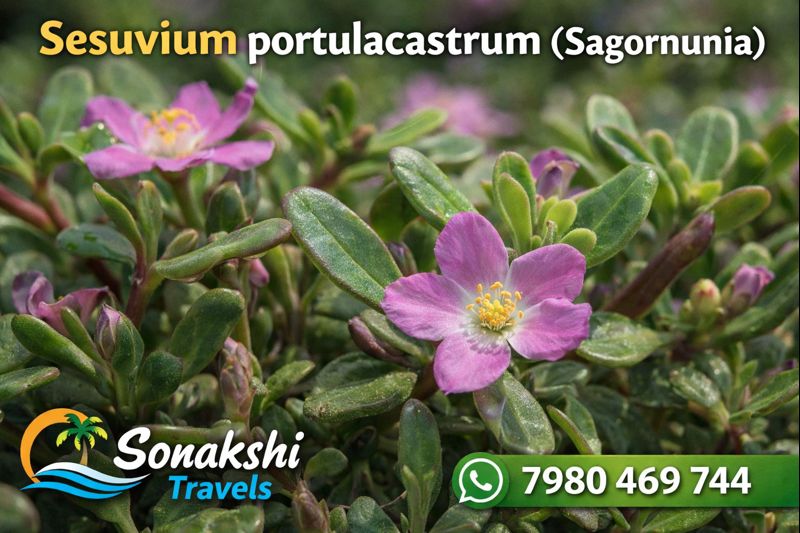
Sesuvium portulacastrum is a low-growing, mat-forming perennial herb with prostrate, fleshy stems that spread horizontally across the substrate. The stems are smooth, cylindrical, and often tinged with reddish or purplish hues, particularly under high salinity or intense sunlight. This creeping habit allows the plant to rapidly colonize open coastal surfaces and stabilize loose soils.
Leaves
Leaves are opposite, thick, and succulent, typically linear to lanceolate in shape. They are smooth, fleshy, and glossy, serving as water-storage organs that enable the plant to withstand prolonged dry periods. The leaf surface often exhibits a subtle sheen, reflecting sunlight and reducing water loss. These leaves also function as salt-storage tissues, sequestering excess salts absorbed from saline soils.
Flowers and Reproductive Structures
The flowers of Sesuvium portulacastrum are solitary and axillary, with no true petals but a series of colored sepals that appear petal-like. These sepals are typically pink, purple, or pale violet, creating a striking contrast against the green foliage. The flowers contain numerous stamens and a superior ovary, and they open primarily during daylight hours.
Fruits are small, capsule-like structures containing numerous tiny seeds. Reproduction occurs both sexually, through seed production, and vegetatively, through stem fragmentation and rooting at nodes, allowing rapid population expansion.
Habitat & Distribution
Sesuvium portulacastrum is a quintessential coastal plant, occupying habitats that are inhospitable to most terrestrial vegetation. Its distribution is closely linked to saline and semi-saline environments influenced by marine processes.
Global Range
The species has a nearly pantropical distribution, occurring along coastlines of Africa, Asia, Australia, the Americas, and various oceanic islands. It is particularly abundant in tropical and subtropical regions where warm temperatures and saline conditions prevail. Its wide geographic range highlights its exceptional adaptability and ecological versatility.
In Asia, Sesuvium portulacastrum is commonly found along the coasts of India, Sri Lanka, Bangladesh, Southeast Asia, and southern China. Its presence across multiple continents has also been facilitated by ocean currents, which aid in seed dispersal.
Preferred Habitat
The preferred habitat of Sesuvium portulacastrum includes sandy beaches, tidal flats, salt marshes, mangrove margins, and coastal embankments. It thrives in substrates with high salinity, poor nutrient availability, and frequent exposure to wind and sunlight. The plant tolerates periodic submergence during high tides and storm surges, making it a resilient component of dynamic coastal systems.
Occurrence
In natural landscapes, Sesuvium portulacastrum often occurs as a dominant groundcover species, forming dense mats that suppress erosion and limit the establishment of less tolerant plants. It is commonly observed along estuarine banks, canal edges, and reclaimed coastal lands where salinity levels fluctuate.
Its occurrence is often associated with early successional stages of coastal vegetation, where it acts as a pioneer species, preparing the substrate for subsequent plant colonization.
Preferred Habitat in the Sundarbans Region
Within the Sundarbans delta, Sesuvium portulacastrum occupies a vital niche along the periphery of mangrove forests and on exposed mudflats. These areas experience daily tidal inundation, high soil salinity, and intense solar radiation, conditions under which few plant species can survive.
In the Sundarbans, Sagornunia is frequently found stabilizing embankments, riverbanks, and newly deposited alluvial soils. Its creeping growth habit reduces surface erosion caused by tidal currents, while its salt tolerance allows it to flourish where freshwater influence is limited. The species often forms transitional vegetation between open mudflats and dense mangrove stands.
Exploring estuarine vegetation is an integral part of understanding delta ecology. A professionally guided Sundarban Tour allows visitors to observe coastal plant species within their natural tidal habitats.
Ecological Role
The ecological role of Sesuvium portulacastrum extends far beyond its modest appearance. As a groundcover species, it plays a crucial role in soil stabilization, reducing coastal erosion caused by tides, wind, and rainfall. Its dense mats trap sediments, facilitating land formation and reducing turbidity in adjacent waters.
The plant also contributes to nutrient cycling in coastal ecosystems. Through leaf turnover and organic matter deposition, it enriches otherwise nutrient-poor substrates. Additionally, its flowers provide nectar resources for insects, while its vegetative cover offers shelter to small invertebrates and juvenile fauna.
Habitat Alteration
Despite its resilience, Sesuvium portulacastrum is not immune to habitat alteration. Coastal development, embankment hardening, land reclamation, and pollution have reduced suitable habitats in many regions. Changes in tidal regimes and increased salinity extremes associated with climate change further threaten its long-term stability.
In the Sundarbans, excessive embankment construction and conversion of intertidal zones for agriculture or aquaculture have disrupted natural vegetation patterns. While Sesuvium portulacastrum can recolonize disturbed areas, repeated disturbances may hinder its ecological function.
Conservation Efforts
Conservation of Sesuvium portulacastrum is closely tied to the protection of coastal and estuarine habitats. Maintaining natural tidal flows, preventing excessive land reclamation, and promoting soft shoreline stabilization techniques are essential strategies.
The species is increasingly recognized for its potential in ecological restoration projects. Its ability to rapidly colonize degraded saline soils makes it a valuable candidate for stabilizing embankments and restoring coastal vegetation. Integrating native halophytes such as Sesuvium portulacastrum into restoration initiatives enhances ecosystem resilience and biodiversity.
Understanding mangrove-edge vegetation enhances any coastal journey. Join an immersive Sundarban Tour to experience the living dynamics of tidal ecosystems.
Did You Know?
Sesuvium portulacastrum is classified as a halophyte, meaning it thrives in highly saline environments.
The plant stores excess salt in its succulent tissues, preventing cellular damage.
It is often used in coastal restoration projects to control erosion.
The species can reproduce both through seeds and vegetative stem fragments.
Its presence indicates relatively stable intertidal conditions.
External Reference
For additional taxonomic and botanical information, consult the following external source: