Botanical Identity, Ecological Importance, and Conservation Perspective
Ichnocarpus frutescens, locally known in eastern India as Dudhia Lata, is a perennial woody climber belonging to the family Apocynaceae. This species is widely recognized for its milky latex, twining growth habit, and long-standing role in traditional medicine systems. In tropical landscapes, Ichnocarpus frutescens forms an integral component of forest edges, scrublands, and secondary vegetation, where it contributes to structural complexity and ecological balance.
The plant derives its vernacular name “Dudhia” from the characteristic white latex exuded when its stems or leaves are injured. This latex, combined with its hardy nature, reflects the plant’s evolutionary adaptation to herbivory, drought, and environmental stress. Across India, Bangladesh, and Southeast Asia, Ichnocarpus frutescens has been historically valued not only for medicinal applications but also for its role in sustaining biodiversity in degraded and semi-natural habitats.
This article provides a detailed, research-oriented account of Ichnocarpus frutescens, covering its taxonomy, morphology, habitat preferences, distribution, ecological role, and conservation considerations, with particular reference to its occurrence in the Sundarbans region.
Taxonomy & Classification
The systematic classification of Ichnocarpus frutescens places it within a family known for latex-bearing plants and diverse growth forms ranging from trees to climbers. Its taxonomic position is outlined below.
Taxonomic Hierarchy
Kingdom: Plantae
Clade: Angiosperms
Clade: Eudicots
Order: Gentianales
Family: Apocynaceae
Genus: Ichnocarpus
Species: Ichnocarpus frutescens (L.) W.T. Aiton
The family Apocynaceae includes many ecologically and pharmacologically important species characterized by milky latex and complex secondary metabolites. Within this family, the genus Ichnocarpus is relatively small, and Ichnocarpus frutescens is its most widely distributed representative. The species exhibits several adaptive traits typical of Apocynaceae, including chemical defenses and climbing growth forms.
Morphology & Field Identification
Field identification of Ichnocarpus frutescens is facilitated by its twining habit, opposite leaves, and distinctive milky latex. These features allow reliable recognition in natural and semi-natural environments.
Growth Habit and Stems
Ichnocarpus frutescens is a woody climber or straggling shrub that often twines around nearby vegetation for support. Stems are slender, flexible, and brownish to grey in mature individuals. When cut or damaged, the stems exude a copious amount of white, milky latex, a defining diagnostic feature of the species.
Leaves
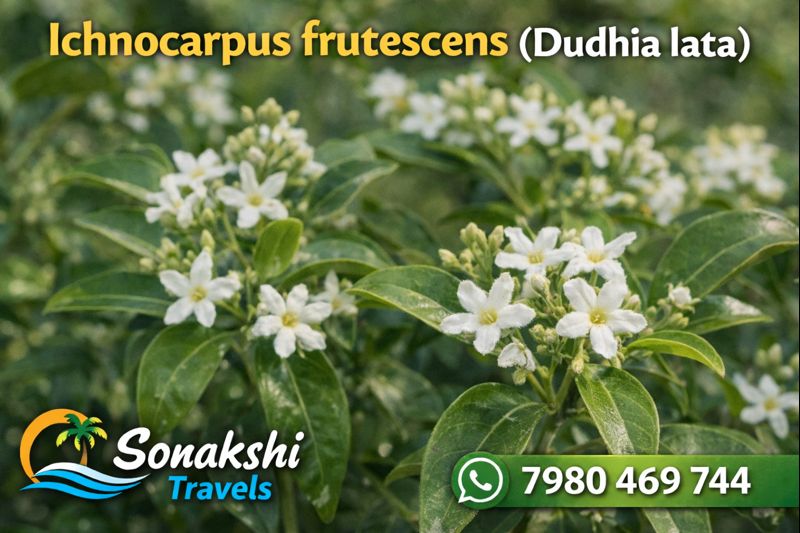
Leaves are opposite, simple, and ovate to elliptic in shape, with entire margins and a pointed apex. The leaf surface is smooth and leathery, with prominent midribs and lateral veins. The dark green upper surface contrasts with a paler underside. Leaf arrangement and texture contribute to efficient photosynthesis under partial shade conditions commonly found along forest edges.
Flowers and Fruits
The flowers of Ichnocarpus frutescens are small, fragrant, and typically white or cream-colored, arranged in terminal or axillary cymes. Each flower exhibits a tubular corolla with five lobes, characteristic of the Apocynaceae family. Flowering generally occurs during warmer months and is followed by the development of paired follicles.
The fruits are slender, elongated follicles that split open upon maturity, releasing numerous seeds. Each seed is often equipped with a tuft of silky hairs that aid in wind dispersal, facilitating colonization of new habitats.
Habitat & Distribution
Ichnocarpus frutescens exhibits a broad ecological tolerance, enabling it to occupy a wide range of habitats across tropical regions.
Global Range
The species is widely distributed throughout South and Southeast Asia, including India, Bangladesh, Sri Lanka, Myanmar, Thailand, and parts of southern China. It is also reported from regions of the Malay Archipelago. This wide geographic range reflects its adaptability to diverse climatic and edaphic conditions.
In India, Ichnocarpus frutescens is commonly found across the plains and lower hill regions, particularly in moist deciduous forests, scrublands, and along riverbanks.
Preferred Habitat
The preferred habitat of Ichnocarpus frutescens includes forest margins, hedgerows, open woodlands, and secondary growth areas. It thrives in well-drained soils with moderate moisture availability and is often found in locations receiving partial sunlight. The species shows a notable tolerance to disturbance, enabling it to persist in degraded landscapes.
Occurrence
In natural ecosystems, Ichnocarpus frutescens typically occurs as a climbing component of shrub and tree layers. It is frequently observed entwining shrubs, small trees, and fences, forming dense tangles in unmanaged areas. Its ability to regenerate from rootstock and stem fragments allows it to re-establish quickly after disturbance.
The species is also commonly encountered near human settlements, where it persists along roadsides, field boundaries, and abandoned lands, reflecting its ecological resilience.
Preferred Habitat in the Sundarbans Region
Within the Sundarbans region, Ichnocarpus frutescens is primarily found in non-saline or mildly saline zones along the fringes of mangrove forests and in village-adjacent woodlands. It does not occur in core mangrove habitats subjected to daily tidal inundation but thrives in elevated areas with reduced salinity influence.
In the Sundarbans landscape, Dudhia Lata is commonly associated with embankments, forest edges, and secondary vegetation near human habitation. These transitional zones provide suitable conditions of soil drainage and light availability. The species contributes to the structural diversity of peripheral vegetation, supporting insects and small fauna.
Exploring forest-edge vegetation reveals many resilient climbers and shrubs. A guided Sundarban Tour offers insights into both mangrove and peripheral plant diversity.
Ecological Role
The ecological role of Ichnocarpus frutescens is multifaceted. As a climbing species, it contributes to vertical habitat complexity, providing shelter and movement pathways for insects and small vertebrates. Its flowers attract pollinators, while its seeds support natural regeneration processes through wind dispersal.
The dense foliage and twining habit also help stabilize vegetation in disturbed areas, reducing soil erosion and supporting successional dynamics. In secondary forests and scrublands, Ichnocarpus frutescens acts as a linking species between herbaceous layers and woody vegetation.
Habitat Alteration
Habitat alteration poses varying levels of impact on Ichnocarpus frutescens. While the species demonstrates resilience to moderate disturbance, large-scale deforestation, urban expansion, and conversion of forest land for agriculture can reduce suitable habitats. Intensive use of herbicides and clearing of hedgerows further limit its local abundance.
In the Sundarbans, embankment development and settlement expansion have transformed natural vegetation patterns. However, these changes often create new edge habitats where Ichnocarpus frutescens can persist, highlighting its adaptability to anthropogenic landscapes.
Conservation Efforts
Ichnocarpus frutescens is not currently classified as threatened due to its wide distribution and adaptability. Conservation efforts therefore emphasize habitat preservation rather than species-specific protection. Maintaining forest edges, hedgerows, and secondary vegetation is essential for sustaining populations.
In regions where the plant is traditionally used, promoting sustainable harvesting practices helps prevent localized depletion. Integrating such native climbers into restoration and afforestation projects enhances ecological resilience and preserves ethnobotanical heritage.
Understanding climbers and shrubs enriches any nature exploration. Join a thoughtfully curated Sundarban Tour to experience the botanical diversity of delta landscapes.
Did You Know?
Ichnocarpus frutescens exudes a white milky latex when injured.
The plant is a woody climber rather than a true vine.
Its seeds are adapted for wind dispersal.
The species is widely used in traditional medicine systems.
It commonly thrives in disturbed and secondary habitats.
External Reference
For additional botanical and taxonomic information, consult the following external source: