Botanical Characteristics, Ecological Significance, and Conservation Perspectives
Acacia nilotica, commonly known as Babla in eastern India, is a robust, thorny tree species of exceptional ecological, economic, and cultural importance. Belonging to the legume family, this species has been an integral component of tropical and subtropical landscapes for centuries. From riverbanks and floodplains to dry savannahs and village commons, Acacia nilotica demonstrates remarkable adaptability to a wide range of environmental conditions.
Renowned for its hard wood, nitrogen-fixing ability, and resilience to drought and grazing pressure, Acacia nilotica plays a pivotal role in maintaining ecosystem stability. In deltaic regions such as the Sundarbans, where soil salinity, seasonal flooding, and human pressures shape vegetation patterns, Babla represents a transitional species bridging terrestrial and semi-estuarine environments. Its presence reflects both natural ecological processes and long-standing human utilization.
This article presents a comprehensive, research-based account of Acacia nilotica, covering its taxonomy, morphology, habitat preferences, geographic distribution, ecological functions, and conservation concerns, with particular emphasis on its occurrence in and around the Sundarbans region.
Taxonomy & Classification
The taxonomic classification of Acacia nilotica places it within a group of legumes known for their ecological versatility and symbiotic nitrogen fixation. Its systematic position is outlined below.
Taxonomic Hierarchy
Kingdom: Plantae
Clade: Angiosperms
Clade: Eudicots
Order: Fabales
Family: Fabaceae
Subfamily: Mimosoideae
Genus: Acacia
Species: Acacia nilotica (L.) Delile
The family Fabaceae is one of the largest plant families globally, characterized by nitrogen-fixing root nodules that enhance soil fertility. Acacia nilotica is a prominent member of this family and has historically been classified under several subspecies and varieties due to its wide morphological variation across different habitats.
Morphology & Field Identification
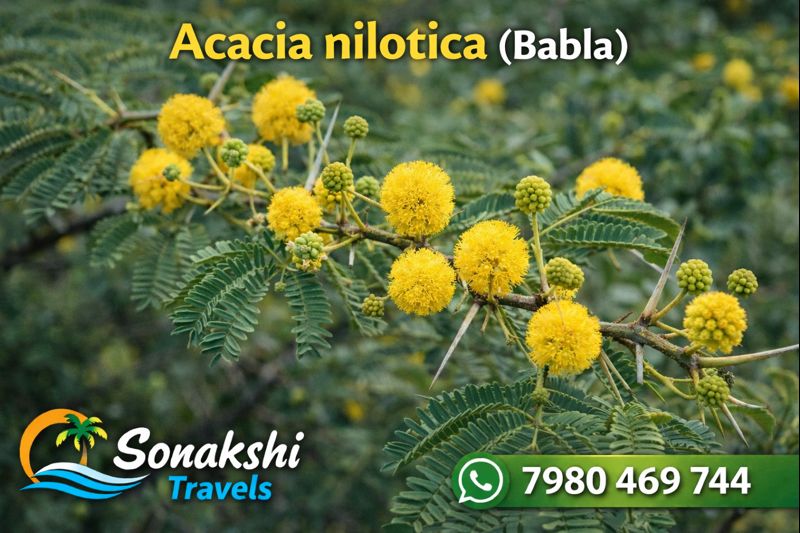
Acacia nilotica is readily identifiable in the field due to its distinctive thorny branches, bipinnate leaves, and bright yellow inflorescences. These features collectively distinguish it from other acacias and thorny trees.
Growth Habit and Trunk
The species typically grows as a medium-sized tree, reaching heights of 5 to 15 meters, although under favorable conditions it may grow taller. The trunk is often short and stout, branching low to form a spreading crown. Bark is dark grey to blackish, rough, and deeply fissured in mature individuals, providing protection against fire and physical damage.
Thorns and Branches
Branches bear paired, straight to slightly curved thorns, which are strong and sharp. These thorns serve as an effective defense against herbivores and browsing animals, enabling the tree to persist in open grazing lands. Young branches are often greenish and pubescent, becoming woody with age.
Leaves
Leaves are bipinnate, with multiple pairs of small leaflets that give the foliage a fine, feathery appearance. This leaf structure reduces water loss by minimizing surface area, an adaptation well suited to dry and semi-arid environments. The leaves are deciduous or semi-deciduous, often shed during prolonged dry periods.
Flowers and Fruits
Flowers are small but numerous, arranged in spherical, bright yellow heads that are highly conspicuous during the flowering season. Each flower produces abundant pollen and nectar, attracting a wide range of insects. The fruit is a constricted, flat to slightly curved pod containing several hard seeds. These pods often persist on the tree for extended periods.
Habitat & Distribution
Acacia nilotica occupies a wide range of habitats, reflecting its ecological flexibility and tolerance of environmental stress.
Global Range
The natural distribution of Acacia nilotica spans Africa, the Middle East, and the Indian subcontinent. It is native to large parts of eastern and northern Africa and has been present in South Asia since ancient times. The species has also been introduced to other tropical regions due to its economic value.
In India, Babla is widespread across plains, plateaus, and riverine landscapes, particularly in regions with seasonal rainfall and open vegetation.
Preferred Habitat
The preferred habitat of Acacia nilotica includes riverbanks, floodplains, grasslands, open woodlands, and village commons. It thrives in well-drained alluvial soils but can also tolerate clayey and slightly saline soils. The species shows high resistance to drought, grazing, and periodic flooding, making it suitable for dynamic landscapes.
Occurrence
In natural ecosystems, Acacia nilotica often occurs as scattered individuals or in small groups rather than dense forests. It is commonly found along rivers, canals, and seasonal watercourses, where moisture availability fluctuates. In human-dominated landscapes, it is frequently planted along roadsides, field boundaries, and grazing lands.
The species regenerates readily from seed and coppice, allowing it to persist under moderate disturbance. Its ability to colonize open areas makes it a characteristic component of secondary vegetation.
Preferred Habitat in the Sundarbans Region
Within the Sundarbans region, Acacia nilotica is not a core mangrove species but occurs in peripheral and transitional zones where salinity is relatively low. It is commonly found along embankments, riverbanks, and village outskirts on slightly elevated ground beyond daily tidal influence.
In these areas, Babla contributes to stabilizing embankments and providing shade and resources for local communities. Its tolerance of occasional inundation and mildly saline soils allows it to survive in the unique environmental gradient of the Sundarbans landscape.
Exploring riverine and village-edge vegetation reveals hardy tree species like Babla. A guided Sundarban Tour offers valuable insights into these transitional ecosystems.
Ecological Role
The ecological role of Acacia nilotica is substantial. As a leguminous tree, it enriches soil fertility through nitrogen fixation, improving conditions for associated plant species. Its flowers support pollinator populations, while its seeds and pods provide food for birds and mammals.
The tree’s dense root system helps prevent soil erosion, particularly along riverbanks and embankments. In open landscapes, Babla contributes to microclimate regulation by providing shade and reducing surface temperatures.
Habitat Alteration
Habitat alteration has both positive and negative effects on Acacia nilotica. While the species can tolerate moderate disturbance, large-scale land conversion, urban expansion, and removal for agriculture reduce its natural populations. Overexploitation for fuelwood and timber can also lead to local depletion.
In the Sundarbans region, embankment construction and settlement expansion have altered natural vegetation patterns. However, Babla often persists in these modified landscapes, highlighting its resilience and adaptability.
Conservation Efforts
Acacia nilotica is not globally threatened due to its wide distribution and adaptability. Conservation efforts focus on sustainable management rather than strict protection. Promoting controlled harvesting, maintaining riverine vegetation, and integrating the species into agroforestry systems support both ecological and economic sustainability.
In deltaic regions, planting Babla along embankments and degraded lands contributes to soil stabilization and ecological restoration, while also providing resources for local communities.
Understanding resilient tree species enhances any nature journey. Join a thoughtfully curated Sundarban Tour to experience the botanical diversity of delta landscapes.
Did You Know?
Acacia nilotica is capable of fixing atmospheric nitrogen, enriching soil fertility.
The tree produces strong thorns that deter grazing animals.
Its flowers are an important nectar source for insects.
The wood is valued for its hardness and durability.
The species tolerates both drought and seasonal flooding.
External Reference
For additional botanical and taxonomic information, consult the following external source: