Botanical Adaptations, Ecological Significance, and Conservation Insights
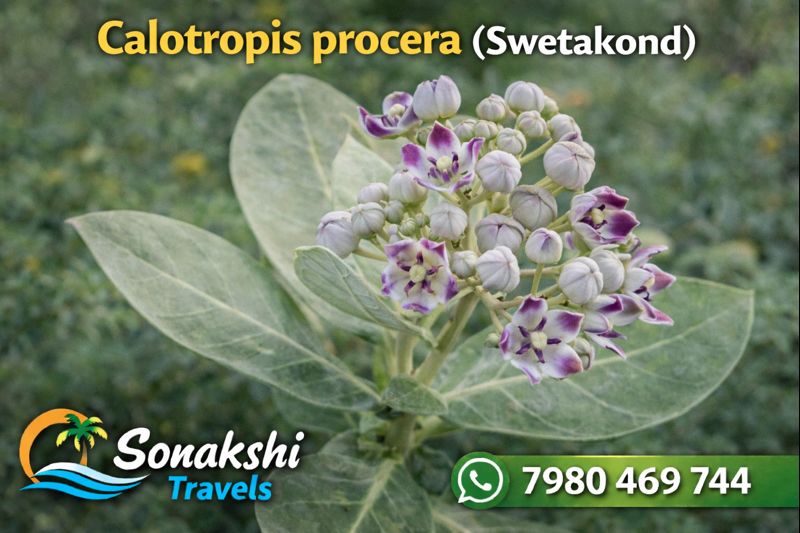
Calotropis procera, commonly known as Swetakond in Bengal and widely referred to as the Sodom Apple or Apple of Sodom, is a hardy perennial shrub belonging to the family Apocynaceae. This species is instantly recognizable by its thick, grey-green leaves, milky latex, and distinctive waxy flowers. Across arid, semi-arid, and disturbed landscapes, Calotropis procera stands as a symbol of botanical resilience, thriving where many other plant species fail to survive.
Historically embedded in traditional knowledge systems, Calotropis procera has been utilized in folk medicine, religious rituals, and rural livelihoods. Ecologically, it functions as a pioneer species, colonizing degraded soils and contributing to early-stage vegetation recovery. Its tolerance of drought, heat, and poor soil fertility has enabled it to spread widely across tropical and subtropical regions, including the Indian subcontinent.
This article presents an in-depth, research-based exploration of Calotropis procera, covering its taxonomy, morphology, habitat preferences, global distribution, ecological roles, and conservation considerations, with particular reference to its occurrence in and around the Sundarbans region.
Taxonomy & Classification
The taxonomic placement of Calotropis procera situates it within a family known for latex-producing plants and complex chemical defenses. Its systematic classification is outlined below.
Taxonomic Hierarchy
Kingdom: Plantae
Clade: Angiosperms
Clade: Eudicots
Order: Gentianales
Family: Apocynaceae
Subfamily: Asclepiadoideae
Genus: Calotropis
Species: Calotropis procera (Aiton) Dryand.
The family Apocynaceae includes numerous species characterized by milky latex and specialized pollination mechanisms. Within this family, the genus Calotropis comprises robust shrubs adapted to harsh environmental conditions. Calotropis procera is the most widely distributed and ecologically significant member of the genus.
Morphology & Field Identification
Calotropis procera exhibits a suite of morphological traits that reflect its adaptation to arid and disturbed environments. These features make it readily identifiable in the field.
Growth Habit and Stems
The plant typically grows as an erect shrub or small tree, reaching heights of 2 to 4 meters. Stems are thick, woody, and covered with a corky bark in older individuals. When damaged, the stems exude a copious amount of white, milky latex, which serves as a chemical defense against herbivores and pathogens.
Leaves
Leaves are large, opposite, and broadly ovate to obovate, with a thick, leathery texture. Their surface is covered with a fine, waxy coating that imparts a grey-green appearance. This waxy layer reduces water loss through transpiration, an essential adaptation in drought-prone environments.
Flowers
The flowers of Calotropis procera are arranged in umbellate clusters and are notable for their waxy texture and star-like structure. Petals are typically white to pale lavender with a central purple or violet crown. The flowers possess a complex pollination mechanism involving specialized pollinia, which are transferred by insects.
Fruits and Seeds
The fruit is a large, inflated follicle that splits open upon maturity to release numerous seeds. Each seed is equipped with a tuft of silky hairs that facilitate wind dispersal, enabling the species to colonize new areas rapidly.
Habitat & Distribution
Calotropis procera occupies a wide range of habitats, particularly those characterized by environmental stress and human disturbance.
Global Range
The species is native to parts of Africa, the Middle East, and South Asia. It has since spread extensively across tropical and subtropical regions, including Southeast Asia, Australia, and parts of the Americas. Its wide global distribution reflects both natural dispersal and human-mediated introduction.
In India, Calotropis procera is widespread across plains, plateaus, and coastal regions, often forming conspicuous populations in open landscapes.
Preferred Habitat
The preferred habitat of Calotropis procera includes dry wastelands, roadside verges, abandoned fields, sandy soils, and degraded pastures. It thrives in well-drained soils with low nutrient content and shows high tolerance to drought, heat, and salinity. The species avoids waterlogged conditions and dense shade.
Occurrence
In natural and semi-natural ecosystems, Calotropis procera often occurs as a pioneer species. It is among the first plants to colonize disturbed ground, stabilizing soil and creating conditions suitable for subsequent vegetation. The species commonly forms scattered or patchy populations rather than dense stands.
Its ability to regenerate from seed and withstand grazing pressure allows it to persist in landscapes subject to continuous disturbance.
Preferred Habitat in the Sundarbans Region
Within the Sundarbans region, Calotropis procera is not a mangrove species and does not occur in core tidal forests. Instead, it is found in peripheral and human-modified zones, including embankments, village outskirts, roadsides, and elevated sandy patches where salinity influence is moderate.
In these transitional zones, Swetakond benefits from open sunlight and well-drained soils. Its presence reflects the dynamic interface between natural deltaic processes and anthropogenic land use. The plant contributes to early-stage vegetation cover in degraded areas surrounding the Sundarbans.
Exploring the village edges and open landscapes around the delta reveals resilient plants like Swetakond. A guided Sundarban Tour offers insight into these transitional ecosystems.
Ecological Role
The ecological role of Calotropis procera is significant in disturbed and marginal habitats. As a pioneer species, it stabilizes loose soils and reduces erosion. Its deep root system enhances soil structure and facilitates water infiltration.
The flowers provide nectar resources for insects, including bees and butterflies, while the plant serves as a host for certain specialized herbivores. The accumulation of leaf litter contributes organic matter to nutrient-poor soils, supporting gradual ecosystem recovery.
Habitat Alteration
Habitat alteration influences Calotropis procera in complex ways. While the species benefits from moderate disturbance, extensive urbanization, intensive agriculture, and chemical pollution can reduce suitable habitats. Conversely, land degradation and abandonment often create new niches for its establishment.
In the Sundarbans region, embankment construction and settlement expansion have increased the availability of open, disturbed sites where Calotropis procera can thrive, highlighting its role as an indicator of landscape change.
Conservation Efforts
Calotropis procera is not currently considered threatened due to its wide distribution and ecological resilience. Conservation efforts focus on habitat management rather than species protection. Recognizing its role in soil stabilization and early succession is important in land restoration planning.
Promoting awareness of its ecological value, alongside responsible management of degraded lands, ensures that Calotropis procera continues to contribute positively to ecosystem dynamics without becoming invasive.
Understanding pioneer plants adds depth to any nature experience. Join a curated Sundarban Tour to explore the diverse vegetation of the delta.
Did You Know?
Calotropis procera produces a toxic milky latex as a defense mechanism.
The plant thrives in some of the poorest and driest soils.
Its seeds are dispersed over long distances by wind.
The species is often among the first to colonize degraded land.
Despite its toxicity, it plays an important ecological role.
External Reference
For additional botanical and taxonomic information, consult the following external source: