Botanical Profile, Ecology, and Environmental Significance
Ricinus communis, commonly known as Castor Plant, and locally referred to as Venna or Reri in many parts of eastern India, is a fast-growing perennial shrub or small tree belonging to the family Euphorbiaceae. Widely recognized for its economic, medicinal, and ecological importance, this species has occupied a unique position in traditional agriculture, indigenous medicine, and modern industrial applications. Beyond its utilitarian value, Ricinus communis also plays a subtle yet meaningful role in disturbed ecosystems, including the fringe landscapes surrounding the Sundarbans mangrove region.
This article presents a comprehensive, research-oriented account of Ricinus communis, covering its taxonomy, morphology, habitat preferences, ecological role, and conservation considerations, with special emphasis on its occurrence and adaptation in the Sundarbans region.
Taxonomy & Classification
Systematic Position
Ricinus communis is taxonomically placed within the spurge family, Euphorbiaceae, a large and diverse plant family known for its latex-bearing species and chemically complex secondary metabolites. Despite the genus Ricinus being monotypic, the species exhibits remarkable phenotypic plasticity across different ecological zones.
Kingdom: Plantae
Clade: Angiosperms
Clade: Eudicots
Order: Malpighiales
Family: Euphorbiaceae
Genus: Ricinus
Species:Ricinus communis L.
The species was formally described by Carl Linnaeus in the 18th century. The generic name Ricinus is derived from the Latin word for “tick,” referring to the resemblance of the seed to an engorged tick.
Morphology & Field Identification
Growth Habit and Stem Characteristics
Ricinus communis typically grows as a robust shrub or small tree, ranging from 1.5 to 5 meters in height under natural conditions, though cultivated varieties may grow taller. The stem is hollow, glabrous, and often exhibits a glaucous coating. Stem coloration varies from green to reddish-purple depending on cultivar and environmental stress.
Leaves
The leaves are large, alternate, and palmately lobed, measuring up to 60 centimeters in diameter. Each leaf usually consists of 5 to 11 pointed lobes with serrated margins. Leaf coloration ranges from bright green to deep maroon, often with a glossy surface. Long petioles attach the leaf blade to the stem, allowing efficient light interception.
Inflorescence and Flowers
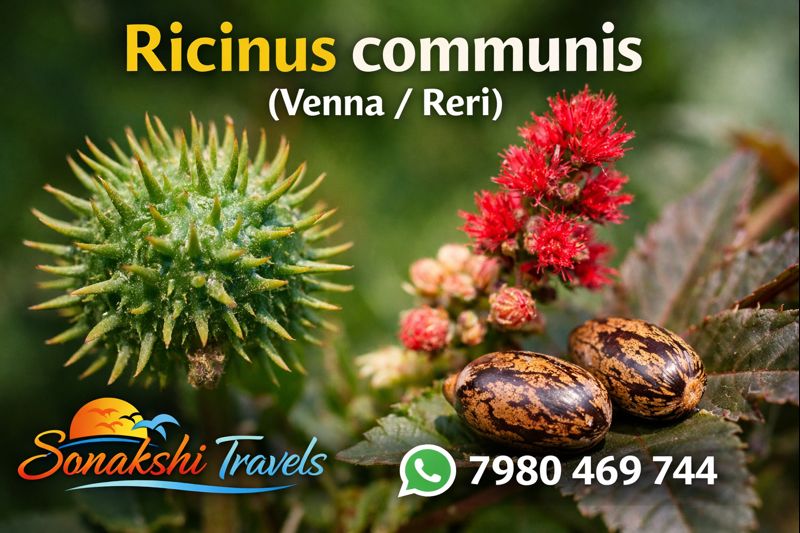
The plant bears monoecious inflorescences arranged in terminal racemes. Male flowers are found at the lower portion of the inflorescence and are characterized by numerous stamens, while female flowers occupy the upper section and possess prominent, feathery red stigmas. Flowering can occur year-round in tropical climates.
Fruits and Seeds
The fruit is a spiny, trilocular capsule that splits upon maturity to release three seeds. The seeds are oblong, glossy, and variably patterned in shades of brown, black, and gray. Despite their industrial importance, the seeds contain the highly toxic protein ricin, making them hazardous if ingested.
Habitat & Distribution
General Habitat Preferences
Ricinus communis is a highly adaptable species that thrives in open, sunny environments. It is commonly found along roadsides, riverbanks, fallow agricultural lands, waste grounds, and disturbed soils. Its rapid growth and tolerance of poor soil conditions allow it to colonize areas where many other plant species struggle to establish.
Climatic Requirements
The species prefers warm tropical to subtropical climates with moderate rainfall. While it can tolerate short dry spells, prolonged waterlogging negatively affects its root system. Optimal growth occurs in regions with annual rainfall between 500 and 800 millimeters.
Global Range
Although the precise center of origin of Ricinus communis remains debated, most botanical evidence suggests northeastern Africa or the Indian subcontinent as its native range. Today, the species is widely naturalized across tropical and subtropical regions of Asia, Africa, the Americas, and southern Europe.
Its global distribution has been facilitated by human cultivation for castor oil production, as well as its ability to escape cultivation and establish self-sustaining populations in disturbed habitats.
Preferred Habitat
The plant demonstrates a preference for well-drained, loamy to sandy soils with neutral to slightly alkaline pH. It performs best in locations receiving full sunlight and minimal competition from taller vegetation. Due to its deep taproot, Ricinus communis exhibits moderate drought resistance.
Occurrence
In India, Ricinus communis is commonly encountered across plains, coastal belts, and plateau regions. It frequently appears as a semi-wild plant near villages, agricultural boundaries, and embankments. Its spontaneous growth is particularly noticeable in regions undergoing land-use transitions.
Preferred Habitat in the Sundarbans Region
Within the Sundarbans landscape, Ricinus communis is not a true mangrove species but occurs in peripheral zones such as embankments, reclaimed lands, village edges, and elevated non-saline patches. These transitional habitats provide suitable conditions for its establishment, especially where soil salinity is diluted by freshwater inputs.
The plant often grows alongside other hardy species that tolerate periodic disturbance, contributing to early successional vegetation cover in areas affected by erosion, cyclones, or anthropogenic modification.
Planning a guided mangrove adventure? Explore our Sundarban Tour Packages and choose the best itinerary for your dates.
Ecological Role
Ricinus communis plays a significant ecological role as a pioneer species. Its rapid growth helps stabilize loose soils and reduces erosion in disturbed landscapes. The large leaves contribute organic matter to the soil upon decomposition, improving soil structure and nutrient availability.
The plant also supports insect biodiversity. Its flowers attract various pollinating insects, while the foliage serves as a host plant for certain Lepidopteran larvae. However, its toxic properties deter excessive herbivory by large mammals.
Habitat Alteration
Land-use change, including agricultural expansion, urbanization, and embankment construction, has altered the distribution patterns of Ricinus communis. While the species often benefits from moderate disturbance, extreme habitat alteration such as prolonged salinization or intensive land management can limit its persistence.
In the Sundarbans region, increasing soil salinity and embankment failures pose indirect threats by reducing suitable transitional habitats where the plant typically grows.
Conservation Efforts
Ricinus communis is not considered a threatened species globally due to its wide distribution and adaptability. Nevertheless, conservation efforts focus on sustainable cultivation practices, especially in regions where castor oil production is economically important.
In ecologically sensitive regions like the Sundarbans, maintaining natural vegetation buffers and minimizing chemical pollution indirectly support populations of this and other associated plant species.
Did You Know?
The castor plant can grow more than three meters in a single growing season under favorable conditions.
Despite its toxicity, castor oil extracted from the seeds is non-toxic and widely used in medicine and industry.
The plant has been cultivated for over 4,000 years, with evidence found in ancient Egyptian tombs.
In traditional practices, different parts of the plant have been used for medicinal and agricultural purposes.
Planning a guided mangrove adventure? Explore our Sundarban Tour Packages and choose the best itinerary for your dates.
External Reference
For additional botanical details, taxonomy, and historical notes, readers may consult the following external source: