Botanical Characteristics, Ecology, and Environmental Relevance
Leucaena leucocephala, commonly known as Ipil Ipil, is a fast-growing leguminous tree widely distributed across tropical and subtropical regions of the world. Renowned for its multipurpose utility, this species occupies a distinctive position at the intersection of forestry, agroecology, and environmental management. Its remarkable adaptability to diverse soil and climatic conditions has facilitated its widespread introduction beyond its native range, making it both an ecologically valuable species and, in certain contexts, an invasive one.
In India and particularly in eastern regions adjacent to the Sundarbans, Leucaena leucocephala has become an integral component of rural landscapes, roadside plantations, and degraded land restoration efforts. This article presents a comprehensive, research-based botanical account of the species, examining its taxonomy, morphology, habitat preferences, ecological role, and its relevance within the Sundarbans region.
Taxonomy & Classification
Systematic Position
Leucaena leucocephala belongs to the family Fabaceae, one of the largest and most ecologically significant plant families, characterized by nitrogen-fixing symbiosis with soil bacteria. The genus Leucaena comprises several species, many of which are native to the Americas and valued for their rapid growth and soil-enriching properties.
Kingdom: Plantae
Clade: Angiosperms
Clade: Eudicots
Order: Fabales
Family: Fabaceae
Subfamily: Mimosoideae
Genus:Leucaena
Species:Leucaena leucocephala (Lam.) de Wit
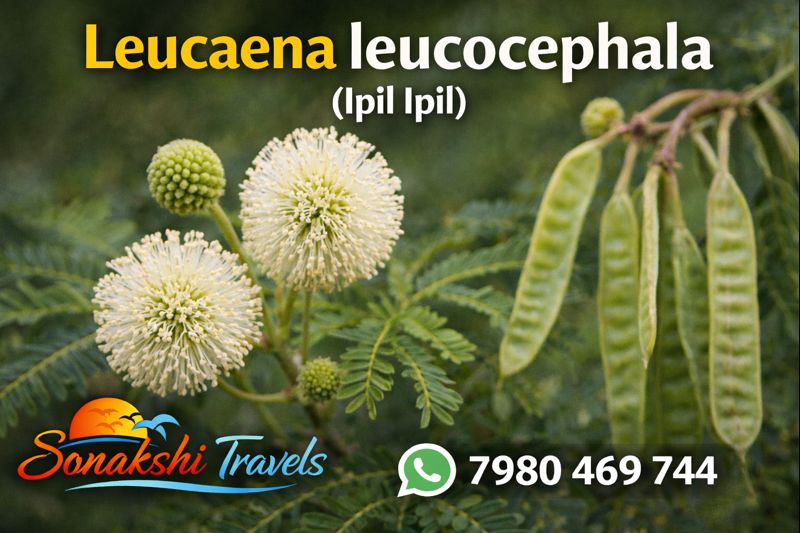
The species name leucocephala is derived from Greek roots meaning “white-headed,” referring to the characteristic pale, spherical flower heads.
Morphology & Field Identification
Growth Habit and Trunk
Leucaena leucocephala is a small to medium-sized tree, typically attaining heights between 5 and 15 meters. The trunk is straight, slender, and often multi-stemmed, particularly in coppiced individuals. Bark coloration ranges from grayish-brown to light brown, with a relatively smooth texture that becomes slightly fissured with age.
Leaves
The leaves are bipinnately compound and finely textured, lending the tree a feathery appearance. Each leaf consists of numerous small, oblong leaflets arranged along secondary pinnae. This structure minimizes water loss and allows efficient photosynthesis under high light conditions.
Flowers
Flowers are borne in axillary, globose heads measuring 2 to 3 centimeters in diameter. Individual flowers are small, creamy-white, and densely packed, with prominent stamens that give the inflorescence its characteristic puffball appearance. Flowering occurs multiple times a year in favorable climates.
Fruits and Seeds
The fruit is a flattened, elongated pod containing multiple hard-coated seeds. Pods mature from green to brown and split open upon drying. The seeds are glossy, dark brown, and capable of remaining viable in the soil for extended periods.
Habitat & Distribution
General Habitat Preferences
Leucaena leucocephala thrives in open, sunlit environments and is commonly found in disturbed habitats such as roadsides, abandoned agricultural fields, embankments, and degraded lands. Its ability to establish rapidly makes it a dominant species in secondary successional stages.
The species shows a high tolerance for a wide range of soil types, including sandy, loamy, and moderately clayey soils, provided drainage is adequate.
Global Range
Native to Central America and southern Mexico, Leucaena leucocephala has been introduced extensively across Asia, Africa, Australia, and the Pacific Islands. Its global spread has been driven by its value as fodder, fuelwood, and soil improver.
Today, it is naturalized in most tropical and subtropical regions and is considered one of the most widely distributed multipurpose tree species in the world.
Preferred Habitat
The species performs best in regions with annual rainfall ranging from 650 to 1,500 millimeters and temperatures between 25°C and 35°C. It prefers well-drained soils with neutral to slightly alkaline pH but can tolerate moderately acidic conditions.
Although drought-tolerant once established, prolonged waterlogging negatively affects its growth and survival.
Occurrence
In India, Leucaena leucocephala is widely planted and naturalized across plains, coastal belts, and plateau regions. It is frequently observed along highways, railway lines, village boundaries, and plantation edges.
Due to its prolific seed production and rapid growth, the species often forms dense stands in unmanaged areas.
Preferred Habitat in the Sundarbans Region
Within the Sundarbans region, Leucaena leucocephala is primarily confined to non-mangrove zones, including embankments, reclaimed lands, and village peripheries. These areas experience reduced salinity compared to core mangrove forests, providing suitable conditions for the species.
The tree is often planted as a windbreak or soil stabilizer along embankments, where its deep root system helps reduce erosion caused by tidal fluctuations and monsoonal rains.
Explore the diverse vegetation and transitional landscapes through a guided Sundarban Tour and gain insight into coastal ecology.
Ecological Role
As a nitrogen-fixing species, Leucaena leucocephala plays a vital role in improving soil fertility. Symbiotic bacteria in its root nodules convert atmospheric nitrogen into forms usable by plants, enhancing nutrient availability in degraded soils.
The species also contributes to erosion control, carbon sequestration, and the creation of microhabitats for insects and small fauna. Its leaf litter decomposes rapidly, adding organic matter to the soil.
Habitat Alteration
While beneficial in controlled settings, Leucaena leucocephala can alter native habitats when unmanaged. Its rapid growth and dense canopy may suppress native vegetation, leading to reduced plant diversity in some ecosystems.
In coastal regions, increasing soil salinity and waterlogging due to embankment breaches can limit its spread, thereby naturally restricting its expansion into mangrove zones.
Conservation Efforts
Leucaena leucocephala is not a species of conservation concern. Instead, management efforts focus on regulating its spread to prevent ecological imbalance. Sustainable planting practices and periodic monitoring are essential in sensitive landscapes like the Sundarbans periphery.
Promoting mixed-species plantations helps balance its benefits with biodiversity conservation goals.
Did You Know?
Leucaena leucocephala is capable of fixing large amounts of atmospheric nitrogen, enriching poor soils.
The species can regrow rapidly after cutting due to strong coppicing ability.
Its seeds can remain viable in soil for several years.
In some regions, it is considered invasive if left unmanaged.
Experience the ecological transitions of coastal Bengal with a curated Sundarban Tour designed for nature enthusiasts.