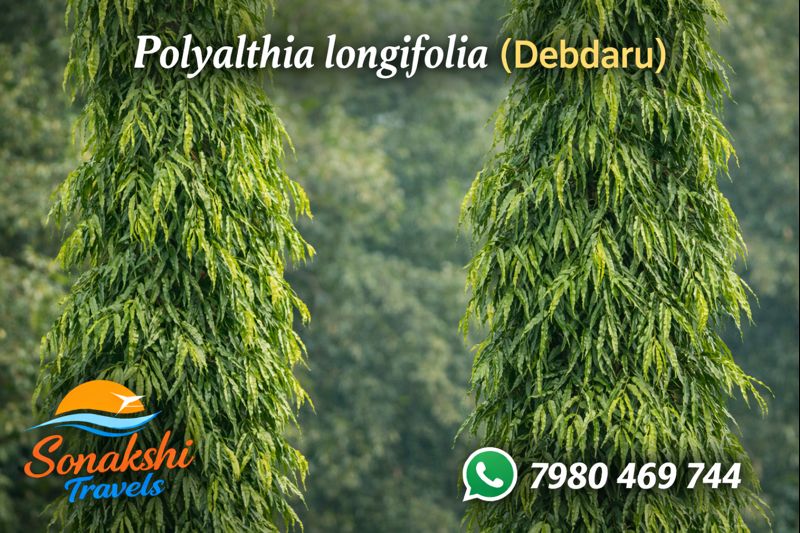
Polyalthia longifolia (Debdaru):
Botanical Characteristics, Ecology, and Landscape Significance
Polyalthia longifolia , popularly known as Debdaru , Indian Mast Tree , or Ashoka (False Ashoka) , is a tall, elegant evergreen tree widely cultivated and naturalized across tropical South Asia. Revered for its columnar form, pendulous foliage, and remarkable adaptability to varied environmental conditions, this species holds both ecological and cultural importance. While often associated with urban landscaping and temple avenues, Polyalthia longifolia also contributes meaningfully to biodiversity, microclimate regulation, and soil stability in peri-urban and rural ecosystems.
This detailed article provides a comprehensive, research-based overview of Polyalthia longifolia (Debdaru) , covering its taxonomy, morphology, habitat preferences, distribution patterns, ecological functions, and relevance within the broader Sundarbans region.
Taxonomy & Classification
Polyalthia longifolia belongs to the family Annonaceae , a large family of flowering plants that includes several tropical trees and shrubs known for their aromatic foliage and ecological significance. The genus Polyalthia comprises species primarily distributed in tropical Asia.
Scientific Classification
Kingdom: PlantaeClade: AngiospermsClade: EudicotsOrder: MagnolialesFamily: AnnonaceaeGenus: PolyalthiaSpecies: Polyalthia longifolia (Sonn.) Thwaites
The species epithet longifolia refers to its long, narrow leaves, which are among its most distinguishing features.
Morphology & Field Identification
Polyalthia longifolia is a medium to tall evergreen tree that typically reaches heights of 12–20 meters, with some specimens exceeding this range under optimal conditions. Its narrow, upright growth habit makes it instantly recognizable.
Trunk and Bark
The trunk is straight and slender, often unbranched for a considerable height. Bark is greyish-brown, smooth in young trees, and slightly fissured with age. The wood is moderately hard and fine-textured.
Leaves
Leaves are long, lanceolate, and pendulous, measuring 15–30 cm in length. They are glossy green with undulating margins, giving the tree a characteristic flowing appearance. Young leaves often exhibit a coppery or light green hue.
Flowers
Flowers are small, greenish-yellow, and borne in clusters along older branches. Though not showy, they emit a subtle fragrance and attract a variety of insects.
Fruits
The fruit consists of small, oval drupes that turn from green to dark purple or black when mature. These fruits are consumed by birds and small mammals, aiding in seed dispersal.
Habitat & Distribution
Polyalthia longifolia thrives in tropical and subtropical climates, demonstrating resilience to varying soil types and moderate environmental stress. It is commonly found in cultivated landscapes but also persists in semi-natural habitats.
Global Range
The species is native to:
Indian subcontinent, particularly Sri Lanka and southern India
Bangladesh and eastern India
Widely cultivated across Southeast Asia
Introduced to parts of Africa and tropical regions worldwide
Its popularity as an ornamental tree has led to its extensive global distribution beyond its native range.
Preferred Habitat
Preferred habitats include:
Well-drained loamy to sandy soils
Areas with full sun to partial shade
Urban avenues, temple grounds, and homesteads
Forest edges and semi-open woodlands
Occurrence
Polyalthia longifolia is frequently encountered as planted rows along roadsides and boundaries. In rural landscapes, it is occasionally found naturalized near settlements and agricultural fields.
Preferred Habitat in the Sundarbans Region
Within the greater Sundarbans region, Polyalthia longifolia is primarily found in inland and fringe zones rather than within core mangrove forests. It is commonly planted along embankments, village roads, and institutional premises where salinity levels are relatively low.
Although not a mangrove species, it contributes to the green buffer zones surrounding the Sundarbans by improving air quality, providing shade, and stabilizing soil along embankments.
Discover the green corridors surrounding the delta with a thoughtfully designed
Sundarban Tour that blends culture, villages, and nature.
Ecological Role
Despite its ornamental prominence, Polyalthia longifolia performs valuable ecological functions. Its dense canopy moderates microclimates by reducing temperature extremes and wind velocity.
Biodiversity Support
The tree provides nesting and roosting sites for birds. Its fruits serve as a food source for frugivorous species, while flowers attract pollinating insects.
Environmental Services
The root system helps bind soil, making it useful in erosion-prone areas. The tree is also known for its capacity to absorb airborne pollutants, contributing to improved air quality in populated regions.
Habitat Alteration
Urban expansion and infrastructure development have increased the cultivation of Polyalthia longifolia , sometimes at the expense of native species diversity. While adaptable, the species does not tolerate prolonged waterlogging or high salinity.
In coastal regions, rising salinity and changing hydrological regimes may limit its suitability without active management.
Conservation Efforts
Polyalthia longifolia is not considered threatened due to its widespread cultivation and adaptability. However, conservation planning increasingly emphasizes balanced planting that includes native species alongside ornamental trees.
Promoting mixed-species green belts around sensitive ecosystems like the Sundarbans can enhance ecological resilience while maintaining aesthetic value.
Did You Know?
Polyalthia longifolia is often mistaken for the true Ashoka tree.Its narrow form makes it ideal for noise and wind barriers.
The tree has been traditionally planted near temples and institutions.
It plays a role in urban heat reduction.
Explore landscapes where human settlements meet nature on a curated
Sundarban Tour highlighting ecology, culture, and sustainability.
External Reference
For general botanical information:
Wikipedia – Polyalthia longifolia
... read more staff. Just one regret with the govt to allow more routes inside core jungle to increase footfall at Sunderbans. All you can see is Deer. However i would surely visit again.
navin jayaramanMarch 17, 2022
... read more trip of Sundarban ( 3D&2N).The trip was tailor made for our need.The staff members were very courteous & looked after all the nitty gritty to make the trip a memorable one.The food used to be prepared as per our requests & was relished by all members.The night stay arranged in the 5 star resort was superb and in an hospitable atmosphere.The resort has the added feature of being located in a natural surroundings of flora and fauna. It provided attractive play areas for kids. On top of everything, it was pocket friendly & no hidden cost was involved. Would strongly recommend SonakshiTravel for this riverine trip.
Arun BiswasJanuary 17, 2023
... read more very beautiful ❤️👍🏻
Sandeep MukherjeeMarch 17, 2022
... read more dismantled as the driver uses it impulsively :) Definitely recommended...
Indraneil GhoshJanuary 17, 2023
... read more local people was truly a fun filled surprise.
Pronami SarkarMarch 17, 2022
... read more end point by professional guides who displayed very courteous behavior. definitely talukdar ji will be my preferred choice for all trips in future as well.
Auditro Hi-Fi SystemsDecember 17, 2022
... read more on board were very cordial and co-operative. The food served was abundant and of good quality and taste. We didn't felt when the whole day passed away. Complete value for money. I would recommend everyone should have a try with Sonakshi Travels.
S DGMarch 17, 2022
... read more people, beautiful presentation of dance and songs to beautiful boat and boatmen with guide. A journey with100% fulfilment. Willing to go again and again. Thanks a lot Sundarban Travel Jyotirmoy Chakraborty Chairman Ispat Cooperative Hospital
JYOTIRMOY CHAKRABORTYMarch 17, 2022
... read more did a fantastic job. Wish them all the very best.
Avik RoyJanuary 17, 2023
... read more food with rustic touch...You're at a right place..Being at a place which is remote, Dinner variety options may be limited but enough to satisfy you..I had Aged people n kid travelling with me and they were taken good care..The accommodation & boat ride were very comforting n all the staffs, tour guide were helpful..I will recommend them to Families, friends for sure.
Arunima RoyMarch 11, 2023
... read more members of the group were also very social and supportive. Thanks for gifting a pleasant memory for a long time.
Biplab SarkarJanuary 17, 2023
... read more was excellent..inspite some language problem staff were very very humble n cooperative n always willing to serve to our satisfaction...i surely will recommend my friends/ relatives to visit the place once in lifetime through Sonakshi Travels...🙏🙏🙏
Munna DewanJanuary 17, 2023
... read more date of departure our resort also exceptionally good I sincerely thanks to all cruise staff and manager to Mr. Talukdar.
Ashis RoySeptember 17, 2022
... read more recommend their package
Sanghita RoyMarch 17, 2022
Dr. Sikka & associatesJanuary 17, 2023
... read more boat is undercover with green carpet,so it'is looking beautiful,all management are peaceful Jumur dance is wonderful our all member danced with Jumur dancers we are all coming a sweet memories. Thanks to continue Mr Talukder.
Avijit SarkarMarch 17, 2022
HRITURAJ CHAKRABORTYOctober 17, 2022
... read more with Mr.Suvabrata Talukder.We were 13 heads (including 3 senior citizen and 2 child of 5 years old).It was a programme from Howrah to Howrah (railway station). Yesterday (13th November 2021) we returned from our trip. Overall experience was awesome.Communication with Mr. Talukder over phone before journey came in reality through the entire tour in every respect. Manager Subrata and other staff of boat along with the staff of the resort was very helpful and polite . Behaviour of the staff was very good. Food quality was really good .Not to much spicy but tasty , quantity was sufficient.The resort we stayed (Sabujdieep) was good /clean/safe and a small walking from jetty where we dropped from boat.One evening we enjoyed tribal music and dance in the resort. We along with my co- travellers enjoyed the tour with amazing experience ,kept beautiful moments and memories for life time with us. Everything was perfect. Arrangements in every angle was Wonderful. I strongly suggest and recommend everyone to enjoy your tour with this Sonakshi Travel (Sonarpur).
Anjan RayMarch 17, 2022
... read more 10th to 12th of December, 2021 ( 2 nights 3 days package). I take pleasure in sharing my/ our experience with Mr Suvabrata ( Sonakshi Travels to us means Mr Suvabrata). # Mr Suvabrata, a perfect gentleman, with polite behaviour, understanding/ empathetic & extremely helpful nature. # Well organized & hastle free tour. # Polite & helpful staffs. # Punctuality is a batch.... whether it's transport, food, sight seeing, arrival or departure, everywhere time schedule was perfectly maintained. # Well designed itinerary & all places covered providing flexibility to the visitors. # Neat & clean car & boat. We were lucky to have a boat for ourselves. Hearty thanks to Mr Suvabrata for the unexpected surprise. # Place of stay was clean, beautiful & comfortable with all basic necessities including hot water. # Delicious food was served both veg & non-veg. # Pocket friendly package. No hidden charges or extra money demanded. Words will fall short to express my appreciation for MR SUVABRATA (SONAKSHI TRAVELS) & his TEAM. No one ( staffs) wore a frown throughout the trip & left not a single area for complaint. Once again I, on behalf of my family & friends, convey my wholehearted thanks to Mr Suvabrata & team. Looking forward to join you for some other trip.
Manisha Roy Chowdhury GhantiMarch 17, 2022
pramod tembhurnikarFebruary 17, 2023
Dipanjan BiswasMarch 17, 2022
... read more customised their programme for our convenience at their best. The boat waiting for us at Gadkhali was decent, neat & clean. The cooperation and helpful gesture of the Boatman Bapibabu and crew Pulak charmed us. The trip through the creeks and distributaries of the rivers of Sunderban became more enjoyable with the excellent taste of food cooked by Bhaskar in the running boat. The property named “Sabuj Dwip” under Lahiripur Gram Panchayat where we were parked at the day-end, was a resort having cottages with clean Rooms, modern Bathrooms & standard amenities including Generator along with a few shortfalls like lack of Geyser, AC, Toilet-shower, Kitchen/Kitchenet, Waste paper bin, Wall Hangers etc., though all such lacuna were covered by the sincere and hearty efforts of the servicemen. The owner may solve these minor problems by purchasing items of trivial value like Emersion Heater, Toilet-shower, Electric Cattle, Waste paper basket & Wall hangers. On 5th December, when the cyclone turned its face to Sunderban, the superb teamwork of Sonakshi rescued us through an alternative safe land-route maintaining our all urbane comfort upto the satisfaction. The courteous behaviour and delicious tasty food are the value-added satisfaction of this trip over the honest, humble and sincere approach of the owner Shuvabratababu which is highly appreciable. I highly recommend Sunderban Trip through this Travels.
Snehansu GangopadhyayMarch 17, 2022
... read more tour confirmation 7/10. I paid advance for booking after checking the availability. But after making the payment, I was informed the required dates are not available and I had to change my dates. Communication of programs are also not up to the mark. 2. Transfer from Kolkata to Gadkhali & Return 8/10. Onward journey driver was new and not carrying proper documents for Vehicle. Stuck at Ghatakpukur for more than 30 minutes in a police checking. Return journey was better but the vehicle given was too old. 3. Boat Arrangements from Gadkhali 10/10. Good & comfortable. Well decorated boat with well behaved staffs. 4. Accommodation 10/10. Very good place selection and enjoyed the staying. This point you will get a bonus point. 5. Food 8/10. First day lunch was awesome but next meals were just below par. Lacking variety. I came to know few other agencies are offering more variants in their service. Finally thanks to all your staffs in the boat and in the hotel. Specially mentioning Tapas, Bapi, your cook and Subrata for their service.
Sibagi GhoshMarch 17, 2022
... read more people. The jungle visit was great and we could see so many animals
Kunal BasuMarch 17, 2022
... read more staff is always up to the mark. Thank you all.
Rupak BhattacharjeeJanuary 17, 2023
... read more staff ( Bapida, Bhaskarda and Uttamda). Special thanks to Talukdar Babu for taking care of everything. Highly recommended.
rupendu banerjeeMarch 17, 2022
... read more group tours were available Mr Talukder arranged a customized tour for us & we were a little apprehensive as the two of us would be traveling alone . But he assured us about our safety & other facilities & truly everything was beyond our expectations. Right from our pickup, boat tours, hotel accommodation & food everything was well arranged. We have come back with sweet memories. Thank you Mr Talukder & every one at Sonakshi tours.
Leena MhatreMarch 17, 2022
... read more of staff was very good
DEV KUMAR PYNEDecember 17, 2022
... read more served us very well. Thank you for all your services.
Shaily GuptaMarch 17, 2022
... read more for the tour. They provide us a car and launch for this trip. It was very organised trip.
Faiz AhmedMarch 17, 2022
... read more team, tour manager Subrata, boat captain Bapi da and our guide Tanmoy da was very cooperative and helpful. Our stay was in Sobuj Deep Resort, the location is next to the river and rooms are quite good in size, there 4 bedrooms can accommodate 2 families with one kid comfortably. The facilities and services of boat and resort was excellent. My objective was to spend some time with family in the nature, and a wild wish if we could spot the graceful royal Bengal tiger in the wild was 100% fulfilled. When I was researching for this tour, I found Sundarbans travel (Sonakshi travel) rated 4.5 among all, and I am not disappointed as well. Next time when I will visit Sundarbans again my choice will be Sundarbans travel. All over experience “The tour is mind blowing”.
Kaustav ChatterjeeMarch 17, 2022
... read more package. Here are few points I would like to mention regarding the tour. PROS: 1) The tour organiser, Mr Talukdar gave us a very clear account of the package and there were no hidden cost. 2) We were appointed a manager ( Mr Subrata) during the tour, who was very polite in his dealings. Since I was travelling with my 4 yr old daughter, I had requested him to make few extra arrangements ( in meal) for her ….for which I never had to remind him again and all my requirements were taken care off. 3 ) since we were only 3 families travelling on one boat, we had enough space to ourselves as compared to other boats I saw during the trip were overly crowded. 4) Food was good and the preparation was quite homely. 5)As we had to spend considerable amount of time on the boat…. I was little apprehensive about the cleanliness of the washroom on the boat. But to my surprise, the washroom was sparkling clean. CONS: 1) Though the hotel we were made to stay was very well located… but the rooms were very basic. Rooms are newly made but not very well maintained. The floor of the rooms felt like they were not dusted and mopped in days.There were cobwebs here and there and bathroom had few centipedes. To my opinion..rooms could have been better than what was provided. Overall, it was a well organised trip and Mr Talukdar kept checking on us during the trip which I truly appreciate. We thoroughly enjoyed. And I would certainly recommend Sundarban Travel to my friends and family.
Vaishali SenguptaMarch 17, 2022
Gourav GhoshJanuary 17, 2023
... read more care of every group member as per the need, especially the elderly ones. I travelled with the parents and the staff members made the trip super comfortable for them as well. Thanks to each one of them!! 😊🙏 Would highly recommend Sonakshi Travels for the Sundarban trip.
Shuchita MitraMarch 17, 2022
... read more homely environment, mainly we are extremely impressed the condition of the boat, cleanliness and food quality was superb. Except the chilli chicken preparation ( not upto the mark), the taste of the food was just like home made food. Resort location was good but not in good quality, need to look into this to provide the best service. Also the car condition is not good. Apart from these we enjoyed a lot throughout the tour. Special thanks to Mr.Talukdar and Team for organizing our memorable trip.
Amit SasmalMarch 17, 2022
... read more cottage were excellent. Subrat dada was extremely well informed about the forests. His knowledge helped us a lot. Extremely grateful🙏
Shradha Suman SatpathyMarch 17, 2022
... read more the stuff were very polite (Special mention- dipankar da).They did everything with professional manner with touch of heart. Strongly recommend them.
ataur rahamanMarch 17, 2022
Tripti DasJanuary 17, 2023
Partha Sarathi MajumderFebruary 17, 2023
... read more are very well organised to set up this Sunderban tour in terms of fooding lodging and irrespective every things which relates to this particular tour. Me and my family has a mind blowing experience. Thanks Subhabrata Talukdar to you and to your team for giving us a memorable experience.
Sagar BanerjeeJanuary 17, 2023