A Detailed Study of Mangrove Biology, Habitat Adaptation and Ecological Role
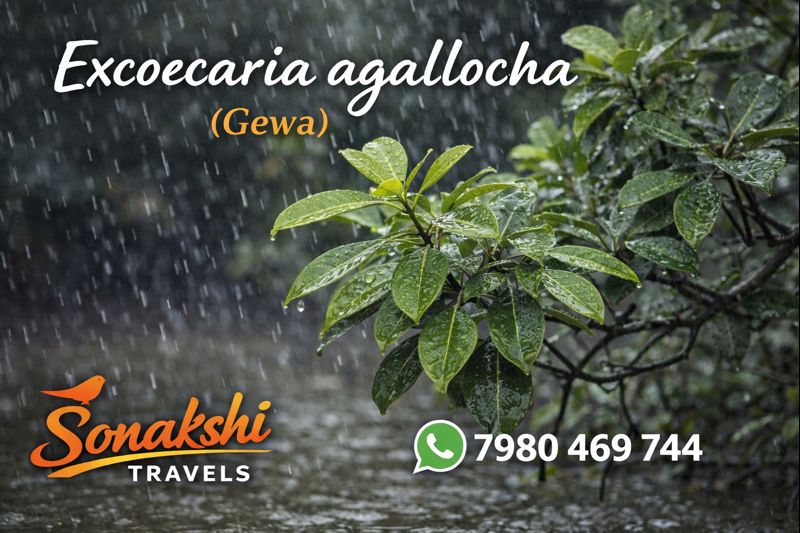
Excoecaria agallocha, commonly known as Gewa in the Sundarbans region and widely referred to as the “blind-your-eye mangrove,” is a distinctive and ecologically important mangrove-associated tree species of tropical coastal zones. This species is renowned not only for its resilience to saline and tidal stress but also for its unique chemical defenses, which have shaped both its ecological interactions and its historical relationship with human communities.
Belonging to the family Euphorbiaceae, Excoecaria agallocha occupies a critical niche within mangrove ecosystems, particularly in estuarine and back-mangrove zones where salinity fluctuates seasonally. In the Indian Sundarbans, Gewa plays a subtle yet foundational role in stabilizing soil, supporting faunal communities, and contributing to the complex mosaic of vegetation that defines the world’s largest mangrove forest.
Although not as visually dominant as species like Sundari or Goran, Gewa is a biological specialist. Its presence often signals transitional habitats where freshwater influence meets tidal saline regimes. Understanding this species provides deeper insight into mangrove succession, wetland health, and adaptive plant strategies in extreme environments.
Taxonomy & Classification
The taxonomic placement of Excoecaria agallocha reflects its evolutionary lineage within the spurge family, a group known for latex-producing species and diverse growth forms. Its classification has remained relatively stable, supported by both morphological traits and phytochemical characteristics.
Systematic Position
Kingdom: Plantae
Clade: Angiosperms
Clade: Eudicots
Order: Malpighiales
Family: Euphorbiaceae
Genus:Excoecaria
Species:Excoecaria agallocha
The genus Excoecaria includes a small number of species adapted to wet or coastal habitats. E. agallocha is the most widely distributed and ecologically significant member of the genus, particularly in mangrove ecosystems across the Indo-Pacific region.
Morphology & Field Identification
Excoecaria agallocha is a medium-sized evergreen to semi-evergreen tree, easily recognizable by its leaf structure, bark characteristics, and the presence of milky latex. These features serve both protective and adaptive functions in its challenging habitat.
Vegetative Structure
The tree typically reaches heights of 8–15 meters, though stunted forms are common in highly saline or waterlogged soils. The trunk is straight, with greyish to brown bark that may become fissured with age. Young branches are smooth and often bear visible latex canals.
Leaves are simple, alternate, and elliptic to obovate in shape, with entire margins and a glossy upper surface. The leathery texture of the leaves reduces water loss and protects against salt spray. When damaged, leaves exude a thick, white latex, a characteristic feature of the species.
Reproductive Features
Excoecaria agallocha is generally dioecious, with male and female flowers borne on separate individuals. Flowers are small, inconspicuous, and arranged in catkin-like inflorescences. Pollination is primarily facilitated by wind, though insects may play a secondary role.
Fruits are small, three-lobed capsules that split upon maturity, releasing seeds into the surrounding substrate. Tidal dispersal allows seeds to colonize new areas, particularly along estuarine margins.
Habitat & Distribution
The species is closely associated with mangrove and mangrove-adjacent habitats. It thrives in areas subject to periodic tidal inundation, brackish water influence, and fine alluvial soils. Unlike core mangrove species, Gewa often occupies slightly elevated or inland zones within the mangrove matrix.
Environmental Conditions
Excoecaria agallocha tolerates a wide range of salinity levels, from near-freshwater conditions to moderately saline environments. It prefers muddy or silty substrates rich in organic matter and benefits from seasonal freshwater inflow that moderates soil salinity.
Global Range
The natural distribution of Excoecaria agallocha extends across the tropical Indo-Pacific region. It is found in India, Bangladesh, Sri Lanka, Myanmar, Thailand, Malaysia, Indonesia, southern China, the Philippines, and northern Australia.
Its broad geographical range reflects a high degree of ecological plasticity, allowing it to persist under varying climatic and hydrological conditions. In many regions, it forms a significant component of secondary mangrove forests.
Preferred Habitat
Gewa shows a marked preference for estuarine margins, tidal creeks, and back-mangrove zones where salinity fluctuates seasonally. It often occurs in association with other mangrove species, contributing to structural diversity and habitat complexity.
Visitors interested in understanding mangrove zonation and plant diversity may explore a guided Sundarban Tour,
where species like Gewa form an integral part of the forest landscape.
Occurrence
In the Indian subcontinent, Excoecaria agallocha occurs naturally along coastal belts and deltaic regions. Within the Sundarbans, it is widely distributed in intermediate zones between core mangrove stands and human-influenced areas such as embankments and village edges.
The species demonstrates year-round presence, though flowering and fruiting are more prominent during specific seasonal windows influenced by rainfall and tidal cycles.
Preferred Habitat in the Sundarbans Region
In the Sundarbans, Gewa thrives along tidal creeks, canal banks, and slightly elevated forest patches that experience reduced but regular tidal flooding. These zones often serve as buffers between high-salinity mangrove interiors and freshwater-influenced village landscapes.
The species contributes to ecological stability by reinforcing soil structure and moderating salinity gradients, making it a key component of the Sundarbans’ transitional ecosystems.
A well-planned Sundarban Tour
offers opportunities to observe such adaptive mangrove species within their natural tidal settings.
Ecological Role
Excoecaria agallocha plays a vital ecological role in mangrove ecosystems. Its root systems help stabilize soft sediments, reducing erosion caused by tidal currents. Leaf litter contributes organic matter to the forest floor, supporting detritivores and microbial communities.
The tree also provides habitat for insects, birds, and small mammals, while its presence enhances overall biodiversity by supporting transitional ecological niches.
Habitat Alteration
Habitat alteration poses significant challenges to Gewa populations. Coastal development, embankment construction, altered freshwater flow, and pollution have reduced suitable habitats in many regions. In the Sundarbans, rising salinity and increased storm frequency further stress existing populations.
Fragmentation of mangrove forests disrupts natural regeneration processes, affecting the long-term viability of the species.
Conservation Efforts
Conservation of Excoecaria agallocha is closely tied to broader mangrove protection initiatives. Sustainable forest management, restoration of degraded mangrove areas, and maintenance of natural tidal flow regimes are essential for its continued survival.
Community awareness programs and inclusion of lesser-known mangrove species in conservation planning enhance ecosystem-level resilience.
Did You Know?
The milky latex of Gewa can cause temporary blindness if it comes into contact with eyes.
The species is often one of the first to colonize disturbed mangrove edges.
Despite its toxicity, it plays a crucial ecological role in mangrove regeneration.
Gewa wood was historically avoided due to its irritant properties.
External Reference
General botanical information on this species is available through Wikipedia.