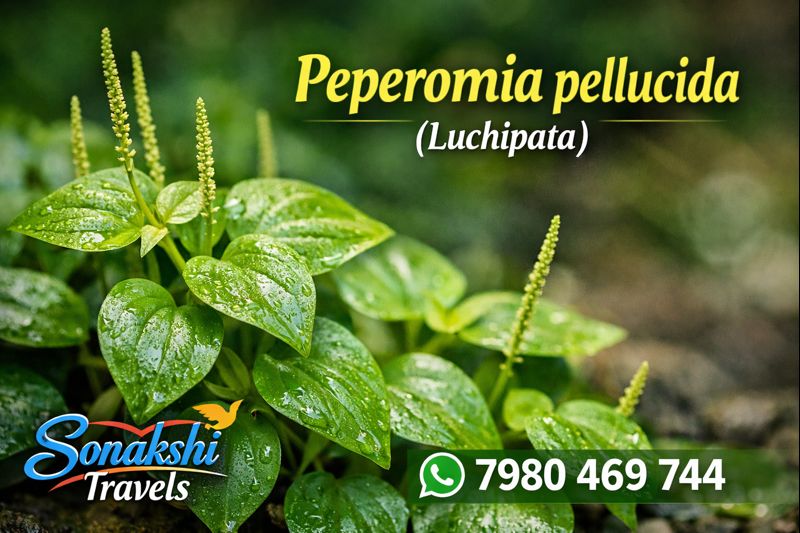
Peperomia pellucida, locally known in several parts of eastern India and the Sundarbans as Luchipata, is a delicate, herbaceous plant widely recognized for its translucent foliage, shallow root system, and remarkable ecological adaptability. Belonging to the pepper family, this species occupies a unique position among tropical understory herbs, thriving in moist, shaded environments with minimal soil depth. Despite its fragile appearance, Peperomia pellucida demonstrates exceptional resilience and plays a subtle yet important role in forest-floor ecology, particularly in humid mangrove-influenced landscapes.
The plant is of growing interest not only to botanists and ecologists but also to ethnobotanists due to its traditional usage across tropical Asia, Africa, and the Americas. In regions such as the Sundarbans, its presence reflects microhabitat stability, soil moisture retention, and low-intensity human disturbance. This article presents an in-depth, research-based overview of the species, focusing on taxonomy, morphology, habitat preference, global distribution, ecological function, and conservation considerations.
Taxonomy & Classification
Kingdom and Higher Classification
Peperomia pellucida belongs to the angiosperm lineage and is classified under the family Piperaceae, a group known for aromatic herbs and shrubs such as black pepper (Piper nigrum). The genus Peperomia is one of the most diverse within the family, comprising over a thousand species adapted to tropical and subtropical environments worldwide.
The species epithet pellucida refers to the translucent nature of its fleshy leaves and stems, a defining morphological characteristic. The plant was formally described by Carl Linnaeus and later refined by Karl Sigismund Kunth, reflecting its long-standing recognition in classical botany.
Morphology & Field Identification
General Growth Habit
Peperomia pellucida is a small, annual to short-lived perennial herb, typically reaching a height of 15–40 cm. The plant exhibits a soft, succulent structure with a shallow root system, allowing it to colonize thin soil layers over rocks, brickwork, and decomposing organic matter.
Stem Characteristics
The stems are erect, glabrous, and semi-translucent, often pale green to light yellowish-green in color. They are fragile and water-rich, breaking easily under mechanical stress. Nodes are clearly visible, from which leaves and inflorescences arise alternately.
Leaf Structure
Leaves are heart-shaped to broadly ovate, measuring approximately 2–6 cm in length. The leaf surface is smooth, glossy, and fleshy, with prominent venation visible through the translucent tissue. The petioles are slender and elongated, contributing to the plant’s delicate appearance.
Inflorescence and Flowers
The flowers are minute and borne on erect, slender spike-like inflorescences arising from leaf axils or terminal positions. These spikes may reach up to 10 cm in length. Individual flowers lack showy petals and are primarily wind-pollinated, reflecting an efficient reproductive strategy in shaded environments.
Habitat & Distribution
Natural Habitat
Peperomia pellucida thrives in moist, shaded habitats with high humidity. It is commonly found along forest floors, stream banks, shaded garden beds, and damp walls. The plant favors substrates rich in organic matter and does not tolerate prolonged drought or direct, intense sunlight.
Altitude Range
The species is predominantly a lowland plant, typically occurring from sea level up to approximately 1,000 meters. In coastal ecosystems, including mangrove-adjacent regions, it occupies microhabitats protected from saline inundation.
Global Range
Geographical Distribution
Peperomia pellucida has a pantropical distribution. It is native to Central and South America but has become naturalized across tropical Africa, Southeast Asia, South Asia, and parts of Oceania. Its wide distribution is attributed to efficient seed dispersal and adaptability to disturbed habitats.
Presence in South Asia
In the Indian subcontinent, the plant is widely distributed in eastern, northeastern, and southern regions, particularly in areas with high rainfall and dense vegetation. It is frequently observed in West Bengal, Assam, Odisha, Kerala, and the Andaman and Nicobar Islands.
Preferred Habitat
Soil and Moisture Requirements
The species prefers loose, well-drained soils enriched with decomposed leaf litter. Constant moisture is essential, although waterlogging is avoided. The plant’s succulent tissues allow temporary water storage, supporting survival during short dry spells.
Light Conditions
Partial to deep shade is optimal for growth. Direct sunlight often causes leaf scorching and reduced vigor, making the species an indicator of shaded, stable microclimates.
Occurrence
Seasonal Appearance
Peperomia pellucida commonly appears during the monsoon and post-monsoon seasons. Germination occurs rapidly after rainfall, and the plant completes its life cycle within a few months under favorable conditions.
Preferred Habitat in the Sundarbans Region
Microhabitats within the Mangrove Landscape
In the Sundarbans, Peperomia pellucida is typically found in shaded village groves, freshwater pondsides, embankment interiors, and elevated forest margins where saline intrusion is minimal. It does not occur in core mangrove zones but thrives in transitional ecotones.
Ecological Significance in the Sundarbans
Its presence indicates relatively undisturbed soil moisture regimes and contributes to understory plant diversity. The species plays a minor but consistent role in nutrient recycling through rapid biomass turnover.
Exploring the delicate understory flora of the delta becomes more meaningful when combined with expert guidance. Plan your nature-focused journey through a curated Sundarban Tour and experience the living landscape responsibly.
Ecological Role
Soil Stabilization and Microfauna Support
The shallow root system helps bind surface soil particles, reducing minor erosion in shaded areas. The plant also provides microhabitat cover for insects and soil invertebrates, contributing to local biodiversity.
Role in Nutrient Cycling
Due to its rapid growth and decomposition, Peperomia pellucida contributes to organic matter accumulation, enhancing soil fertility in forest understories.
Habitat Alteration
Impact of Land-Use Change
Urban expansion, embankment construction, and excessive clearing of shaded vegetation negatively affect the microhabitats required by this species. Reduction in canopy cover leads to moisture loss and local population decline.
Climate Sensitivity
Altered rainfall patterns and prolonged dry periods may reduce germination success and shorten the growing season, particularly in coastal landscapes such as the Sundarbans.
Conservation Efforts
Current Conservation Status
The species is not globally threatened; however, its local populations are sensitive to microhabitat disturbance. Conservation of shaded, moist environments indirectly supports its persistence.
Sustainable Habitat Management
Preservation of village groves, maintenance of freshwater zones, and reduced chemical usage in surrounding areas contribute to sustaining natural populations of Peperomia pellucida.
To observe such subtle plant species in their natural settings, opt for a thoughtfully planned Sundarban Tour
that emphasizes ecological awareness and low-impact exploration.
Did You Know?
Interesting Botanical Insights
Despite its soft texture, Peperomia pellucida can rapidly colonize disturbed soil surfaces. Its translucent leaves allow efficient light penetration to lower tissues, maximizing photosynthesis in shaded environments.
Ethnobotanical Relevance
In many tropical cultures, the plant has been traditionally valued for its perceived medicinal properties, contributing to its recognition beyond pure ecological interest.
External Reference
For additional taxonomic details and historical botanical records, consult the Wikipedia entry on Peperomia pellucida.