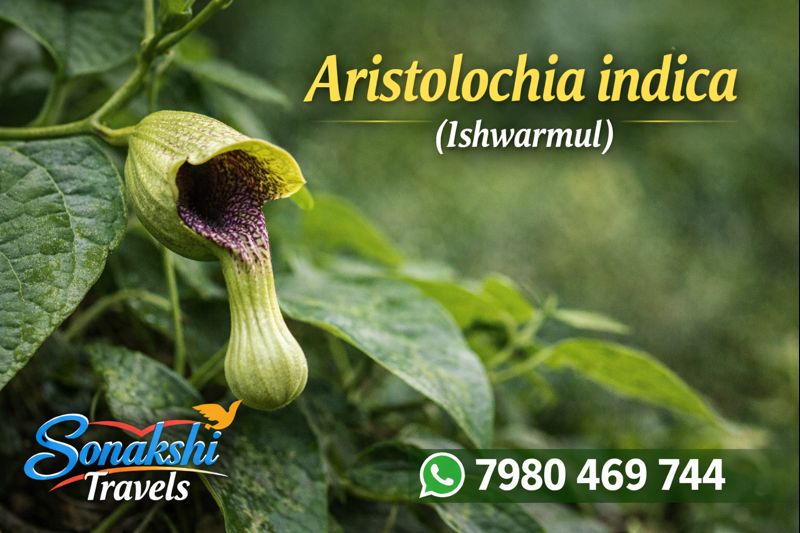
Aristolochia indica, widely known in traditional Indian ethnobotany as Ishwarmul, is a perennial woody climber recognized for its distinctive tubular flowers, extensive medicinal history, and ecological importance in tropical forest systems. The plant has long been associated with classical Ayurvedic literature, folk medicine, and forest-based cultural practices across South Asia. Beyond its medicinal relevance, Aristolochia indica represents a structurally significant climber species contributing to forest stratification, understory dynamics, and insect–plant interactions.
Characterized by its twining growth habit and heart-shaped leaves, Ishwarmul thrives in moist deciduous to semi-evergreen forests. Its presence is often indicative of relatively undisturbed habitats with adequate canopy cover and soil moisture. In regions such as the Sundarbans fringe areas, the species persists in transitional forest zones where freshwater influence remains dominant. This article presents a comprehensive, research-oriented examination of Aristolochia indica, encompassing its taxonomy, morphology, habitat preference, ecological role, and conservation considerations.
Taxonomy & Classification
Systematic Position
Aristolochia indica belongs to the family Aristolochiaceae, a lineage known for morphologically complex flowers and chemically distinctive secondary metabolites. The genus Aristolochia comprises several hundred species distributed mainly across tropical and subtropical regions, many of which are climbers or herbaceous perennials.
The genus name Aristolochia originates from Greek terms meaning “best childbirth,” reflecting the historical medicinal associations of several species. The species epithet indica denotes its strong association with the Indian subcontinent.
Morphology & Field Identification
Growth Form and Habit
Aristolochia indica is a perennial woody climber with long, slender, twining stems that rely on surrounding vegetation for support. The plant may extend several meters in length, forming dense tangles within forest understories and along woodland edges.
Stem Characteristics
The stems are cylindrical, glabrous to slightly pubescent when young, and become woody with age. Mature stems display a light brown to greyish bark, often marked by longitudinal fissures. Nodes are prominent, facilitating leaf and branch emergence.
Leaf Morphology
Leaves are simple, alternate, and broadly ovate to cordate in shape, measuring 8–15 cm in length. The leaf apex is acuminate, while the base is distinctly heart-shaped. The lamina is smooth, leathery, and dark green above, with a paler underside. Venation is reticulate and clearly visible.
Flower Structure
The flowers of Aristolochia indica are among its most distinctive features. They are solitary, axillary, and tubular, exhibiting a curved, pipe-like structure. Flower coloration ranges from greenish-yellow externally to purplish-brown or dark maroon internally. The unusual morphology facilitates pollination by insects, particularly flies, through temporary trapping mechanisms.
Fruit and Seeds
The fruit is a pendulous, oblong capsule that splits open upon maturity to release numerous flat, winged seeds. These seeds are adapted for dispersal by wind and gravity, allowing colonization of nearby suitable habitats.
Habitat & Distribution
Natural Habitat
Aristolochia indica is typically found in moist deciduous forests, semi-evergreen woodlands, forest margins, and shaded scrublands. It favors environments with moderate to high humidity and partial shade, where climbing support from trees and shrubs is readily available.
Altitude Range
The species occurs from sea level up to approximately 900 meters. In coastal and deltaic regions, it persists primarily in inland or elevated areas with minimal saline influence.
Global Range
Geographical Spread
Aristolochia indica is native to South Asia and parts of Southeast Asia. Its natural range includes India, Sri Lanka, Bangladesh, Myanmar, and neighboring regions. While not globally invasive, the species has been introduced into select tropical botanical collections due to its medicinal importance.
Distribution within India
Within India, the plant is widely distributed across the Western Ghats, Eastern Ghats, central Indian forests, northeastern states, and parts of eastern India, including West Bengal.
Preferred Habitat
Soil and Moisture Conditions
The plant prefers well-drained loamy soils enriched with organic matter. Consistent soil moisture is essential, although waterlogged conditions are generally avoided. Leaf litter accumulation supports seedling establishment.
Light and Canopy Requirements
Partial shade to filtered sunlight is optimal. Dense canopy cover protects the foliage from excessive transpiration while supporting sustained growth.
Occurrence
Seasonal Growth Pattern
Vegetative growth intensifies during the monsoon season, followed by flowering and fruiting in the late monsoon to early winter period. The plant remains perennial, with above-ground parts persisting year-round in favorable climates.
Preferred Habitat in the Sundarbans Region
Local Distribution Characteristics
In the Sundarbans region, Aristolochia indica is primarily found in fringe forests, village woodlots, and elevated embankment zones where freshwater influence dominates. It does not occur within core mangrove swamps but thrives in transitional forest patches with reduced salinity.
Environmental Indicators
Its presence reflects relatively stable soil conditions, adequate canopy cover, and limited anthropogenic disturbance, making it a useful indicator species for habitat quality.
Understanding the rich botanical diversity of forest margins becomes more immersive through a thoughtfully curated Sundarban Tour, where nature interpretation and conservation awareness go hand in hand.
Ecological Role
Support for Insect Biodiversity
Aristolochia indica plays a significant ecological role as a larval host plant for certain butterfly species. The specialized chemical compounds present in its tissues influence insect feeding behavior and predator deterrence.
Structural Contribution
As a climber, the species enhances vertical habitat complexity, offering shelter and movement corridors for small fauna within forest understories.
Habitat Alteration
Anthropogenic Pressures
Deforestation, overharvesting for medicinal use, and land conversion significantly impact natural populations. Loss of climbing support and canopy assurance directly limits regeneration.
Climate-Related Stress
Changes in rainfall patterns and prolonged dry spells may reduce flowering success and seed viability, especially in marginal habitats.
Conservation Efforts
Current Status
While not classified as globally endangered, Aristolochia indica faces localized population declines. Sustainable harvesting practices and habitat preservation are critical for long-term survival.
Conservation Strategies
Encouraging cultivation in home gardens, protecting forest edges, and raising awareness about responsible use can significantly reduce pressure on wild populations.
To witness forest-edge species like Ishwarmul within their natural landscape, consider an eco-sensitive Sundarban Tour that prioritizes education and habitat respect.
Did You Know?
Unique Botanical Traits
The unusual flower shape of Aristolochia indica temporarily traps pollinating insects, ensuring effective pollen transfer before releasing them unharmed.
Cultural and Ethnobotanical Significance
For centuries, Ishwarmul has been revered in traditional knowledge systems, underscoring the deep connection between forest biodiversity and cultural heritage.
External Reference
For additional scientific background and taxonomic history, visit the Wikipedia page on Aristolochia indica.