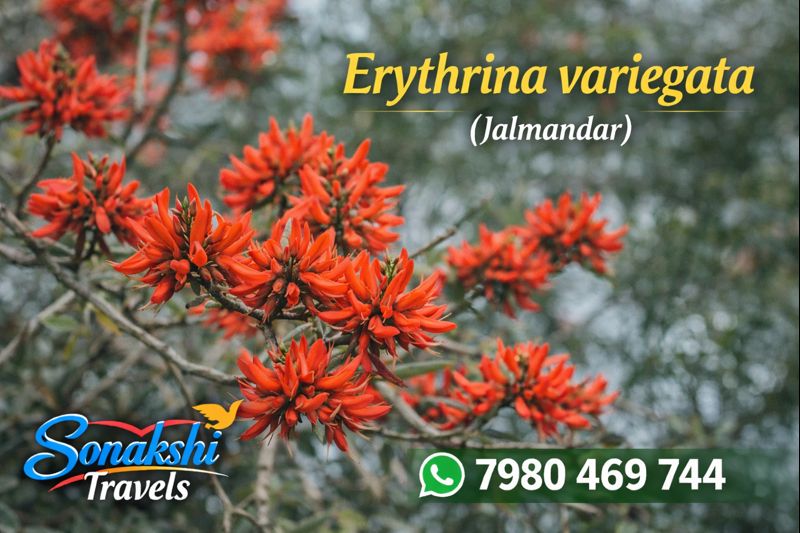
Erythrina variegata, commonly known as Jalmandar in eastern India and Bengal, is a striking deciduous tree admired for its vivid scarlet blossoms, broad ecological adaptability, and long-standing association with coastal and tropical landscapes. Belonging to the legume family, this species is widely distributed across the Indian subcontinent and Southeast Asia, where it serves both ecological and cultural functions. The tree is especially notable during its flowering season, when leafless branches erupt into dense clusters of bright red flowers, transforming riverbanks, village edges, and coastal roadsides into vivid natural displays.
Beyond its ornamental appeal, Erythrina variegata plays a meaningful role in soil enrichment, habitat provision, and traditional agroforestry systems. Its presence in deltaic regions such as the Sundarbans reflects its tolerance to seasonal flooding, saline air exposure, and varied soil conditions. This comprehensive article examines Jalmandar through a botanical and ecological lens, detailing its taxonomy, morphology, habitat preferences, distribution, ecological role, and conservation context.
Taxonomy & Classification
Systematic Placement
Erythrina variegata is a member of the Fabaceae family, a diverse group known for nitrogen-fixing capabilities and ecological importance in terrestrial ecosystems. The genus Erythrina includes numerous species recognized for their showy flowers and use as shade or support trees in tropical agriculture.
The genus name Erythrina is derived from the Greek word erythros, meaning red, a reference to the vivid flower coloration characteristic of the genus.
Morphology & Field Identification
Growth Habit and Size
Erythrina variegata is a medium-sized deciduous tree, typically reaching heights of 15–20 meters. The trunk is short and stout, supporting a broad, spreading crown. The tree often exhibits a sculptural appearance, particularly during the dry season when leaves are shed.
Bark and Stem Features
The bark is grey to light brown, rough in texture, and occasionally armed with small conical prickles, especially on younger branches. The stem and branches are thick and succulent when young, gradually becoming woody with age.
Leaf Characteristics
Leaves are trifoliate, large, and broadly ovate, with each leaflet measuring up to 20 cm in length. The leaf surface is smooth and bright green, providing dense shade during the growing season. Leaf fall typically precedes flowering.
Flowers and Inflorescence
Flowers are large, showy, and borne in dense terminal or axillary racemes. The petals are bright red to crimson, sometimes with orange hues. Flowering occurs when the tree is nearly leafless, enhancing pollinator visibility.
Fruits and Seeds
The fruit is a long, cylindrical pod containing several hard, kidney-shaped seeds. Mature seeds are glossy and dark brown to black, capable of remaining viable for extended periods.
Habitat & Distribution
Natural Habitat
Erythrina variegata occurs naturally in coastal forests, riverbanks, mangrove margins, open woodlands, and village landscapes. It thrives in regions with seasonal rainfall and tolerates brief flooding events.
Altitude Range
The species is primarily found in lowland areas from sea level up to approximately 800 meters, favoring warm and humid climates.
Global Range
Geographical Distribution
Erythrina variegata has a wide natural range extending across South Asia, Southeast Asia, northern Australia, and several Pacific islands. It has also been introduced to tropical regions worldwide as an ornamental and agroforestry species.
Distribution in the Indian Subcontinent
In India, Jalmandar is common along coastal belts, riverine plains, and rural landscapes, particularly in West Bengal, Odisha, Andhra Pradesh, Tamil Nadu, Kerala, and northeastern states.
Preferred Habitat
Soil Preferences
The tree grows well in loamy, sandy, and alluvial soils, showing tolerance to moderate salinity and poor soil fertility. Its root system contributes to soil stabilization.
Light and Moisture Conditions
Full sunlight is ideal for optimal flowering and growth, although young plants can establish under partial shade. Seasonal moisture availability supports vigorous vegetative growth.
Occurrence
Phenological Cycle
Leaf shedding generally occurs during the dry season, followed by prolific flowering in late winter or early spring. Fruiting takes place before the onset of the monsoon.
Preferred Habitat in the Sundarbans Region
Local Distribution Pattern
In the Sundarbans region, Erythrina variegata is primarily found along embankments, village boundaries, freshwater canals, and buffer zones adjacent to mangrove forests. It does not dominate core mangrove areas but thrives in low-salinity transitional zones.
Adaptive Significance
Its tolerance to brackish air, waterlogged soils, and seasonal inundation makes Jalmandar well-suited to the dynamic deltaic environment.
Exploring flowering trees along riverbanks and embankments adds color and context to any Sundarban Tour,
where landscapes change with the seasons.
Ecological Role
Nitrogen Fixation and Soil Health
As a leguminous species, Erythrina variegata enhances soil fertility through nitrogen fixation, supporting surrounding vegetation and agricultural systems.
Support for Wildlife
The bright flowers attract birds, bees, and other pollinators, while the canopy provides nesting and shelter opportunities for avifauna.
Habitat Alteration
Human Influence
Land conversion, embankment modification, and replacement with non-native species can reduce natural populations. However, its popularity as a shade tree often offsets severe decline.
Climate Adaptability
The species shows resilience to coastal winds, variable rainfall, and moderate salinity, making it adaptable under changing climatic conditions.
Conservation Efforts
Current Conservation Status
Erythrina variegata is not considered globally threatened. Its widespread cultivation contributes to population stability.
Sustainable Planting Practices
Encouraging mixed-species plantations and maintaining native tree diversity ensures long-term ecological balance.
Observing Jalmandar trees in bloom is a memorable highlight of a guided Sundarban Tour,
where ecology and seasonal beauty intersect.
Did You Know?
Leafless Flowering Phenomenon
Erythrina variegata flowers when almost completely leafless, a strategy that enhances pollinator attraction and visual prominence.
Traditional Agroforestry Use
The tree has long been used as a live support for climbers such as betel vine and black pepper, reflecting its agricultural importance.
External Reference
For additional botanical details and historical context, visit the Wikipedia page on Erythrina variegata.