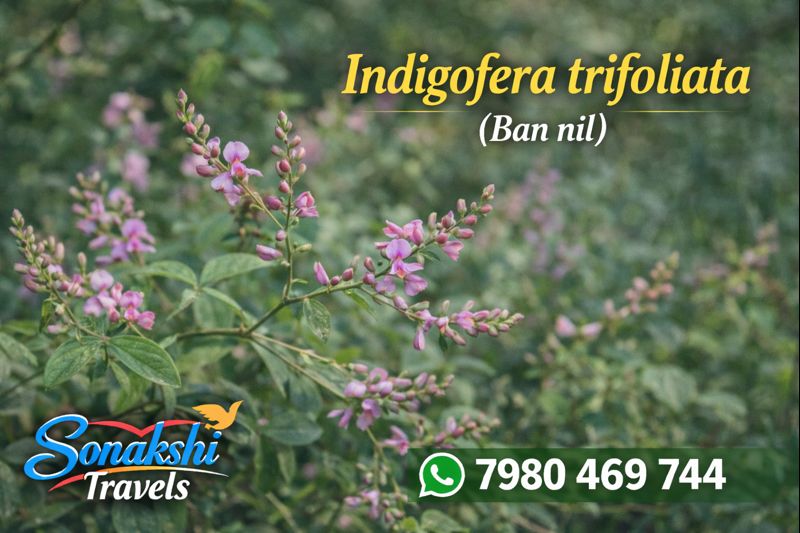
Indigofera trifoliata, commonly known in parts of eastern India and Bengal as Ban Nil, is a low-growing perennial herb belonging to the legume family. Though modest in stature, this species plays a vital ecological role in soil stabilization, nitrogen fixation, and sustaining grassland and open-forest ecosystems. As a member of the large and diverse genus Indigofera, Ban Nil shares a lineage with historically significant dye-yielding plants, yet it is primarily valued today for its ecological resilience rather than commercial pigment production.
This herbaceous species is widely distributed across tropical and subtropical regions, where it colonizes open fields, forest edges, roadsides, and degraded lands. In the Sundarbans and its adjoining landscapes, Indigofera trifoliata contributes to ground-layer vegetation, enhancing soil fertility and supporting microfauna. This article presents a detailed, research-based exploration of the plant’s taxonomy, morphology, habitat preferences, distribution, ecological significance, and conservation considerations.
Taxonomy & Classification
Systematic Placement
Indigofera trifoliata belongs to the family Fabaceae, one of the most ecologically important plant families, characterized by symbiotic nitrogen fixation and adaptability to diverse environments. The genus Indigofera comprises over 700 species, many of which are shrubs or herbs adapted to tropical climates.
The species name trifoliata refers to the characteristic trifoliate leaf arrangement, a key feature for field identification.
Morphology & Field Identification
Growth Habit
Indigofera trifoliata is a low-growing, spreading perennial herb that typically forms mats or small clumps close to the ground. Stems are slender, prostrate to ascending, and may root at the nodes when in contact with moist soil.
Stem Characteristics
The stems are thin, slightly woody at the base, and covered with fine hairs. Young stems are green and flexible, gradually becoming tougher with age.
Leaf Structure
Leaves are trifoliate, with three small obovate to elliptic leaflets. Each leaflet measures approximately 1–3 cm in length, with a smooth to slightly hairy surface. The leaflets are bright green, often folding slightly during intense sunlight or moisture stress.
Flowers and Inflorescence
Flowers are small, papilionaceous, and typically pink to purplish-red in color. They are borne in short axillary racemes. Though individually inconspicuous, flowering can be prolific during favorable conditions, adding subtle color to open landscapes.
Fruits and Seeds
The fruit is a small, cylindrical pod containing several tiny seeds. Pods mature quickly and split open upon drying, facilitating local seed dispersal.
Habitat & Distribution
Natural Habitat
Indigofera trifoliata thrives in open grasslands, fallow fields, forest margins, scrublands, and roadsides. It is especially common in areas with periodic disturbance, where its rapid growth enables quick colonization.
Altitude Range
The species is predominantly found from sea level up to approximately 1,000 meters, displaying adaptability across lowland and gently elevated terrains.
Global Range
Geographical Distribution
Indigofera trifoliata has a broad tropical distribution, occurring naturally across South Asia, Southeast Asia, Africa, and parts of northern Australia. It has also become naturalized in several other tropical regions due to its hardy nature.
Distribution in the Indian Subcontinent
In India, Ban Nil is widely distributed across plains and coastal regions, including West Bengal, Odisha, Andhra Pradesh, Tamil Nadu, Kerala, and northeastern states.
Preferred Habitat
Soil Requirements
The plant prefers well-drained sandy or loamy soils but can tolerate poorer substrates. Its nitrogen-fixing ability allows it to thrive in nutrient-depleted environments.
Light and Moisture
Full sunlight to partial shade is ideal for growth. Moderate moisture supports vigorous vegetative development, although the plant can withstand short dry periods.
Occurrence
Seasonal Growth Pattern
Vegetative growth is most active during the monsoon and post-monsoon periods. Flowering and fruiting may occur multiple times a year under favorable conditions.
Preferred Habitat in the Sundarbans Region
Local Distribution
In the Sundarbans region, Indigofera trifoliata is commonly found along embankments, village outskirts, open fields, and freshwater-influenced buffer zones. It does not grow within core mangrove forests but thrives in transitional habitats.
Environmental Adaptation
The species tolerates periodic flooding and slight salinity, making it suitable for deltaic landscapes with fluctuating environmental conditions.
Exploring ground-layer vegetation and riverine landscapes becomes more meaningful during a guided Sundarban Tour, where subtle plant diversity tells a larger ecological story.
Ecological Role
Nitrogen Fixation
As a leguminous plant, Indigofera trifoliata enriches soil through nitrogen fixation, improving fertility and supporting neighboring plant species.
Soil Stabilization
Its creeping growth habit helps bind soil, reducing erosion in open and disturbed areas.
Habitat Alteration
Anthropogenic Impact
Land-use change, excessive grazing, and chemical-intensive agriculture can reduce local populations. However, the species often recolonizes disturbed sites quickly.
Climate Resilience
The plant exhibits resilience to variable rainfall and temperature fluctuations, allowing persistence under changing climatic conditions.
Conservation Efforts
Current Conservation Status
Indigofera trifoliata is not considered threatened at a global level due to its wide distribution and adaptability.
Sustainable Land Management
Maintaining open green spaces, minimizing excessive chemical use, and conserving buffer habitats support the continued presence of this species.
Understanding how small herbs sustain large ecosystems adds depth to a nature-focused Sundarban Tour,
where every plant has a role.
Did You Know?
Member of the Indigo Lineage
Although not a primary dye source, Indigofera trifoliata belongs to the same genus as historically important indigo-yielding plants.
Rapid Colonizer
The plant can quickly establish itself on disturbed soils, making it valuable for ecological recovery.
External Reference
For additional botanical information, visit the Wikipedia page on Indigofera trifoliata.