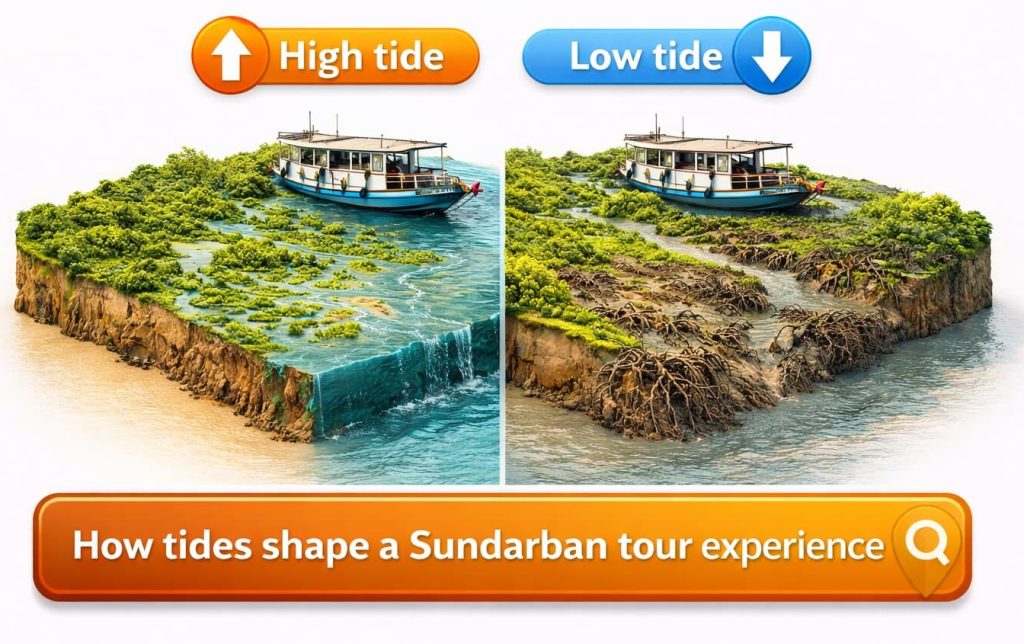
In the Sundarban, the true architect of every journey is neither the forest department map nor the route plotted by a boatman. It is the tide. Twice a day, the rivers rise and retreat, transforming narrow creeks into navigable passages and exposing wide mudflats that shimmer under a pale sun. To travel here without understanding tides is to misunderstand the delta itself. Every authentic exploration of this vast mangrove landscape is choreographed by lunar cycles, saline currents, and the silent breathing of estuarine waters.
A well-planned Sundarban Travel itinerary inevitably revolves around these tidal rhythms. The experience of a visitor—what they see, hear, and feel—is shaped profoundly by the daily rise and fall of water. From wildlife sightings to boat movement, from fishing communities to mangrove root systems, the tide governs all.
Understanding the Tidal Character of the Sundarbans
The Sundarbans form the lower delta of the Ganges–Brahmaputra–Meghna river system, where freshwater rivers meet the saline waters of the Bay of Bengal. Unlike inland forests defined by fixed trails, this region is amphibious. Channels widen and shrink within hours. Small creeks disappear during ebb tide and reappear at flood tide. This fluid geography makes the forest dynamic and unpredictable.
The tidal amplitude here can range between 3 to 5 meters in certain sectors. During high tide, saline water penetrates deep into the forest creeks, submerging the pneumatophores—the breathing roots of mangrove species. During low tide, mudbanks are exposed, revealing intricate patterns of crab burrows and fish tracks. For a traveler, these alternating conditions present two entirely different landscapes within the same day.
High Tide: When the Forest Becomes Accessible
Navigating the Creeks
High tide allows boats to enter narrow channels otherwise inaccessible. This is the moment when exploration deepens. The boat glides silently over submerged roots, and mangrove branches almost brush the deck. Such passages are central to immersive wildlife viewing, especially in areas where animals approach water to drink.
Many structured itineraries, including those planned under a Sundarban Tour from Kolkata, deliberately time creek visits during rising tides. It is not merely convenience; it is strategic. The higher water level reduces engine noise impact and allows smoother entry into sensitive zones.
Wildlife Activity During Flood Tide
High tide often coincides with increased aquatic activity. Mudskippers swim across shallow water, estuarine crocodiles patrol the edges, and birds perch above waterlogged flats. Spotted deer frequently gather near elevated patches that remain unsubmerged. The forest appears alive, animated by the influx of water.
Low Tide: The Revealing Landscape
Mudflats and Exposed Ecology
When the tide recedes, the Sundarbans reveal another personality. Wide expanses of grey-brown mud stretch along riverbanks. These mudflats are not barren; they are ecological laboratories. Fiddler crabs emerge in thousands, waving oversized claws. Kingfishers dive into shrinking pools. The skeletal forms of mangrove roots create a surreal, almost sculptural scene.
Travelers who opt for shorter visits, such as a Sundarban Single Day Package, often encounter at least one low tide phase. Though creek navigation may be restricted, the educational value increases. Guides frequently interpret visible root systems and explain how mangroves stabilize sediment.
Human Adaptation to Ebb Tide
Fishing communities schedule net casting and crab collection according to tidal retreat. Wooden boats rest on mudbanks awaiting the next rise. Watching this rhythm offers cultural insight. The tide is not only ecological—it is economic. It sustains livelihoods.
The Science Behind the Tidal Forest
The Sundarbans are the world’s largest contiguous mangrove forest and a recognized as World Heritage Site. Its survival depends on saline exchange. Tidal influx prevents stagnation, distributes nutrients, and moderates salinity gradients. Without this daily flushing, the ecosystem would collapse.
Mangrove species such as Heritiera fomes and Avicennia marina have evolved to tolerate fluctuating salinity. Their aerial roots allow respiration even when submerged. For visitors, understanding this adaptation enhances appreciation of the forest’s resilience.
Seasonal Tides and Changing Experiences
Not all tides are equal. Spring tides during full and new moon phases produce stronger currents and higher amplitudes. Neap tides are gentler. During winter months, calmer winds make tidal transitions smoother, resulting in comfortable boat journeys.
In contrast, monsoon tides can be forceful. River discharge increases, sediment load intensifies, and certain creeks become temporarily unsafe. Tour planners adjust routes accordingly. This seasonal awareness ensures safety and environmental sensitivity.
Tidal Timing and Itinerary Planning
Experienced explorers emphasize studying tide charts before departure. Morning high tide allows early creek entry, while afternoon low tide may restrict movement. Multi-day itineraries are structured to align watchtower visits and creek safaris with optimal water levels.
Those seeking more refined and personalized scheduling sometimes explore curated experiences such as a Sundarban Luxury Tour, where private vessels can adapt routes based on real-time tidal shifts. Flexibility enhances immersion.
Festivals and Tidal Culture
The tide also influences seasonal cultural events. The annual Sundarban Hilsa Festival 2026 aligns with migratory patterns of hilsa fish that move upstream with tidal currents. Culinary traditions, fishing rituals, and market rhythms all depend on these aquatic cycles.
Observing such events provides insight into how deeply embedded tides are within local identity. The river is not merely a boundary; it is a provider.
Practical Insights for Travelers
Choose the Right Season
Winter (November to February) offers stable tidal transitions and clearer skies. Wildlife visibility improves due to lower humidity. Early summer mornings can also be productive, though afternoon heat intensifies evaporation.
Understand Daily Timing
Request tide information in advance. Align boat safaris with rising water if creek exploration is a priority. Low tide periods are ideal for ecological interpretation and photography of exposed mudflats.
Respect Safety Regulations
Tidal currents can be deceptively strong. Follow forest department instructions strictly. Avoid leaning over boat edges during strong flow periods. Life jackets should remain accessible.
Photography Considerations
Golden hour during high tide creates reflective water surfaces, amplifying mangrove silhouettes. Low tide offers textural compositions—crab patterns and root structures. Carry protective gear for camera equipment due to saline moisture.
The Emotional Experience of a Tidal Landscape
Perhaps the most profound realization during a Sundarban journey is humility. The traveler adapts to the tide, not the reverse. Plans are fluid. Routes shift. Patience becomes essential. This surrender to natural rhythm distinguishes the Sundarbans from other forest destinations.
Standing on a boat deck at dawn, watching water rise inch by inch along mangrove trunks, one senses the forest inhaling. Hours later, as the tide retreats, the same landscape exhales. Few ecosystems demonstrate such visible respiration.
Learning to Travel with the Tide
A Sundarban tour is not defined solely by wildlife sightings or scenic vistas. It is defined by rhythm. The tide scripts the narrative of each day—opening passages, concealing mudbanks, sustaining fish, guiding birds, and shaping human life.
To travel here responsibly and meaningfully is to observe these patterns with attentiveness. The delta teaches patience, ecological respect, and adaptability. When visitors begin to read water levels as carefully as maps, the journey deepens. The Sundarbans cease to be merely a destination and become a living, tidal dialogue between land and sea.
In understanding how tides shape a Sundarban tour experience, one begins to understand the delta itself—a landscape where water writes and rewrites the story twice each day.