Why a Thoughtfully Designed Sundarban Tour Becomes a Living Journey Through River Light, Wild Nature, Cultural Memory, and the Deep Poetry of the Delta
There are landscapes that impress the visitor at first glance, and there are landscapes that continue to unfold long after the journey has ended. The Sundarban belongs to the second category. It is not merely a destination of mangrove forest, tidal creeks, and wildlife movement. It is a place where geography behaves like emotion, where water reshapes silence, and where every meaningful journey depends on one’s willingness to observe rather than merely consume. For that reason, a true Sundarban tour should never be understood only as an itinerary. It is better understood as an encounter with a living delta whose moods are shaped by dawn, tide, birdsong, village memory, river colour, cuisine, and the ever-present tension between beauty and wilderness.
What gives the Sundarban its extraordinary power is not a single attraction but the meeting of many forms of experience. Here, the river does not serve merely as transport; it becomes the medium through which the forest is approached, interpreted, and felt. The wildlife does not appear as staged spectacle; it remains elusive, dignified, and inseparable from the ecosystem that shelters it. The villages are not decorative cultural stopovers; they form part of the region’s moral and historical fabric. Even the food, particularly seasonal preparations rooted in local identity, carries the atmosphere of place in a way that ordinary travel language often fails to describe. A well-conceived Sundarban travel experience therefore combines wilderness, slowness, taste, interpretation, and emotional resonance into one continuous narrative.
To enter the delta with sensitivity is to understand that the Sundarban is not only about what can be seen, but also about what can be felt in the spaces between visible events: the pause before sunrise on the river, the stillness of mudbanks where reptiles rest, the rhythm of a boat cutting through soft tidal water, the scent of cooking emerging from a riverside halt, and the subtle awareness that this is one of the rare landscapes where humans remain guests within a larger ecological order. That is why a carefully curated journey here carries both pleasure and humility. It offers comfort, discovery, and memory, but it also teaches restraint, patience, and attention.
The Sundarban as a Landscape of Arrival, Not Consumption
Many travellers make the mistake of approaching ecological destinations with the mentality of accumulation. They wish to collect sightings, complete checklists, and move through landscapes as quickly as possible. The Sundarban resists that way of thinking. It reveals itself gradually, through repetition, changing light, and the relationship between river and forest. The true beginning of the journey is not the moment one reaches a jetty or boards a boat. It begins when the mind adjusts to the tempo of the delta and accepts that meaning here emerges slowly.
This is why the most memorable itineraries are those that allow the traveller to feel the transition from settled land into tidal wilderness. The river widens. The banks alter. Human sound recedes. The horizon grows more fluid. This movement into ecological depth is not only scenic; it is psychological. A journey such as Sundarban tour through river and forest confluence suggests precisely this deeper threshold, where travel begins to take on the character of personal memory and legacy rather than ordinary sightseeing. The phrase is meaningful because the Sundarban often leaves behind not a catalogue of attractions but a transformed sense of scale and presence.
In such a setting, the idea of legacy should not be interpreted as grand or ornamental. Rather, it refers to the kind of travel memory that continues to shape a person’s understanding of beauty and place. A serious Sundarban tour package does not merely deliver logistics. It should guide travellers into this slower mode of arrival, where the experience becomes not a series of interruptions but a continuous conversation with landscape. The best journeys therefore create room for silence, observation, and reflection. They recognize that the Sundarban is not diminished by gentleness; it is best understood through it.
When the Delta Becomes a Gallery of Primitive Beauty
The visual power of the Sundarban lies in its refusal to appear polished. Its beauty is primal rather than ornamental. Mudflats, tangled roots, shifting light, and open channels do not conform to decorative expectations, yet together they produce one of the most compelling environments in South Asia. This is a landscape where nature appears to paint with elemental materials: saline water, silt, green density, reflective sky, and sudden movement. Such beauty feels ancient because it is inseparable from ecological process. Nothing appears fixed. Everything seems to be in a state of becoming.
A thematic expression such as Sundarban wilderness shaped by primal nature captures this distinctive visual identity. The Sundarban is not manicured nature. It is nature working in its own grammar. The colours of the region often resist simplification. Dawn introduces gold and silver. Afternoon sharpens the contrast between water glare and mangrove shadow. Evening softens the channels into reflective darkness. During these shifts, the traveller does not merely observe scenery but witnesses atmosphere itself changing form.
For this reason, photography, birdwatching, and quiet deck observation become deeply rewarding in the delta. One need not always chase dramatic wildlife sightings to feel the intensity of place. Sometimes the most unforgettable moment is the sight of sunlight filtering across a tide-fed creek or the sight of an egret lifting itself above a silent channel. Such experiences remind us that Sundarban wildlife tourism should not be reduced to a single charismatic species. The ecological richness of the region includes textures, moods, and non-human rhythms that together produce a fuller sense of wonder.
Travellers who enter the Sundarban with patience often discover that its beauty works less through spectacle and more through accumulation. A branch pattern, a rippled mudbank, the curve of a watchtower approach, the changing posture of the sky over water: each element contributes to a slowly intensifying visual narrative. In this sense, the Sundarban functions as a living gallery, though one without walls or fixed frames. Its artistry lies in movement, and its compositions are rewritten by tide and light every day.
The Quiet Drama of Wildlife and the Ethics of Looking
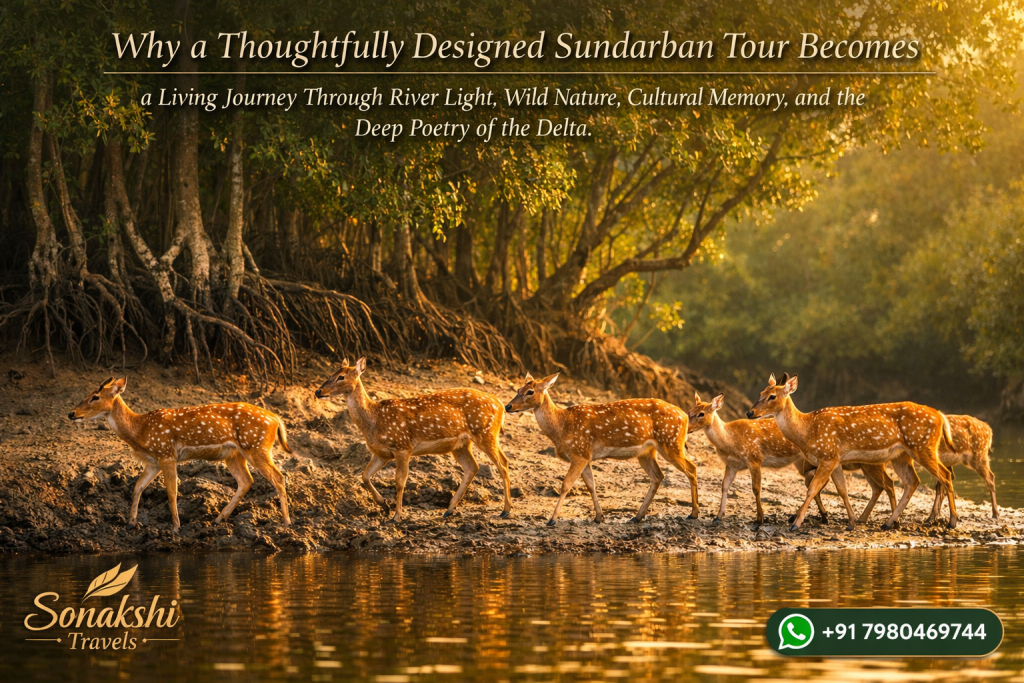
Any serious discussion of the Sundarban must acknowledge its wildlife, yet it must do so carefully. The power of the region’s fauna lies not only in their biological importance but in the way they are embedded within a difficult, interdependent environment. The crocodile on a mudbank, the kingfisher by a creek, the spotted deer near a clearing, the distant raptor above open sky: each is part of an ecological drama that is always unfolding, whether or not the visitor is present to witness it.
A phrase like Sundarban river journey with crocodile country evokes precisely this tension between repose and latent danger. The crocodile appears still, even dreamlike, yet that stillness belongs to a powerful predator entirely adapted to its environment. In the Sundarban, apparent calm should never be mistaken for passivity. Nature here is watchful. It lives through concealment, patience, and precision. This makes the wildlife experience especially profound because it requires the traveller to adopt the same habits of attention.
The ethics of looking therefore matter greatly. Responsible travel in the delta is not about forcing proximity or reducing wild creatures to photographic trophies. It is about learning how to observe without intrusion. A refined Sundarban luxury tour or premium river journey should embody this ethic by privileging expert guidance, safe distance, respectful interpretation, and an atmosphere of ecological seriousness. Comfort and sophistication are valuable, but in a destination like the Sundarban they should serve awareness rather than distraction.
This wildlife ethic also deepens the emotional impact of the journey. When a traveller understands that every sighting is contingent, every movement meaningful, and every silence inhabited, the forest becomes more than backdrop. It becomes a living intelligence that can never be fully mastered. That is one of the reasons the Sundarban remains unforgettable. Its creatures are not staged for the visitor’s convenience. They belong first to the delta. The traveller’s privilege lies in being allowed a brief glimpse into that larger order.
River Cuisine, Seasonal Memory, and the Cultural Soul of the Delta
To speak of the Sundarban only in terms of ecology would be incomplete. The region is also lived, cooked, narrated, and celebrated. Its human culture is inseparable from water routes, seasonal rhythms, fishing traditions, household knowledge, and the deep emotional associations attached to food. This is especially important because culinary experience in the delta is not simply about taste. It is about context. A meal enjoyed on land elsewhere may be satisfying; a meal enjoyed after a long morning on the river, in the company of local memory and seasonal atmosphere, can become part of the identity of the journey itself.
This is why a narrative such as Sundarban Hilsa Festival and river dining experience reflects something far deeper than a festive meal. It points to the way the delta transforms food into memory. The image of sunset over river water paired with the unmistakable aroma of mustard-rich Hilsa suggests a union of place, season, appetite, and emotion. In the Sundarban, cuisine becomes one of the most elegant ways through which landscape enters personal recollection.
Seasonal festivals and food-centred travel also reveal that the delta is not only wild but hospitable. It contains human warmth alongside ecological mystery. For travellers, this balance matters. A complete Sundarban tour package should include not just forest views and boat routes, but also the chance to engage with the flavours that define regional belonging. Dishes prepared with care, served in the right setting, create a bridge between the visitor and the living culture of the place.
More importantly, such culinary experiences prevent the journey from becoming abstract. They return the traveller to the human dimension of the delta: to kitchens, hosts, local ingredients, and the continuity of regional tradition. In a destination often described through wilderness, this cultural depth is essential. It reminds us that the Sundarban is not an empty nature zone but a richly inhabited world where ecology and everyday life remain intricately connected.
Dawn, Light, and the Emotional Architecture of the Journey
If there is a single time of day that best captures the emotional truth of the Sundarban, it is dawn. Morning in the delta is not merely a convenient hour for sightseeing. It is a transformation of atmosphere. The air feels cleaner, the water more receptive, the horizon more generous. Light moves gradually across the channels, and the forest seems to wake not through noise but through subtle activation. Birds begin their circuits. The surface of the river starts to carry colour. The day announces itself without haste.
The evocative idea of golden dawn over the Sundarban delta points to this emotional architecture of the journey. In those early hours, the traveller often feels closest to the true spirit of the place. Dawn suspends ordinary time. It creates a brief interval in which the delta appears both ancient and freshly made. This is when many travellers begin to understand that the Sundarban is not simply visited; it is absorbed through repeated sensory impressions.
From an experiential perspective, dawn also teaches why timing matters in itinerary design. The best journeys do not treat morning as a rushed transition into activity. They allow space for stillness, tea on deck, unhurried viewing, and the quiet excitement of watching the forest emerge. Such pacing elevates the quality of a Sundarban private tour because privacy and comfort become instruments of perception. The traveller can attend to the changing light without crowd, noise, or interruption.
This is also where the emotional intelligence of travel planning becomes clear. The Sundarban cannot be reduced to inclusions alone. A journey becomes memorable when it is shaped around the moods of the landscape itself. Dawn, river breeze, slow cruising, local meals, careful wildlife observation, and reflective evenings together form a coherent rhythm. Without that rhythm, even a technically complete tour can feel shallow. With it, the experience acquires depth, continuity, and grace.
Why the Finest Sundarban Experience Balances Wilderness, Comfort, and Meaning
The enduring appeal of the Sundarban lies in its complexity. It is at once dangerous and serene, remote and hospitable, visually expansive and emotionally intimate. Because of this, the finest journeys are those that respect all dimensions of the place rather than privileging only one. Too much emphasis on convenience can flatten the wildness. Too much emphasis on adventure can ignore the subtle pleasures of comfort, cuisine, and interpretation. Too much emphasis on luxury without ecological seriousness can feel disconnected from the region’s true character.
The ideal approach is balance. A thoughtfully arranged itinerary allows the traveller to experience the mystery of the forest, the elegance of the river, the cultural richness of local food traditions, and the restorative value of privacy and careful pacing. This is where the idea of premium or tailored travel becomes meaningful. In the Sundarban, luxury should not mean excess. It should mean depth without discomfort, immersion without confusion, and refinement without losing contact with the elemental reality of the delta.
Such a philosophy has practical value as well. Travellers seeking family journeys, couple experiences, nature-focused escapes, or seasonal cultural tours all benefit from design that prioritizes rhythm, interpretation, and setting. A strong Sundarban luxury private tour is therefore not defined by ornament alone but by how intelligently it responds to the landscape. It creates space for dawn, respect for wildlife, appreciation of regional cuisine, and a sense of continuity from one part of the day to the next.
Ultimately, the Sundarban remains one of those rare destinations where meaning grows in retrospect. People may arrive hoping for scenery, wildlife, or a pleasant getaway. They often leave with something richer: an altered relationship to silence, a stronger sense of ecological humility, and a set of memories bound not just to what was seen, but to how the entire delta was felt. That is the deeper promise of a well-designed journey here. It offers not only travel, but a form of inward expansion made possible by river light, forest shadow, seasonal flavour, and the quiet authority of a world that still belongs first to nature.
For that reason, the most memorable Sundarban tour is never merely a passage through waterways. It is an experience in which landscape becomes story, cuisine becomes memory, wildlife becomes reverence, and dawn becomes revelation. When these dimensions come together with care, the Sundarban does what very few destinations can still do: it leaves the traveller not only impressed, but changed.