An In-Depth Study of Biology, Ecology, and Behavioral Adaptations
The Bank Swallow (Riparia riparia), also known as the Sand Martin in many parts of the world, is the smallest and one of the most ecologically distinctive members of the swallow family. Renowned for its agile flight, colonial nesting habits, and extraordinary migratory endurance, this species represents a remarkable example of evolutionary adaptation to aerial insectivory and riverine ecosystems. Although modest in size and coloration, the Bank Swallow plays a disproportionately important role in controlling insect populations and maintaining the ecological balance of wetland and riparian habitats across multiple continents.
Taxonomy & Classification
The Bank Swallow belongs to the order Passeriformes, the largest order of birds, encompassing perching species characterized by complex vocalizations and advanced flight abilities. Within this order, it is placed in the family Hirundinidae, which includes swallows and martins adapted for continuous flight and aerial feeding. The genus Riparia derives its name from the Latin word meaning “of the riverbank,” a direct reference to the bird’s preferred nesting habitat. The species epithet riparia further emphasizes its close association with riverine landscapes. Fossil evidence and molecular studies indicate that this lineage diverged early from other swallows, retaining a conservative body plan optimized for burrow nesting rather than tree or building attachment.
Morphology & Field Identification
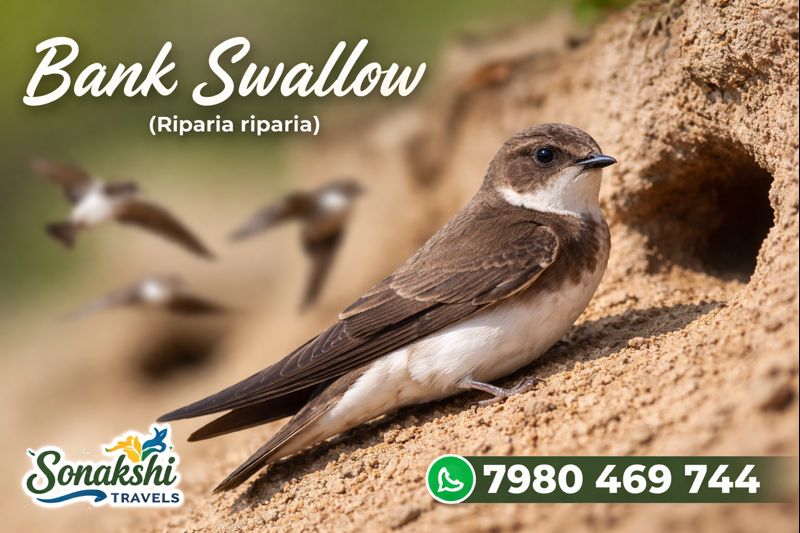
In the field, the Bank Swallow can be identified by its compact body, slender wings, and rapid, fluttering flight. Unlike many other swallows, it lacks iridescent plumage, instead displaying a subtle earth-toned palette that blends seamlessly with sandy cliffs and riverbanks. The most distinctive feature is a well-defined brown breast band separating the white throat and belly from the darker upperparts. This field mark is especially useful when observing mixed flocks of swallows in flight.
Male Features
Male Bank Swallows exhibit muted but functional coloration. The crown, back, and wings are uniform brown, offering camouflage against soil and sediment. The breast band in males is typically slightly darker and more sharply defined, possibly serving as a visual cue during mate selection. Males possess elongated primary feathers that enhance maneuverability and sustained flight during courtship displays and territorial defense near nesting colonies.
Female Features
Females closely resemble males in overall appearance, reflecting minimal sexual dimorphism. However, the breast band in females may appear marginally lighter and less sharply edged. This similarity likely reduces predation risk during nesting, as both sexes spend considerable time entering and exiting burrows, where conspicuous coloration could attract predators.
Size & Wingspan
The Bank Swallow is among the smallest swallows, measuring approximately 12–13 centimeters in length. Its wingspan ranges from 25 to 30 centimeters, a proportion that allows for exceptional agility while maintaining energy efficiency during long migratory flights. The lightweight skeletal structure and reduced body mass are key adaptations for sustained aerial activity.
Flight Characteristics
Flight in the Bank Swallow is characterized by rapid wingbeats interspersed with short glides. This pattern enables precise maneuvering while capturing small, fast-moving insects. Compared to larger swallows, its flight appears more erratic, a trait that enhances feeding success in cluttered airspaces above water bodies and vegetation.
Habitat & Distribution
The Bank Swallow occupies a broad range of habitats centered on open landscapes with access to exposed soil banks. Its distribution spans multiple continents, reflecting a high degree of ecological plasticity. However, suitable nesting substrates remain the most critical limiting factor in habitat selection.
Global Range
This species breeds widely across North America, Europe, and northern Asia. During the non-breeding season, it migrates to warmer regions, including sub-Saharan Africa, South America, and South Asia. Such extensive migratory routes demonstrate remarkable navigational abilities and physiological resilience.
Preferred Habitat
Preferred habitats include riverbanks, lakeshores, coastal bluffs, sand quarries, and occasionally human-made embankments. Proximity to open water is essential, as it supports abundant insect prey and provides open airspace for foraging.
Diet & Feeding Ecology
The Bank Swallow is a specialized aerial insectivore, feeding almost exclusively on flying insects. Its diet primarily consists of small dipterans, midges, mosquitoes, and other soft-bodied insects that are abundant near water bodies. Seasonal variations in prey availability can influence foraging behavior and habitat use.
Foraging Technique
Foraging occurs on the wing, often in loose flocks that sweep low over water surfaces. The bird captures prey by opening its beak mid-flight, relying on precise timing and visual acuity. This feeding strategy minimizes energy expenditure while maximizing intake.
Breeding & Reproduction
Breeding typically occurs during late spring and summer in temperate regions. The Bank Swallow is highly colonial, forming nesting aggregations that may contain dozens or even hundreds of burrows. Colonial nesting provides protection through collective vigilance and predator dilution.
Nesting Sites
Nests are constructed within horizontal burrows excavated into vertical or steeply sloped banks. Each burrow may extend up to one meter in length, terminating in a nesting chamber lined with grasses and feathers. Both sexes participate in excavation, a labor-intensive process that reinforces pair bonds.
Unique Adaptations & Behavioral Ecology
The Bank Swallow exhibits a suite of adaptations that reflect its dependence on aerial feeding and burrow nesting. These traits have evolved in response to selective pressures such as predation, climate variability, and habitat availability.
Speed & Agility
Exceptional agility allows this species to exploit dense insect swarms that other birds cannot efficiently access. Its rapid acceleration and tight turning radius are products of specialized wing morphology and muscle structure.
Camouflage and Nesting Strategy
The subdued coloration of the Bank Swallow provides effective camouflage against sandy substrates. Burrow nesting further reduces exposure to predators and environmental extremes, creating a stable microclimate for egg incubation and chick development.
Social Behavior
Social interactions are pronounced during the breeding season. Vocalizations, synchronized flight, and cooperative defense behaviors reinforce colony cohesion. Outside the breeding period, the species becomes more gregarious, forming large migratory flocks.
Occurrence & Seasonal Movement
Seasonal movements are driven by insect availability and climatic conditions. The Bank Swallow undertakes long-distance migrations, often crossing continents and ecological barriers. Timing of migration is finely tuned to ensure arrival at breeding sites when conditions are optimal.
Preferred Habitat in the Sundarbans Region
In the Sundarbans region, the Bank Swallow is typically observed during migration periods rather than as a breeding resident. The extensive network of rivers, mudflats, and open embankments provides suitable stopover habitats where migrating individuals can rest and forage. Exposed riverbanks created by tidal action offer temporary roosting and feeding opportunities, highlighting the region’s importance as a migratory corridor.
Naturalists and bird enthusiasts exploring mangrove waterways can enhance their experience by choosing a guided Sundarban Tour
that focuses on seasonal avifauna and riverine ecosystems.
Ecological Role
The Bank Swallow plays a critical role in regulating insect populations, including species considered agricultural pests and disease vectors. By consuming vast numbers of insects daily, it contributes to ecosystem stability and indirectly benefits human communities.
Habitat Alteration
Habitat alteration poses significant challenges to the species. Riverbank stabilization, dam construction, and sand mining reduce the availability of suitable nesting sites. Additionally, climate change influences insect phenology, potentially disrupting the timing of breeding and migration.
Conservation Efforts
Conservation strategies emphasize the protection and restoration of natural riverbanks and the regulation of extractive activities. Monitoring programs across breeding and wintering ranges provide valuable data on population trends, informing adaptive management practices.
Eco-travelers interested in observing migratory birds within tidal forests may consider a curated Sundarban Tour
designed around responsible wildlife viewing and conservation awareness.
Did You Know?
Despite its small size, a single Bank Swallow can consume hundreds of insects in a day. Large colonies collectively remove millions of insects from the environment each breeding season, underscoring their ecological importance.
External Reference
For additional scientific details, distribution maps, and taxonomic updates, refer to the authoritative species account available on Wikipedia: Bank Swallow (Riparia riparia).